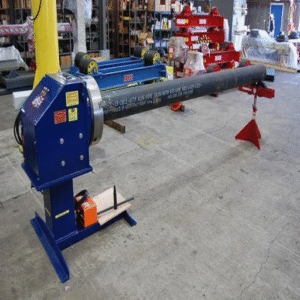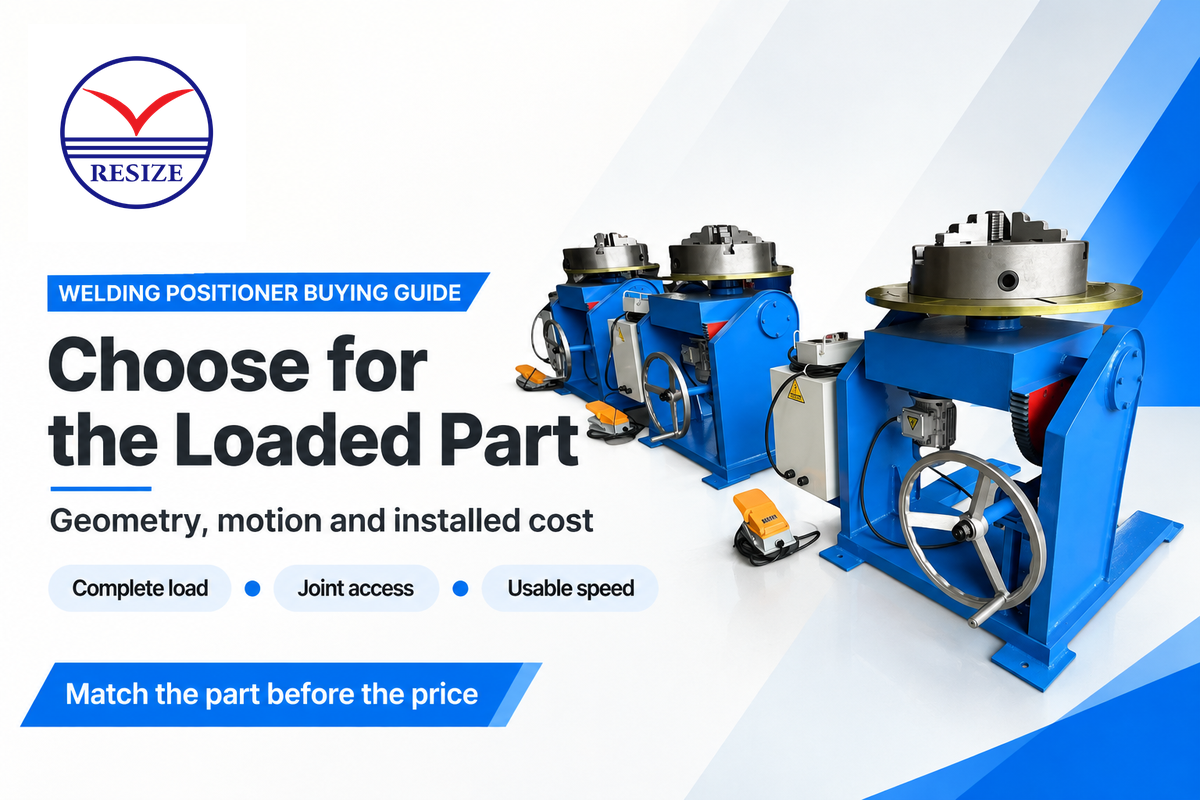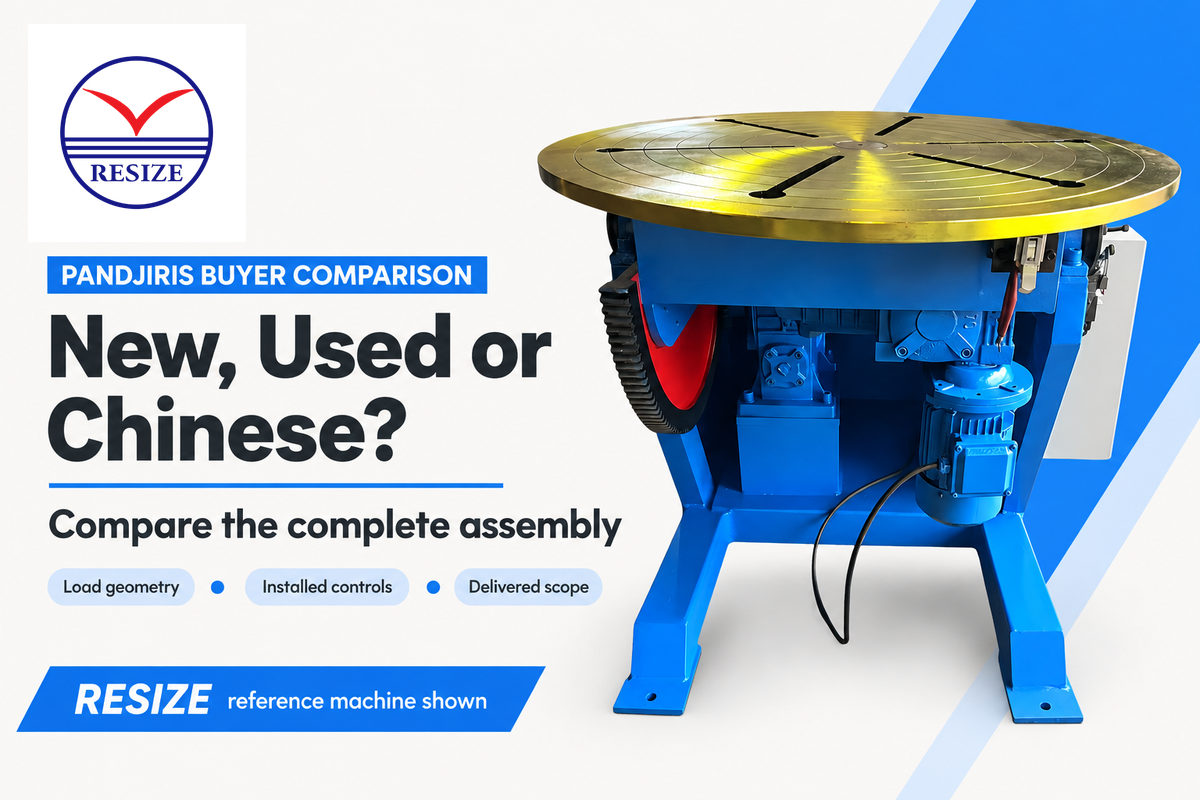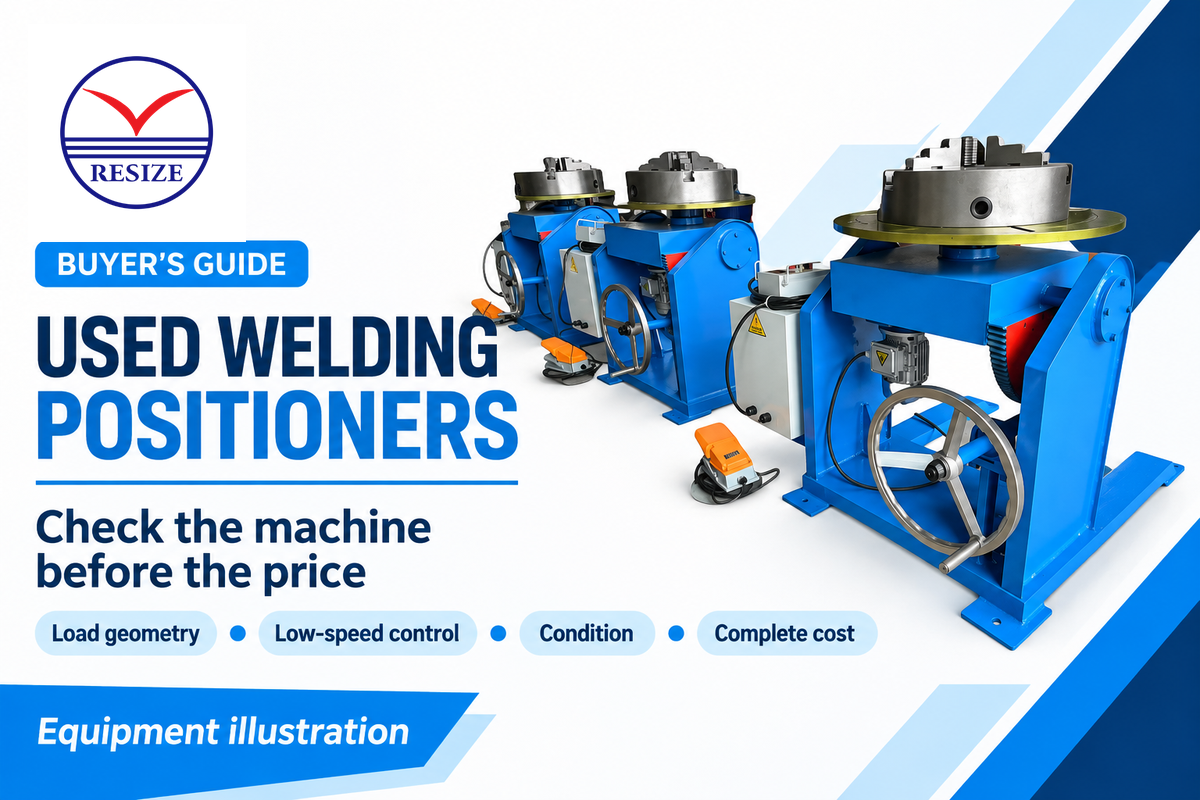
A Pandjiris welding positioner presents a workpiece to the operator or to the welding head. A new machine can be suited to a specific, supported installation, while a used unit can be suited to a known repeat job. Chinese industrial machines can be considered in the comparison, if their quoted load geometry, controls and the scope of their installation match the job.
Updated October 2026
Assemblies on a table, like the part, chuck, and a fixture, can be meaningfully compared. A well-known brand name or larger capacity doesn’t define that assembly by itself. RESIZE supplies positioners and publishes the comparison; the model specifications that follow are from the manufacturers, and the used prices are individual seller asks.
Pandjiris Welding Positioner: What It Does
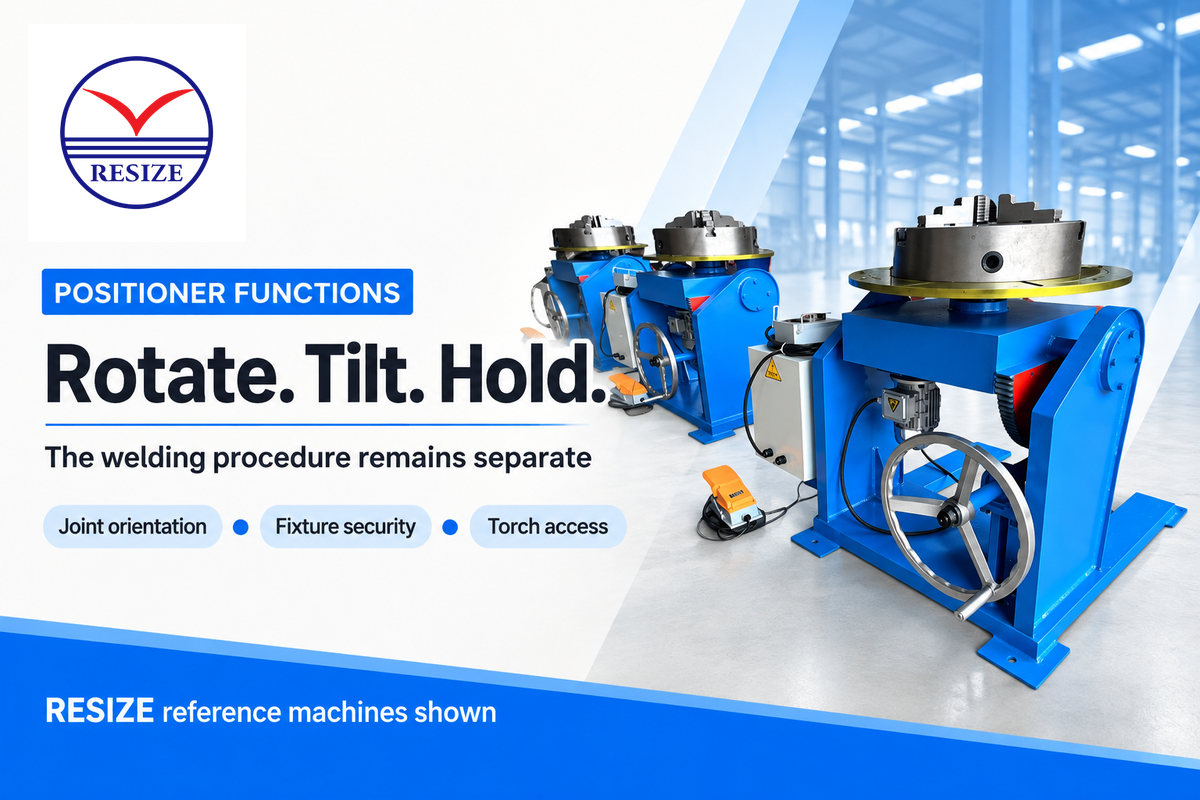
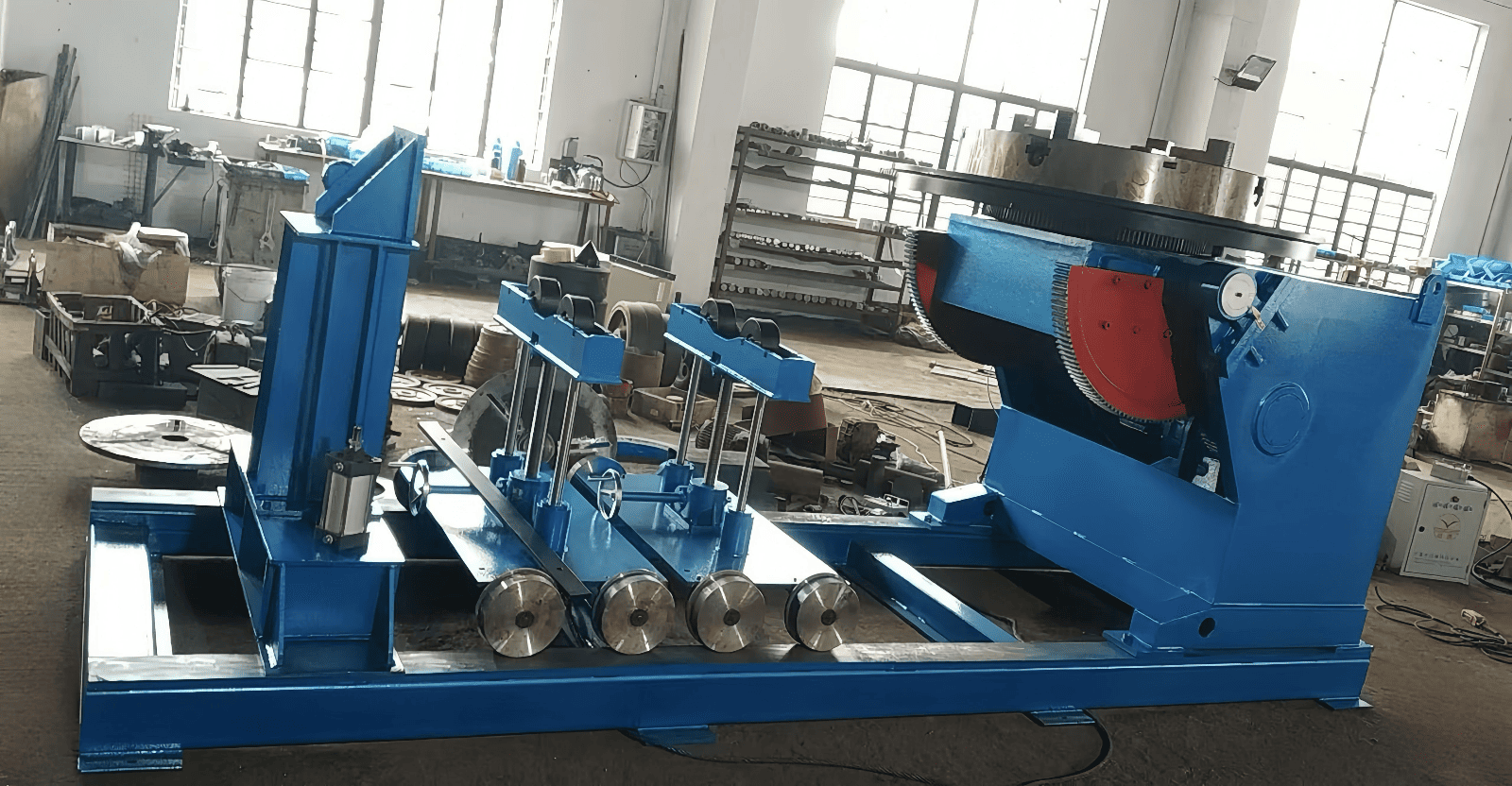
Pandjiris positioners support and rotate a weldment, so that the joint can face the torch at a workable angle. Tilt may be manual or powered, according to the model. Moving the workpiece can reduce repeated handling, but the fixture must still hold it throughout rotation and tilt; the machine does not establish the welding procedure.
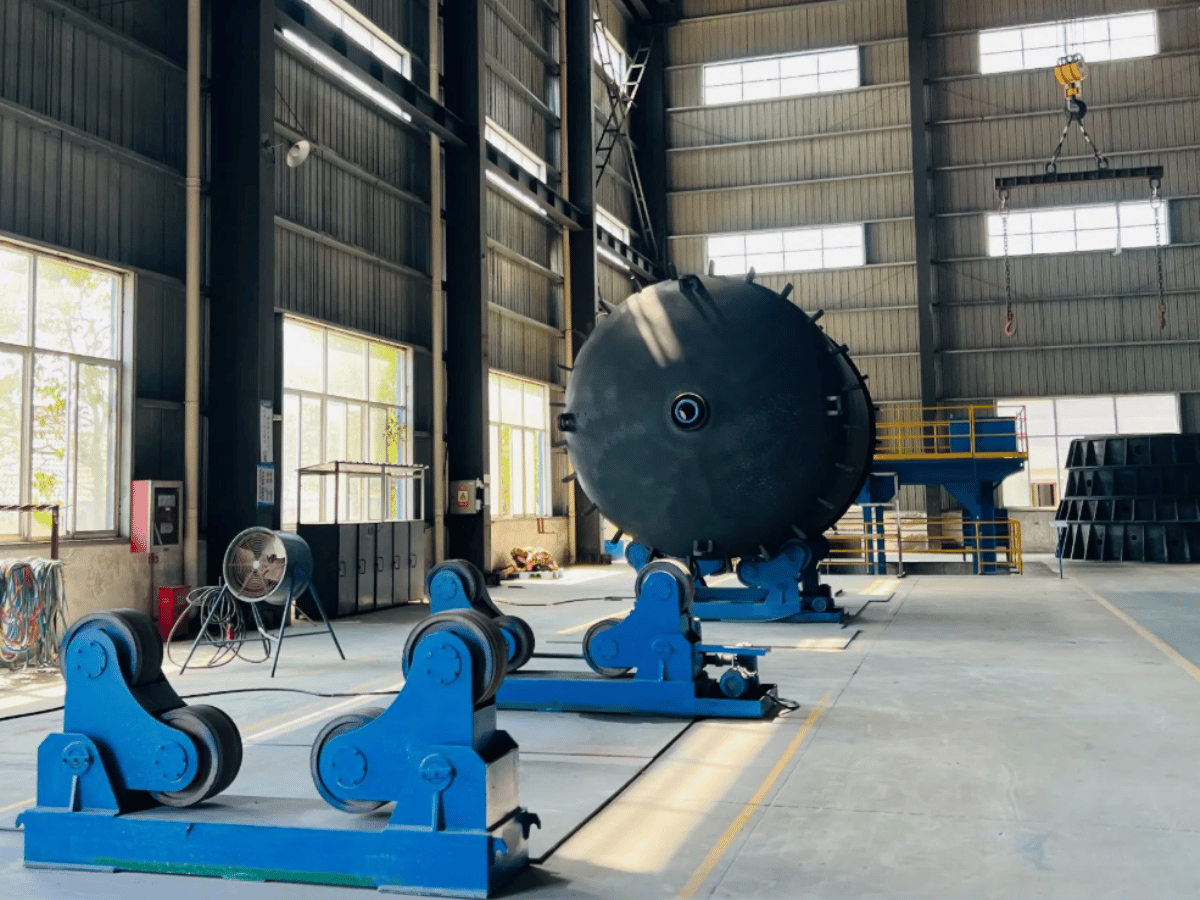
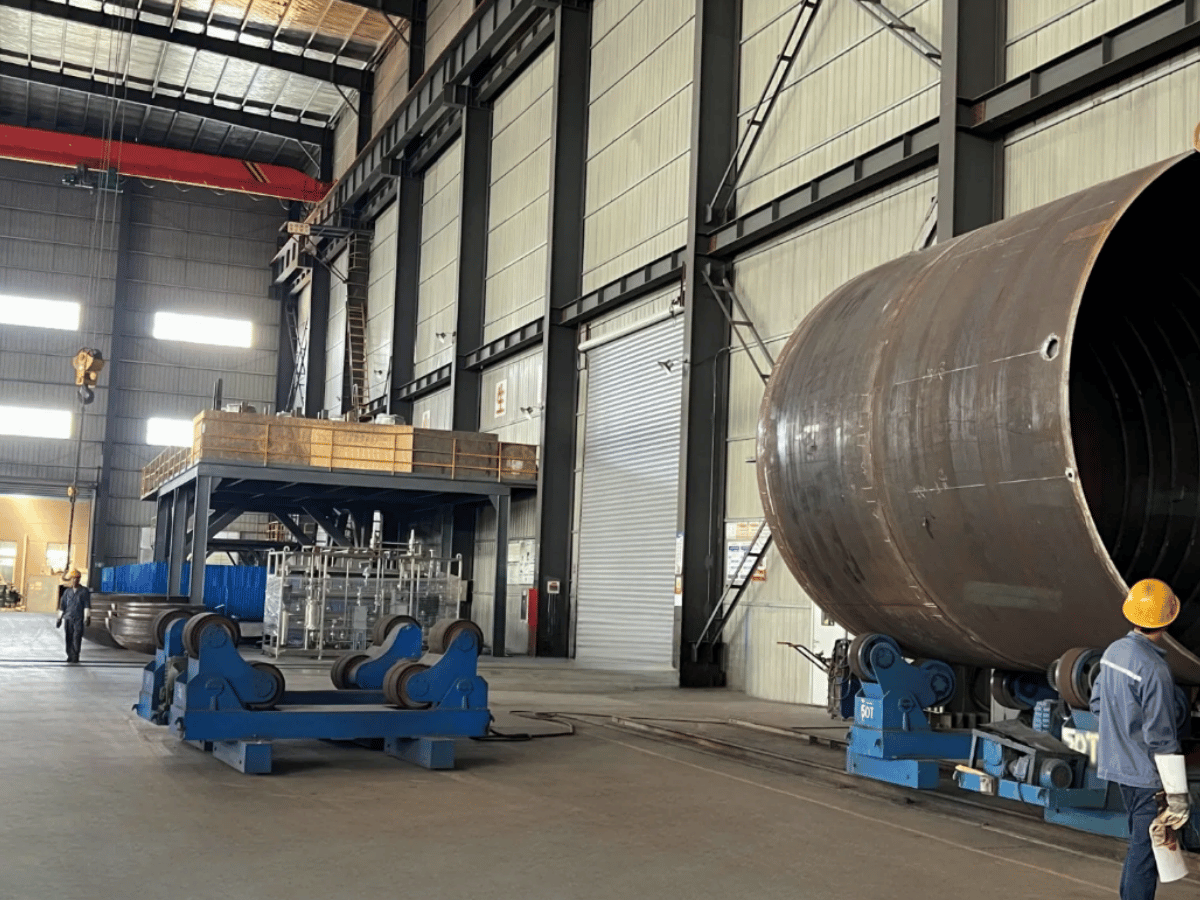
A benchtop Mini Pro and a large floor-mounted table perform that basic task at different scales. Their shared product category doesn’t make their chucks, tilt drives, or permissible offsets interchangeable. A cylindrical vessel resting on driven rolls is another arrangement: welding rotators for cylindrical work turn the shell through contact with its outside surface rather than clamping it to a faceplate.
What is the main function of a welding positioner?
A welding positioner’s main function is to hold and move the workpiece into a useful welding orientation. Controlled rotation can carry a circular seam past a stationary torch, while a tilting table changes the joint angle. The welder or automated system still controls heat input, travel conditions and acceptance of the finished weld.
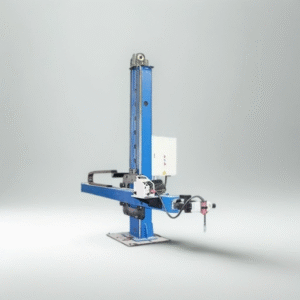
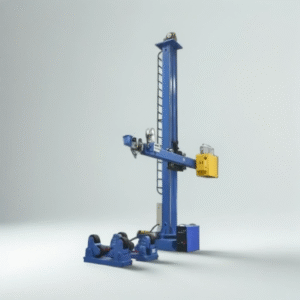
Long assemblies may need headstock and tailstock positioning to support both ends. A column-and-boom manipulator instead carries the welding head. Selecting among those equipment types is an access and support decision before it becomes a brand decision. The American Welding Society describes workpiece positioning within automated fabrication; welding applications still require their own process and fixture design.
Load Capacity: Weight, Offset and Fixture Geometry
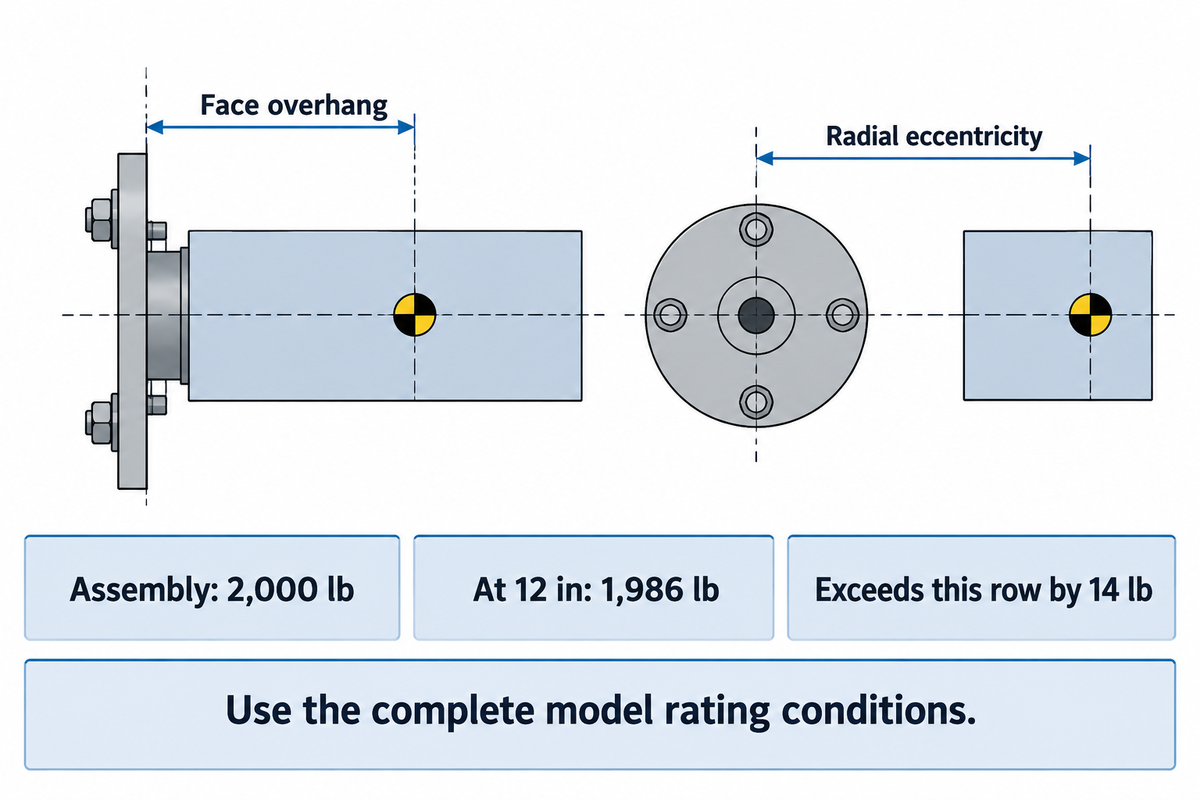
Pandjiris’s September 2020 30-6 sheet rates the model family at 3,000 lb with 6 in of face overhang and 6 in of eccentricity. Those are two different distances. A fixture can move the combined center of gravity away from the table face and the rotation axis, and place more demands on the positioner.
“Fixtures and chucks add weight and distance from the faceplate”
Consider carrying a toolbox close to the body versus at arm’s length. The weight doesn’t change, but the turning effect does. For a positioner, the drawing needs to show the perpendicular distance of the center of gravity from the faceplate, as well as the radial distance parallel to the face. Koike’s sizing also takes into account the overhang of the machine in the tilt calculation. A rotation-torque number cannot replace a tilt-load assessment.
2-Offset Load Example
The 2-Offset Load Example separates face overhang from radial eccentricity and then compares an assembly to a model’s Load Chart.
| Overhang d in OEM table | Tabulated load AW | How to use the row |
|---|---|---|
| 0–6 in | 3,000 lb | Read with the sheet’s complete rating conditions. |
| 12 in | 1,986 lb | Do not carry the headline capacity to this overhang. |
| 18 in | 1,484 lb | Fixture depth can change the applicable row. |
| 24 in | 1,185 lb | A lighter assembly may still exceed the listed load. |
Source: Pandjiris 30-6 model sheet, effective September 2020, rated-overhung-load table. These are example rows, not a capacity formula for other positioners.
Consider a hypothetical fabrication shop mounting a 1,800 lb weldment on a 200 lb fixture. The complete assembly weighs 1,800 + 200 = 2,000 lb. Suppose its combined center of gravity is 12 in from the table face and 6 in radially from the rotation axis. The 12 in row above lists 1,986 lb, so this assembly exceeds that row by 14 lb, despite weighing less than the headline rating. Moving the mounting face may shorten the overhang, but that change also affects clamping, torch access and the path swept by the part. The next decision is a revised fixture or another machine, followed by review against the full model drawing and rating conditions.
18,000 in-lb rotation torque and 35,250 in-lb inherent tilt torque are listed on the same sheet. These values define different functions of the mechanism. Clearance, structural limits, stability, and work holding remain distinct constraints, even if preliminary moment calculations seem to work in our favor.
Pandjiris Models and the Specifications That Matter
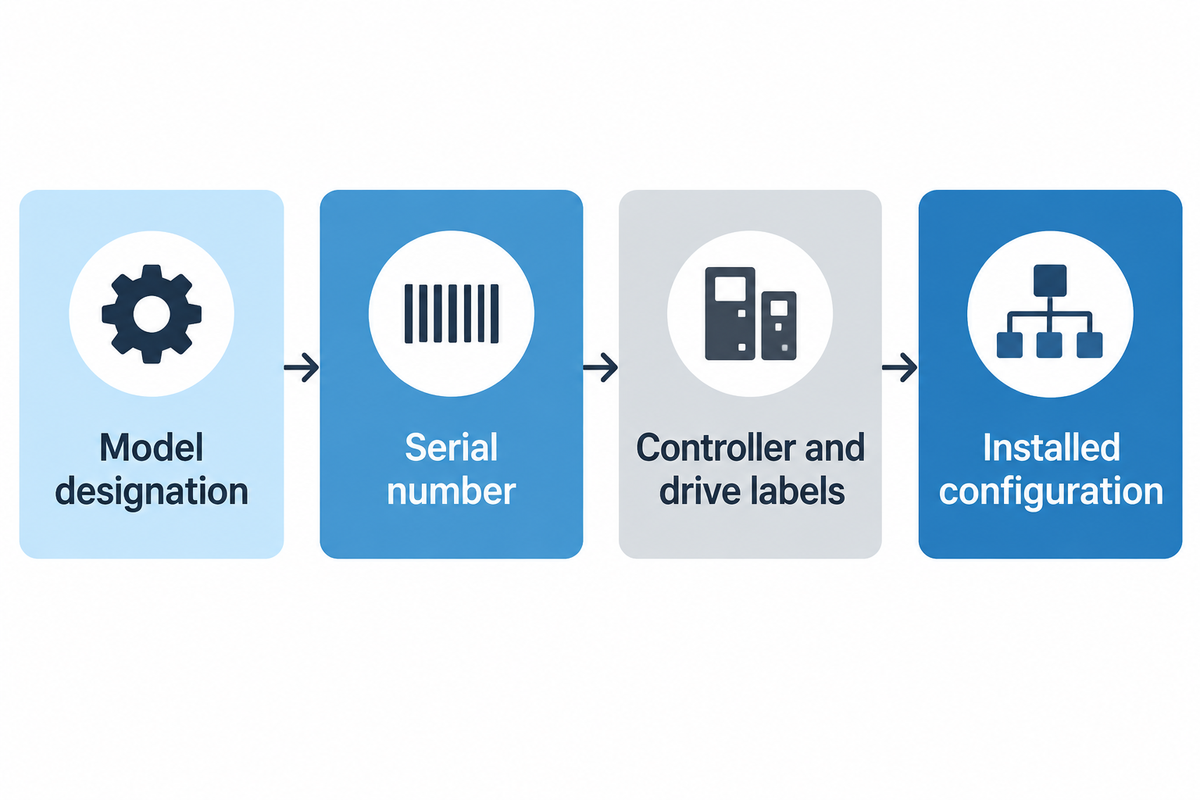
A Pandjiris model comparison requires the rated load condition, rotation range, tilt arrangement and working height, among other factors. The positioner table published by the manufacturer distinguishes small, manual-tilt machines from fixed-base and adjustable-base industrial models. A model number provides a preliminary answer, and the serial number and controls installed on the machine determine the actual machine being offered.
| Modèle | Published capacity basis | Table and movement |
|---|---|---|
| Mini Pro | 350 lb, horizontal and vertical | 8 in table; 0–90° manual pinned tilt |
| 15-4FB | 1,500 lb at 4 in eccentricity | 24 in table; catalog speed 0.08–1.6 rpm |
| 30-6AB | 3,000 lb at 6 in eccentricity | 30 in table; adjustable base; catalog speed 0.05–1.4 rpm |
Source: Pandjiris product catalog. The separate 30-6 model sheet gives more detailed geometry and a 0.046–1.40 rpm rotation range.
There are differences in the specifications of a machine from one catalog to the next that matter at the shop floor. The Mini Pro catalog lists a 0.65 rpm minimum, while Weld Plus lists a 0.37 rpm minimum for their Mini Pro 350. For the 30-6AB, the OEM drawing labels table height as 33–53 in, while a Mitrowski offer gives 28–42 in from the table center to the floor. Different revisions or measuring positions may account for the difference in table height. The dimensioned drawing of the selected machine will resolve an operator-height or swing constraint better than merging the two height constraints.
Which Pandjiris welding positioner do I have?
Identify a Pandjiris positioner from its machine nameplate, serial number and model designation, then match those identifiers to the manufacturer’s documents. Record the controller and drive labels, as well. A replaced motor, pendant or chuck can change the installed configuration without changing the original machine’s model designation.
Photographs of the table, base, controls and labels help distinguish a fixed-height machine from an adjustable or powered-elevation version. A current model full line is a good comparison reference, but a current catalog isn’t always a parts list for older machines. The capabilities and distinctions explained by Jason Ladd remain applicable when identifying the duty of an older table.
US and Chinese Positioners: Compare the Same Duty
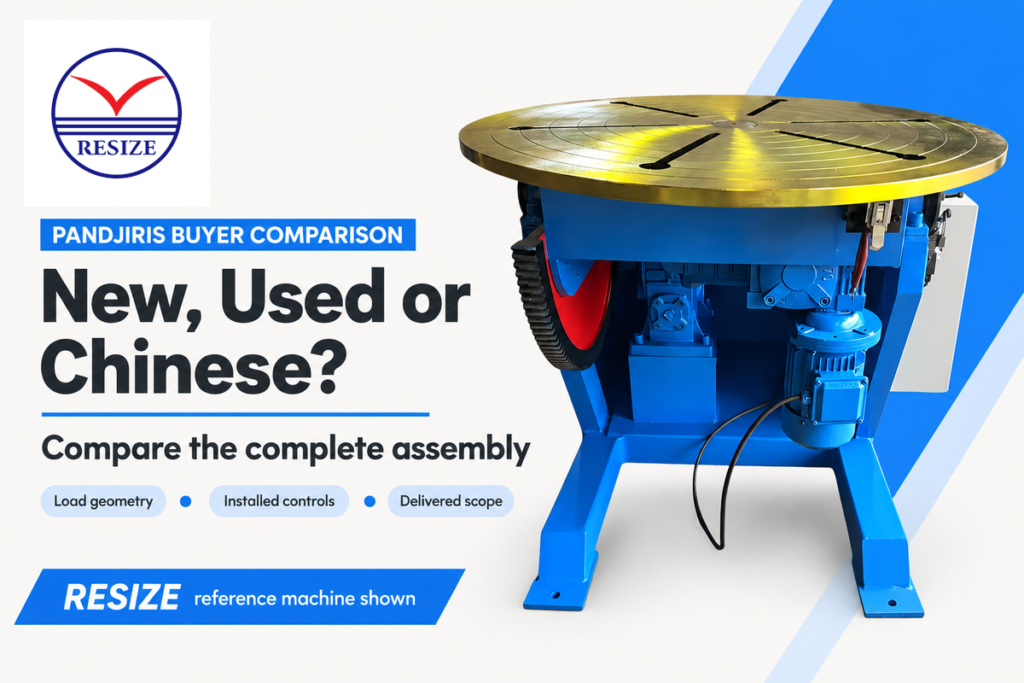
It’s when the two suppliers quote the same loaded fixtures, welding movement and installation, that we can fairly compare new US and Chinese positioners. Country of origin alone does not establish usable capacity or delivered value. RESIZE’s HBJ model Table and Pandjiris’s 30-6 documentation are good examples.
Le industrial welding positioner options from RESIZE include an HBJ-12 row listing 1,200 kg, 0.05–0.5 rpm, 0–120° tilt and a 1,200 mm table. Its HBJ-30 row lists 3,000 kg, 0.05–0.5 rpm, 0–135° tilt and a 1,400 mm table. The listed data are supplier-published model specifications. The HBJ-30’s 3,000 kg entry isn’t the same mass as a 3,000 lb Pandjiris rating.
The HBJ table does not state the associated center-of-gravity distances or rotation and tilt torque limits. Likewise, the 30-6 sheet’s optional current collectors and voltage arrangements are open to a specified order. “Standard” in one offer may include a current collector and voltage arrangements that are priced separately in another offer.
Compare the quoted job
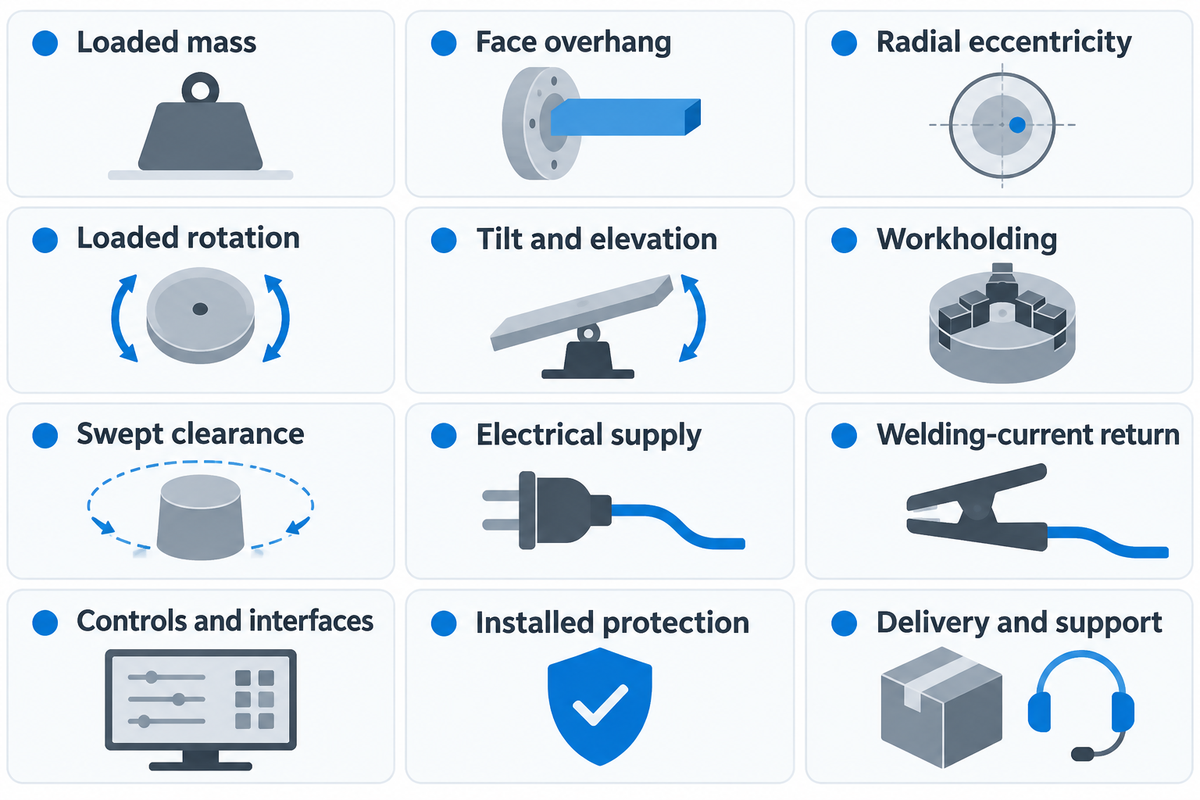
Send both suppliers the same assembly drawing and request the fields described in the returned offer. Production needs the movement and access; quality assurance needs repeatable process conditions; purchasing and finance need the equipment, installation and service responsibilities priced together.
| Quote field | Shared requirement | Decision consequence |
|---|---|---|
| Loaded mass | Part plus chuck, fixture and attachments; explicit kg or lb | Prevents comparing the same numeral in different units. |
| Face overhang | Combined center of gravity perpendicular to table | Connects the fixture to the offered load chart. |
| Radial eccentricity | Combined center of gravity parallel to table | Separates rotation demand from face overhang. |
| Loaded rotation | Required welding speed and control behavior with the fixture | An unloaded speed display does not reproduce the weld cycle. |
| Tilt and elevation | Angles, powered/manual movement and dimensioned working positions | Manual tilt and powered tilt are different operating scopes. |
| Workholding | Table interface, chuck, jaws and complete fixture drawing | Chuck grip capacity does not replace the machine rating. |
| Swept clearance | Part, cables and torch throughout the planned motion | A part can fit the table yet hit the base during tilt. |
| Electrical supply | Site voltage, phase, frequency and named supply arrangement | A different electrical option can alter installation cost. |
| Welding-current return | Rated collector or specified return path for the welding process | Protective grounding and welding-current return serve different purposes. |
| Controls and interfaces | Pendant, pedal, feedback and any robot-axis integration | Variable speed alone does not provide coordinated robotic motion. |
| Installed protection | Guarding, anchoring, energy isolation and commissioning responsibilities | A usable installation costs more than the bare machine. |
| Delivery and support | Freight, insurance, duties, tax, trade term, spares and service owner | Makes the commercial comparison usable for purchasing. |
Technical fields synthesized from the Pandjiris 30-6 sheet, Koike sizing guidance and the installation requirements discussed below; landed-cost components follow the US International Trade Administration guidance . These are detailed below along with the landed-cost components, following the guidance of the US International Trade Administration.
A high quality weld depends on the process, fit-up and execution as well as positioning equipment. Supplier sayings such as “custom solution” are useful when tied to the actual fixture drawing, controls and agreed acceptance work.
New and Used Pandjiris Positioner Prices
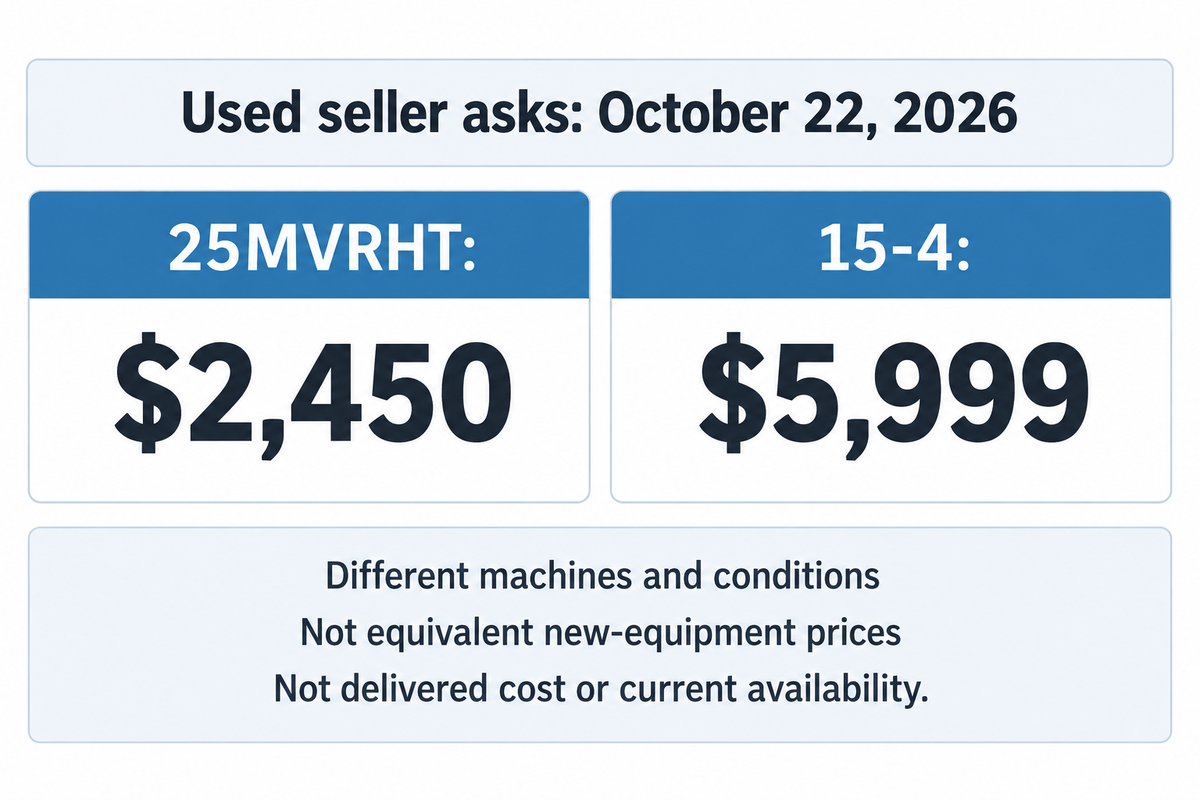
Two individual used Pandjiris offers displayed asking prices of $2,450 and $5,999 when reviewed on October 22, 2026. They provided different descriptions for the machines and condition. The dealer pages for the new Mini Pro 350 and 30-6AB, reviewed herein, invite a quotation. Thus, the used asks should not be considered prices for equivalent new equipment. Sources: the individual Equipt and Surplus Record listings above, reviewed October 22, 2026.
| Seller and machine | Asking price | Listed configuration |
|---|---|---|
| Mohawk Machinery, 25MVRHT, listing 182935 | $2,450 | Seller states 250 lb capacity, 12 in three-jaw chuck, powered rotation and 135° manual tilt; location wording says “FOB ON WAY IN.” |
| HGR24, 15-4, stock 0926-098-0014 | $5,999 | Foot pedal listed. The capacity field gives “50” without a clear unit; no rated mass is adopted here. |
The offers above don’t reflect a completed sale, delivered cost or current availability.
Consider a purchasing manager pricing a repeat flange job and a larger offset weldment at the same time. The lower-priced 25MVRHT has a listed chuck and manual tilt, which may interest the flange-job team. The heavy fixture requires a different load review, so that listing can’t serve as its price benchmark. The manager separates the jobs, asks the seller for the identified machine’s condition and complete scope, and obtains a new-machine offer for the offset assembly. Freight, missing workholding, and refurbishment join the purchase price in the comparison. The apparent difference between two website prices is no longer being mistaken for the saving available on one defined production task.
For an import, the US International Trade Administration landed-cost guidance includes insurance, freight, tariffs, taxes, and other fees in addition to the original price. The trade term helps specify payment responsibilities. A written offer should identify the delivered scope and the classification and tax assumptions used; a country-level discount percentage can’t supply that information.
Parts, Controls and the Case for a Used Machine
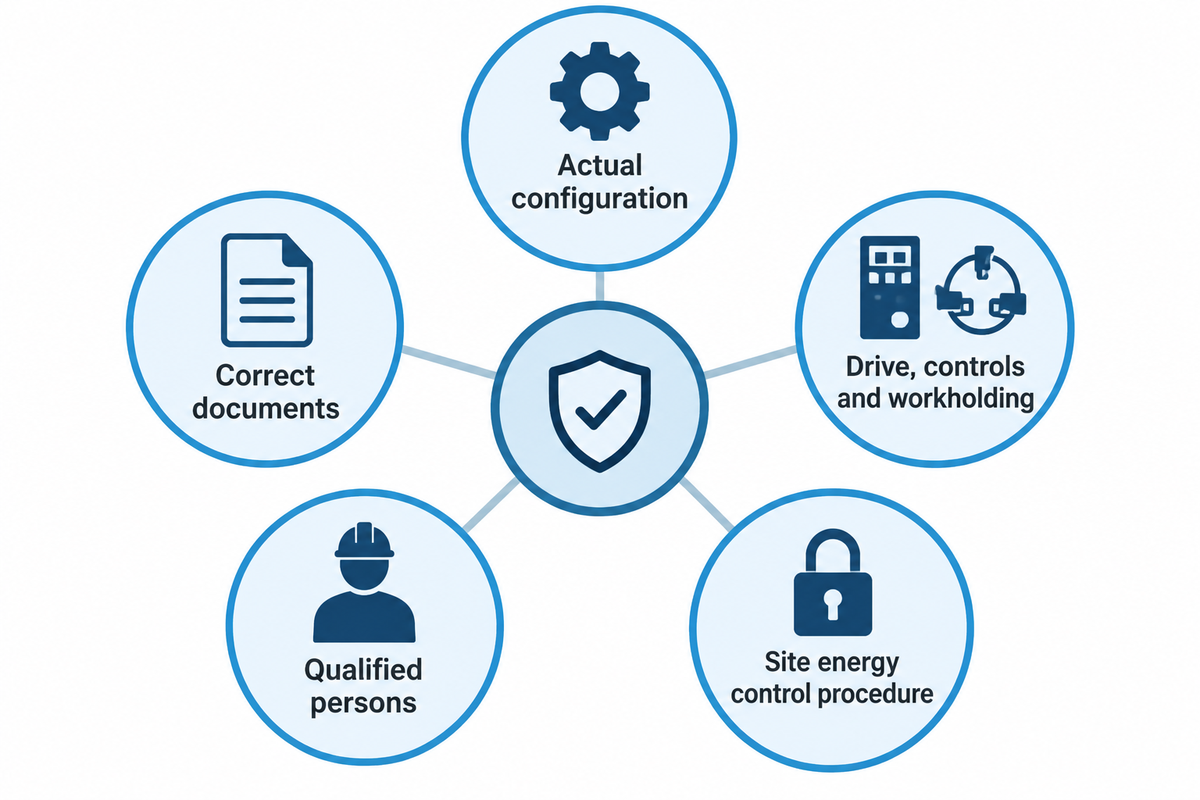
A used positioner that has an actual configuration that matches that of a repeat job and a known repair route is typically a stronger candidate. The important part is the installed drive, controls, and workholding, as opposed to the brand badge. The missing chuck, obsolete control, and/or uncertain service responsibility can influence the value of a machine that otherwise appears to be good.
A WeldingWeb repair thread describes a motor running while the chuck did not turn; its eventual report concerned loose gear screws. Other posts in the thread describe different symptoms relating to the controls and pedals. They’re individual experiences and shouldn’t be used to diagnose another machine, nor should they be used to establish a failure rate for Pandjiris.
Pandjiris describes EZLink PLC controls for new equipment and retrofits, including configured circumferential positioners. Diameter-based surface-speed settings and optional feedback devices are specific controller features. An older table offered with a pedal does not automatically include that package.
The limits of repair have also been defined. Certain aspects of OSHA 1910.147 relate to unexpected or stored energy that could cause injury while servicing equipment. OSHA 1910.147 addresses servicing where unexpected energization or stored energy can cause injury, with defined scope and exceptions; a pushbutton isn’t an energy-isolating device. OSHA’s arc-welding rule restricts repairs to qualified personnel. Therefore, the service plan needs to have the correct documents, qualified persons, and the site’s energy control procedure.
Pipe Fixtures, Chuck Fit and Installation
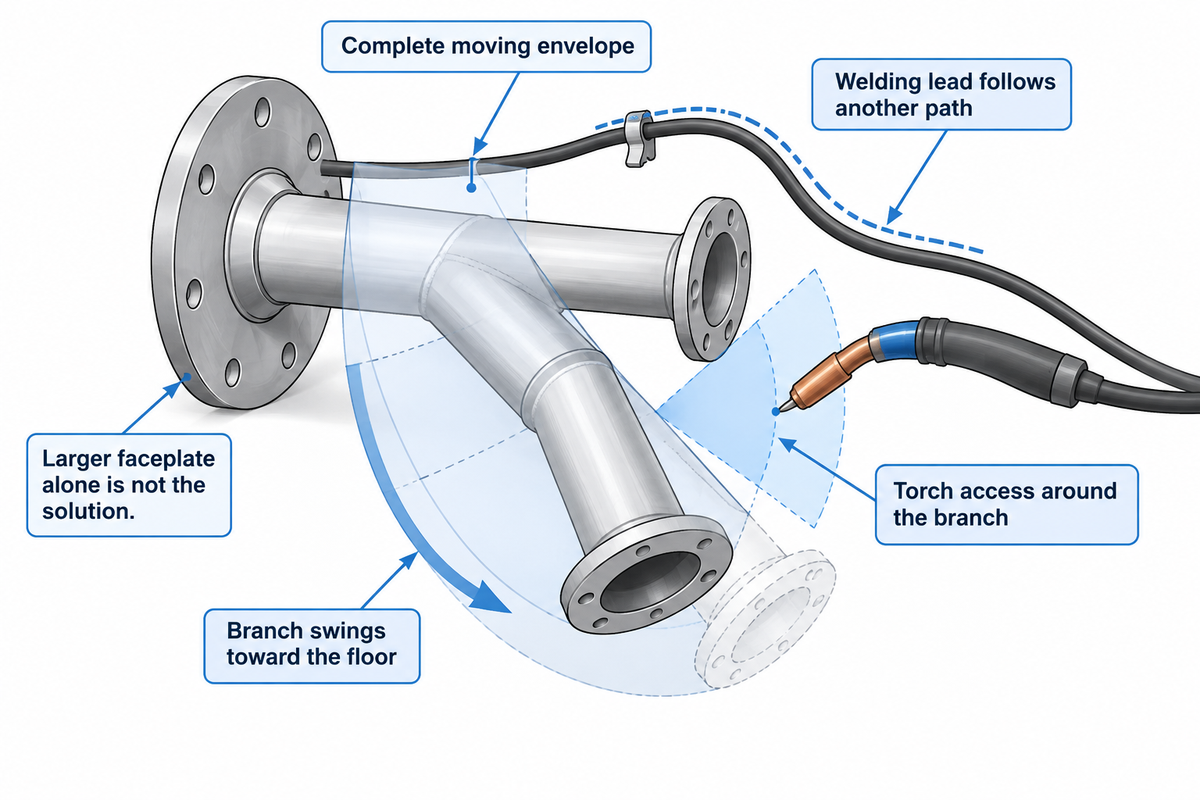
Installing a positioner requires a compatible chuck or fixture. It also requires clearance throughout the workpiece’s movement, as well as the specified electrical supply. A table diameter doesn’t establish any of these. Pipe length, projections, supports and cable routing can determine whether the planned weld remains accessible when the assembly turns or the table tilts.
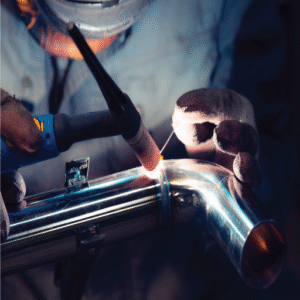
Consider a hypothetical shop welding a long spool with a branch connection. The spool bolts to the table and the straight pipe clears the base when horizontal. During tilt, however, the branch swings toward the floor and the welding lead follows another path. A larger faceplate would not by itself solve either obstruction. The fixture designer may change the mounting position, introduce an engineered support arrangement or move the job to another equipment type. The welding supervisor also needs torch access around the branch, rather than merely a drawing showing that the pipe can rotate. Discussing pipe welding positioners should include the complete moving envelope.
The 30-6 sheet lists 460 V, three-phase, 60 Hz as its standard supply, with other arrangements available on request. Its 600 A and 1,200 A current collectors are options. Welding-current return and protective frame grounding have different functions: OSHA 1910.254 addresses both, including adequate current collection where a fixture regularly carries return current.
Guarding is part of the installed safety arrangement. OSHA 1910.212 requires protection from relevant machine-area hazards and secure anchoring for fixed machinery. Access for loading, rotation and maintenance must be compatible with the protection arrangement.
Which Positioner Fits Your Job
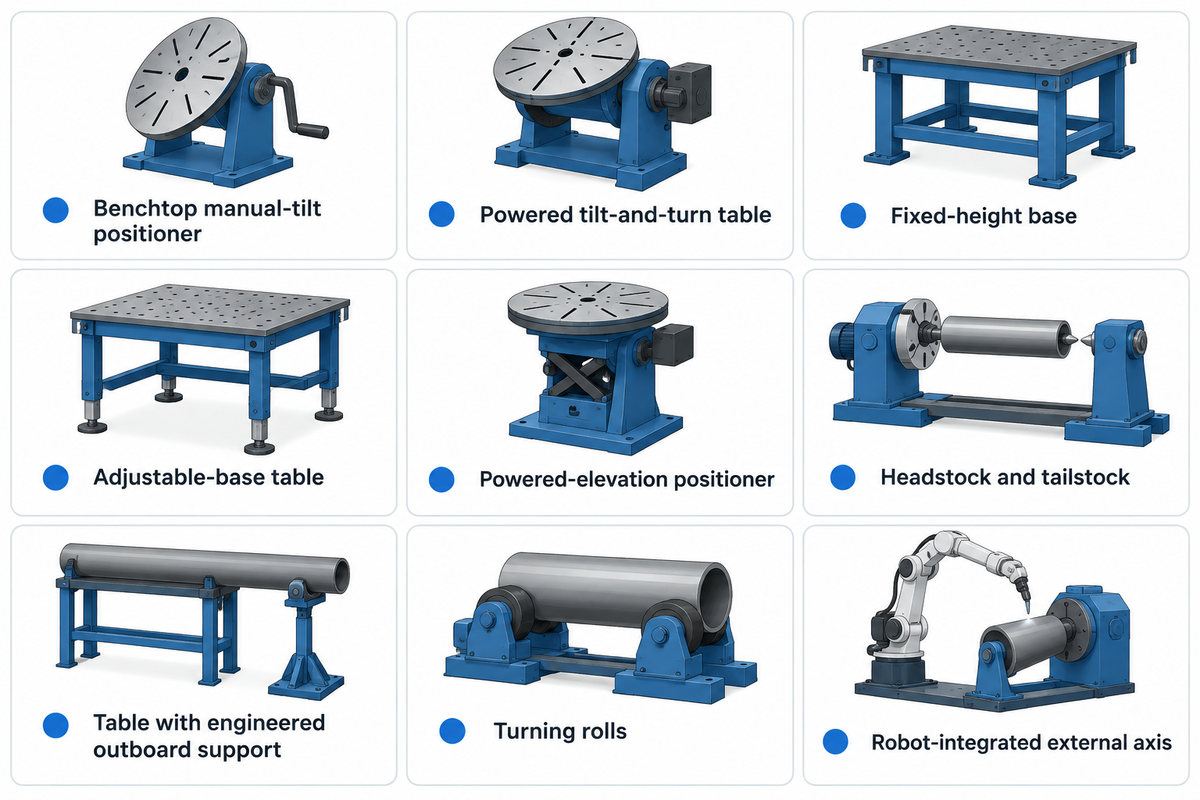
The positioner that supports the job maintains the complete assembly while allowing access for welding and required movement. A compact manual-tilt machine may be appropriate for a small repeat part. A long assembly may need support at the end. Robotic work adds controls and integration that a conventional variable speed table may not address.
What can stop the job
| Arrangement | Job it addresses | Constraint that can stop the job |
|---|---|---|
| Benchtop manual-tilt positioner | Small clamped parts | Manual repositioning must suit the work and the machine’s instructions. |
| Powered tilt-and-turn table | Controlled orientation of a face-mounted assembly | Offset geometry can exceed the applicable load chart. |
| Fixed-height base | A repeat job at a known working position | Operator access or part swing may not fit the fixed height. |
| Adjustable-base table | Jobs needing a different set working height | Pinned adjustment is different from powered elevation during a cycle. |
| Powered-elevation positioner | Specified changes in working elevation | Height, swing and movement limits belong to the offered model. |
| Headstock and tailstock | An assembly supported at both ends | Support alignment and fixture interfaces determine usable motion. |
| Table with engineered outboard support | Long work extending from a faceplate | Adding support changes the load path and needs engineering review. |
| Rouleaux tournants | Cylindrical shells supported on their outside surface | Diameter, contact and projections govern access and support. |
| Robot-integrated external axis | Motion coordinated with a welding robot | Axis control, feedback and cell protection require an integrated design. |
This application guidance synthesizes Pandjiris model and controller descriptions, Koike sizing guidance, and articles from The Fabricator on positioners and automation. Each entry describes a configuration choice, rather than a capacity suggestion.
What are the best welding positioners?
For a given shop, the best choices for welding positioners are the machines that meet the fixtures, movement, and support needs of the shop. For a documented repeat duty, compare offers for the new and used equipment. For a changing offset assembly or robotic cell, prioritize an engineered configuration and integration responsibility over an unsupported brand ranking.
For a 3000 lb Pandjiris machine, the purchase decision still follows the complete loaded geometry. A chuck’s separate gripping rating, the table’s mass rating and the required low-speed weld cycle answer different questions. Koike welding product manager Don Burgart’s positioneering discussion explains how operator interaction, access and controls enter that choice.
Automation Outlook: Buy for the Next Fixture
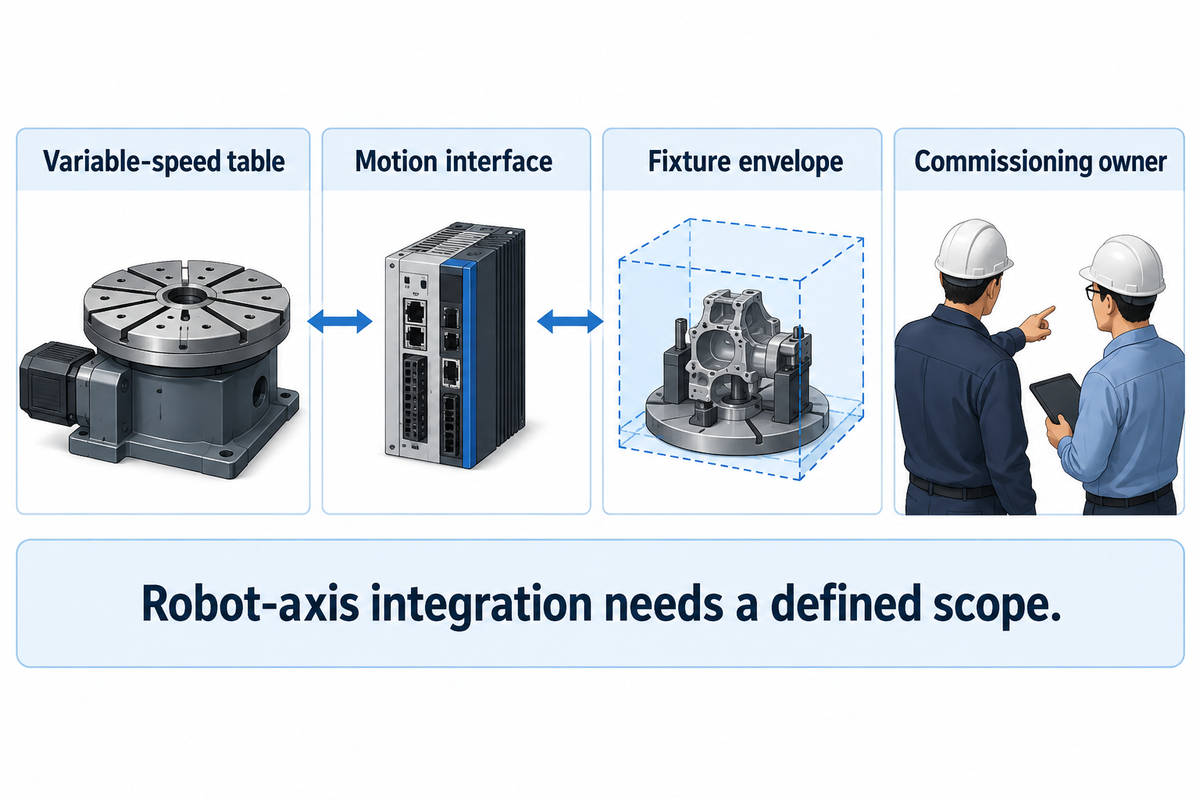
Automation is likely to affect the control interfaces required, and therefore the commissioning scope, in future positioner integration. For example, consider a table that rotates past a fixed torch. In the future, that table might need a different drive, feedback and protection systems to function as a robotic axis. The useful upgrade question concerns the next fixture and process, rather than the presence of a speed display.
In February 2026, Pemamek provided an outlook on adaptive welding, digital twins and virtual commissioning as emerging trends in automated fabrication. From the supplier’s perspective, how do such changes impact a buyer for the next product family? Who will define and program the new joints and fixtures, and who will commission and qualify the changes?
Pandjiris’s EZLink description gives a concrete, narrower example: configured circumferential welding can use work diameter to set surface speed, with optional feedback equipment. In the discussion on fabrication automation in the Fabricator, system questions addressed include reach and fixture clearance, and tracking of seams.
The standards context changed in 2025. ISO 10218-2:2025 addresses industrial robot applications and cells; A3’s ISO 10218 update explains the distinction between the robot manufacturer’s role and the application integrator’s role. That application boundary matters when a positioner becomes part of a cell. ISO 14732:2025 concerns qualification of operators and setters for mechanized and automatic metal welding within its stated scope. Where the applicable code or contract calls for that qualification, training and personnel scope belong in the project budget.
A 2026 project specification can name the intended motion interface, fixture envelope and commissioning owner prior to the machine order. This enables the client to determine the cost of the upgrade path, rather than assuming a variable-speed machine will become a robot axis in the future.
FAQ
Where are Pandjiris welding positioners made?
Pandjiris describes its manufacturing facility in St. Louis, Missouri, with fabrication, machining, assembly, painting and electrical departments.
The company’s About page describes those operations and its welding-automation manufacturing history. For a particular new order or used machine, origin documentation should identify that machine and any contractual domestic-content requirement. A facility description doesn’t mean that every motor, controller, chuck or other component in every configuration has the same country of origin.
Is Pandjiris still in business?
Pandjiris Inc.’s official website continues to list new positioners, controllers and quotation contacts as of October 2026.
The practical route for a current purchase or parts inquiry is the manufacturer’s published contact channel or the identified dealer handling the offer. Availability, order acceptance and support for a particular serial number need a current response. The website’s product listings describe its public commercial presence; they aren’t a legal-entity status search or a guarantee of stock.
Where can I find a Pandjiris positioner manual?
Obtain a Pandjiris positioner manual from the manufacturer or supplying dealer using the exact model, serial number and installed controller details.
Public model sheets can help identify dimensions, published ratings and options, but a specification sheet is different from the operating, electrical and maintenance documents for the installed machine. Include photographs of the nameplates and controls with the request. If the unit has been retrofitted, the documents should cover the replacement equipment as well as the original machine.
Can I fit a welding chuck to a used positioner?
A used positioner can accept a suitable chuck when its mounting interface, loaded geometry and movement clearance match the machine.
The Model A gripper in the reviewed dealer offer has its own gripping specification. Add chuck mass and offset to the assembly assessment; use positioner chuck fit as the separate workholding topic.
Why is my Pandjiris positioner not working?
A positioner that will not move needs diagnosis against its actual controls, drive and mechanical arrangement; the symptom alone does not identify the failed part.
A service request should describe whether the issue affects rotation, tilt or both, what the controls display, and when the symptom began. Provide the machine and controller identifiers and any known retrofit history. The repair discussion cited above includes different mechanical and control symptoms, so another owner’s fix shouldn’t be transferred to this machine. Avoid removing covers, bypassing protective devices or attempting a loaded movement to reproduce an unexplained fault. Qualified personnel should follow the applicable manual and the site’s hazardous-energy procedure where servicing falls within its scope. A clear symptom record helps the service provider select the next diagnostic action without turning an online answer into an electrical or mechanical repair instruction.
References & Sources
- 5 Things Welders Need to Know About Weld Positioners Jason Ladd, The Welder
- The Future of Fabrication Société américaine de soudage
- Welding Automation Gets Heavy The Fabricator
- Welcome to the World of Positioneering The Welder
- 29 CFR 1910.254: Arc Welding and Cutting OSHA
- 29 CFR 1910.212: General Requirements for All Machines OSHA
- 29 CFR 1910.147: Control of Hazardous Energy OSHA
- Determine Total Export Price: Landed Cost US International Trade Administration
- ISO 10218-2:2025: Industrial Robot Applications and Cells ISO public scope and edition information
- ISO 14732:2025: Welding Operators and Setters ISO public scope and edition information
- Updated ISO 10218 FAQ Association for Advancing Automation
Why RESIZE Compares the Complete Assembly
RESIZE supplies welding positioners and custom welding equipment. This Pandjiris comparison uses public manufacturer documents and identified seller listings, rather than a comparative factory trial. The distinction between fixture overhang and radial eccentricity, and between a listed asking price and an installed machine, shapes the buying guidance. RESIZE’s commercial interest is part of that context.
For a new positioner enquiry, send the assembly drawing, fixture mass, weld access and required movement when you discuss your part and fixture with RESIZE. Those details give the supplier a defined job to quote.