By GW • Reviewed by Wuxi Yuanpeng Machinery Equipment Factory Technical Team • Updated November 2026
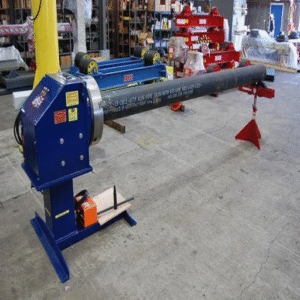
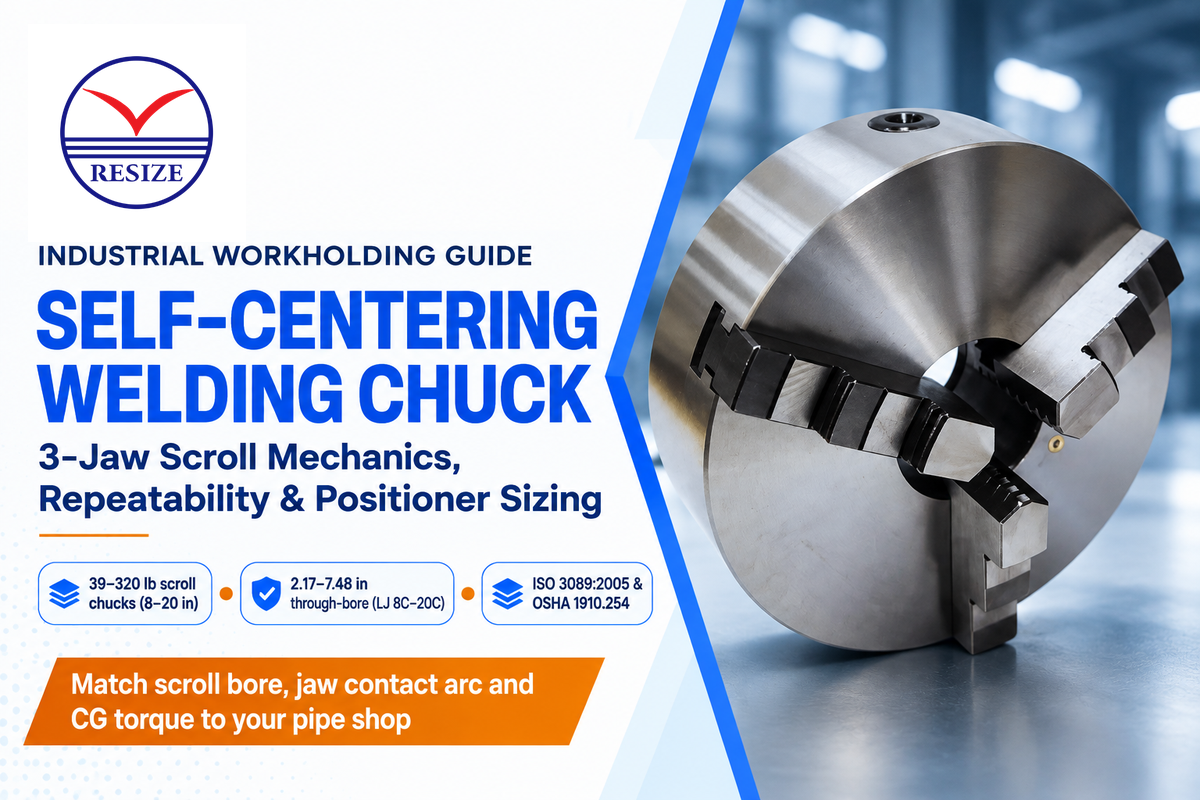
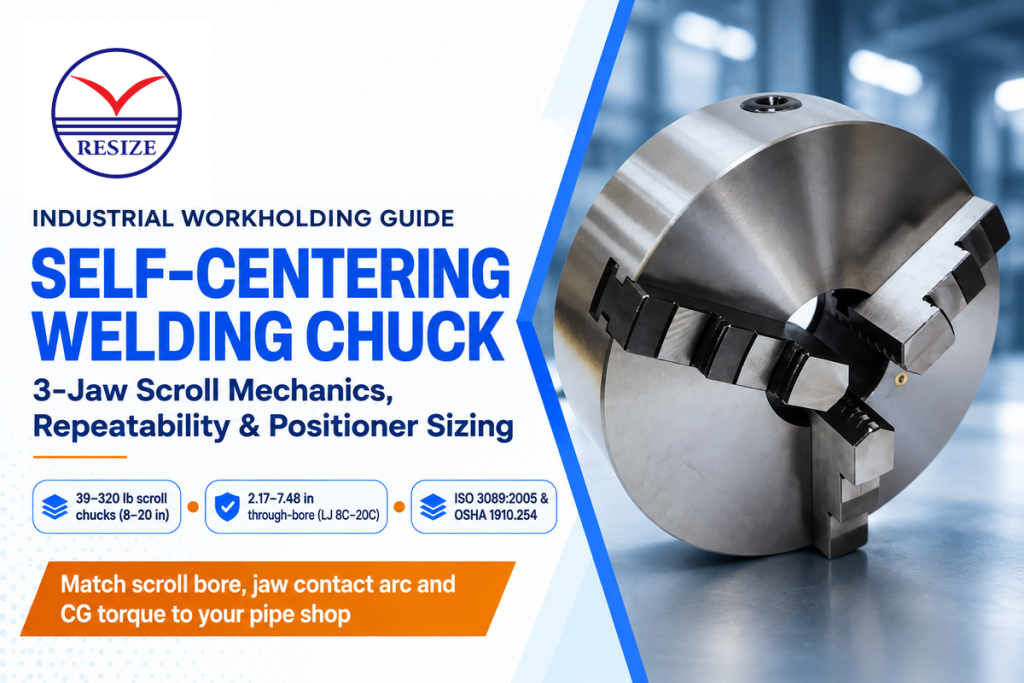
A self centering welding chuck is a rotary fixture that drives three jaws together from one input to clamp round pipe, flanges, and shafts on a positioner. Industrial 8-inch to 20-inch scroll models weigh 39 to 320 lb (17.7 to 145.1 kg). Dedicated welding bodies trade micron-level lathe tolerances for low profile spatter shielding and fast batch changeover.
Sizing errors happen when shops buy a chuck by nominal diameter alone or bolt an ungrounded lathe chuck onto a rotary table. This guide covers internal scroll and cam mechanics, dial indicator repeatability checks, thin-wall deformation limits, overhung center of gravity torque math, rotary grounding, pricing tiers, and supplier selection.
Quick Specs: Self-Centering Welding Positioner Chucks
| Standard Jaw Geometry | 3 reversible jaws spaced 120° apart (universal scroll or cam-lock gripper) |
| Industrial Scroll Weight Range | 39 lb (8-in) to 320 lb (20-in) on LJ Welding 8C–20C models; 48 lb on Koike WP-400 |
| Heavy Gripper Load Range | 250 lb @ 1 in (Pandjiris J-15) up to 7,500 lb @ 5 in (C-48/C-60, PC-60C) |
| Spin-Lock Speed Limit | 50 RPM maximum recommended on Preston Eastin Spin Lock models |
| Listed U.S. Price Band (Nov 2026) | $240–$4,985 (Profax WPC-6 to WPC-25 at Harris); $799.99 (Woodward Fab WFWP20-S); $1,123.50 (Koike WP-400) |
| Key Reference Standards | ISO 3089:2005 (confirmed 2025), OSHA 29 CFR 1910.254(c)(2), ASME B36.10M-2018, ISO 14732:2025 |
How Does a Self-Centering Welding Chuck Work? Scroll, Cam, and Jaw Mechanics
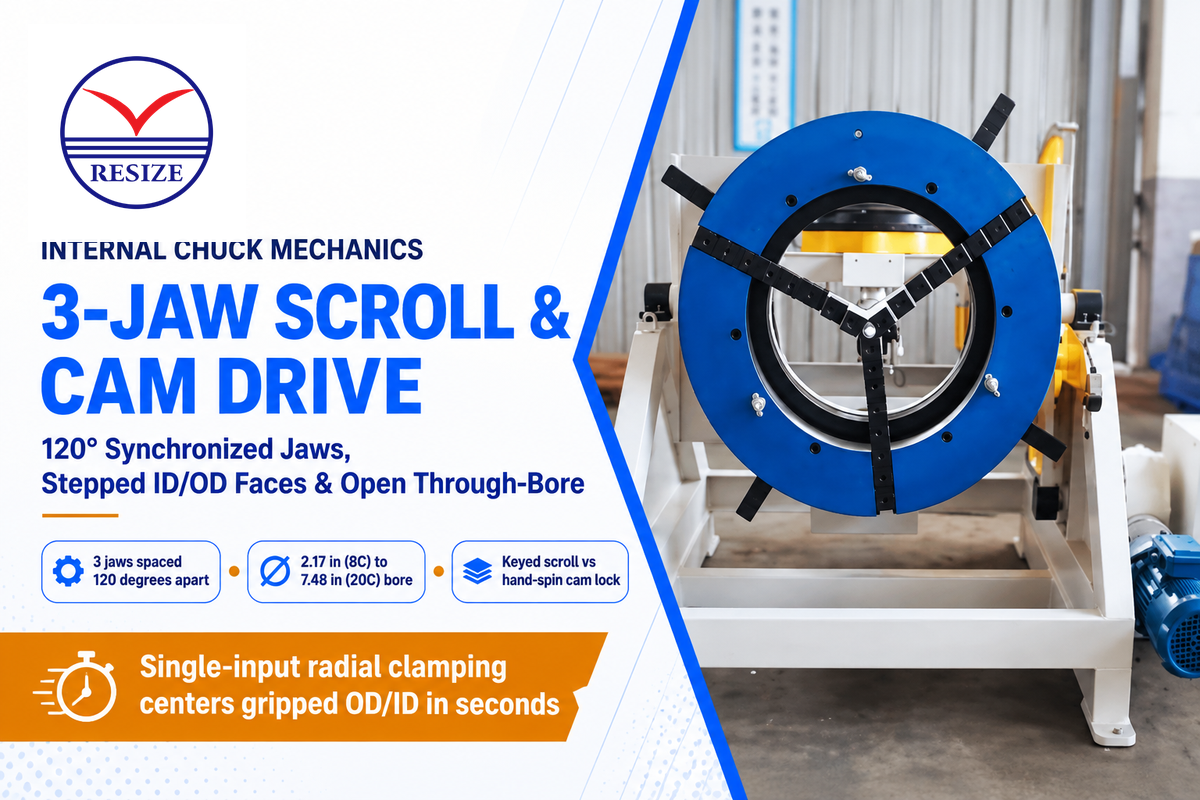
A self-centering welding chuck synchronizes three jaws spaced 120 degrees apart to all travel inward or outward at the same rate. Turning one bevel pinion or quick-lock lever rotates an internal spiral scroll plate or cam ring. That single input grips round pipe or hex stock on the same axis in a few seconds.
Think of the internal mechanics as a camera aperture iris closing around a lens. All three blades move together because a single central slotted plate drives them. In a keyed 3-jaw self-centering scroll design, spiral ribs on the scroll plate engage teeth on each jaw. That gear reduction gives the required clamping torque to turn the pipe spools. On some models, the welder can spin a slotted ring by hand to close the jaws fast, as with a spin-lock welding chuck. A mechanical lock lever or ball pin secures the grip without a wrench.
Every industrial welding chuck relies on reversible jaws with stepped faces. Facing the steps inward grips the outside diameter (od) of pipe, bars, and flange necks for external workholding. Flipping or indexing those reversible stepped jaws outward expands them against an internal pipe bore or ring wall. Most welding positioner models also leave a large open through-bore at the center. For example, LJ Welding scroll chucks open from a 2.17 in bore on the 8C model up to a 7.48 in bore on the 20C model. That hollow center lets long shafts pass through the table and carries argon back-purge hoses cleanly. Readers new to basic anatomy can review welding chuck fundamentals and our breakdown of 3-jaw welding chuck structure.
A common mistake in shops is thinking self-centering jaws will pull an oval or bowed pipe back into true weld-seam concentricity. The clamping jaws center only the three contact points they touch on the gripped surface. If the pipe bevel is eccentric relative to the mill-rolled OD, the weld will still wobble during rotation. This geometric restriction means that shop-floor dial verification is required before automatic or TIG welding.
Are Three-Jaw Welding Chucks Always Self-Centering?
Nearly every 3 jaw welding chuck sold for rotary positioners is self-centering because three contact points evenly spaced on a circle define a circle automatically. Independent adjustment normally requires four jaws, so opposing pairs can move a part along the X and Y axes. Custom three-jaw welding fixtures can add eccentric jacking screws, but standard catalog units move synchronously.
Fabricators also encounter specialized 2+2 paired concentric designs in high-production pipe and frame shops. As documented in The Fabricator’s report on Team Industries and expired machine-tool USPTO patent US6220608B1 (assigned to American Workholding Inc), a 2+2 architecture uses two separate cam plates to drive two opposing jaw pairs independently. One pair centers the width while the second pair centers the height on rectangular tubing or ovalized pipe. Standard 3-jaw scroll chucks remain a fast choice when stock is round or hexagonal.
Self-Centering Welding Chuck Repeatability and Concentricity: Realistic Shop Tolerances
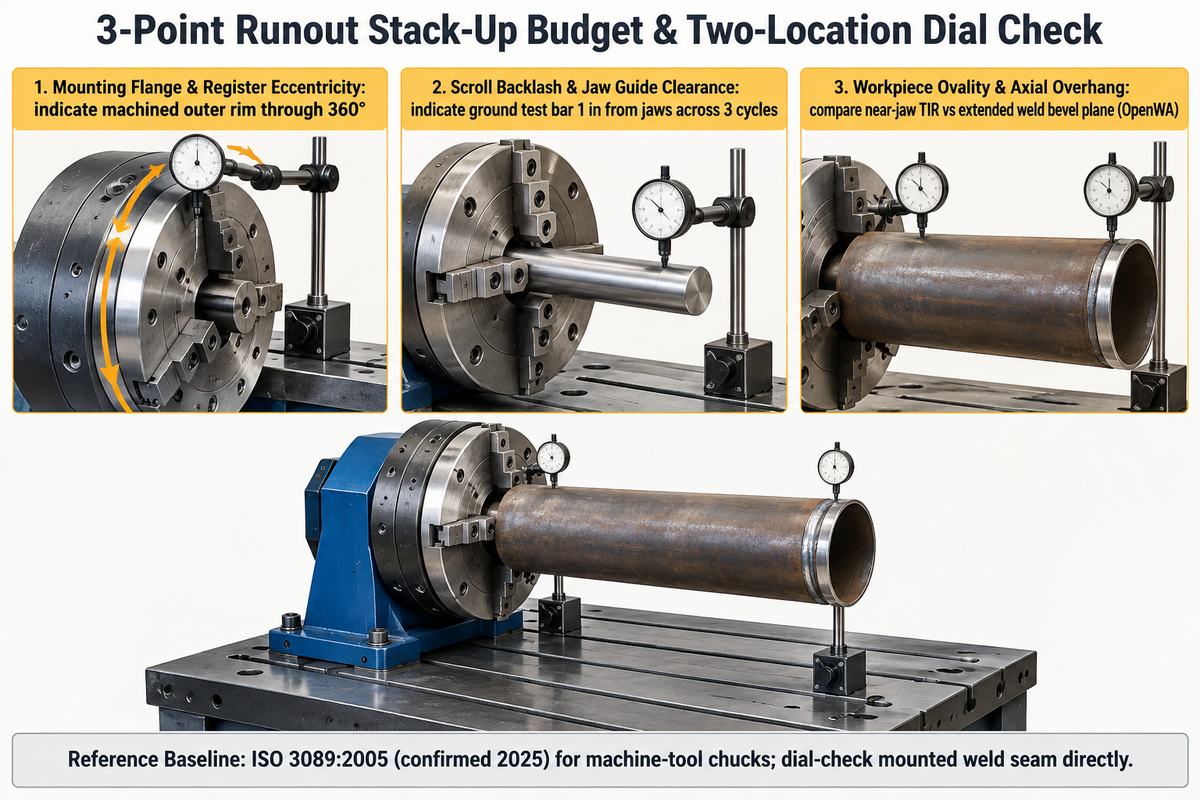
Dedicated welding chucks trade ground-scroll precision for spatter clearance and low profile, and OEM catalogs rarely publish factory TIR ratings. Machine-tool chucks follow ISO 3089:2005 (confirmed current in 2025) for rotational and centering geometry on one-piece jaws. Welding shops treat that standard as a reference baseline and dial-check the mounted weld seam directly.
ISO 3089:2005 defines inspection methods for rotational accuracy, straightening, and workpiece centering on manually operated machine-tool chucks. It covers geometric test conditions rather than dynamic counterbalancing or gripping force ratings. On a welding positioner, total seam wobble comes from three separate error sources stacking together rather than the scroll plate alone. The 3-Point Runout Stack-Up Budget below isolates each source so technicians fix the real cause instead of blaming the chuck prematurely.
| Stack-Up Source | Physical Mechanism | Diagnostic Dial Check | Corrective Action |
|---|---|---|---|
| 1. Mounting Flange & Register Eccentricity | Chuck bolted to T-slots off center without a machined spigot or centering ring | Indicate the machined outer rim of the chuck body while rotating the table 360° | Loosen hold-down bolts, tap chuck body concentric, or machine a pilot spigot register |
| 2. Scroll Backlash & Jaw Guide Clearance | Radial play between scroll thread, jaw teeth, and worn master-jaw slots | Indicate a ground test bar 1 in from the jaws across 3 unclamp-and-reclamp cycles | Always tighten with the same marked pinion socket; clean slag or replace worn scroll |
| 3. Workpiece Ovality & Axial Overhang | Angular jaw tilt or pipe bow multiplies radial wobble linearly with stick-out length | Compare near-jaw TIR against TIR at the extended weld bevel plane | Add an outboard pipe roller stand or tailstock live center before welding |
When fabricators upgrade from manual MIG to mechanized TIG or robotic circumferential welds, repeatability across real mill tolerances matters more than a single machined test bar. Writing in AWS Welding Digest, weld engineer Adam White (Glendale Manufacturing Co.) warns buyers to qualify fixtures with real production extremes rather than cherry-picked samples:
Do not force or hammer parts into fixtures—proving representative best- and worst-tolerance production parts with the integrator before shipment helps prevent fixture damage, clamp fatigue, and poor welds.
Perform the best-and-worst sample check on the mounted self centering chuck for mechanized TIG or narrow-groove wire processes. Some weld procedures require precise radial tracking to under 0.5 mm, while mill pipe runs 2 mm out of round. In cases like these, use a mechanical seam tracker, or change to an independent 4-jaw chuck to dial the bevel directly.
How Do You Measure Runout and Repeatability on a Welding Positioner Chuck?
Mount a magnetic-base dial indicator on the stationary positioner frame and measure radial total indicator reading (TIR) in two locations. Check runout near the jaws first, then check again at the extended weld plane. Rotate the table slowly through 360° after final tightening, then unclamp and reclamp the part three times to measure repeatability.
Following the two-location inspection sequence from OpenWA machining practice prevents false confidence. Near-jaw readings look clean even with a bent pipe or worn jaw step that throws the far weld seam by several millimeters. Mark the high-spot clock position on the chuck OD and always lock the same numbered pinion socket with consistent torque. The true working accuracy of a particular station is reflected by recording the difference across three reclamp cycles in your shop weld procedure log.
3-Jaw Self-Centering Welding Chuck vs. 4-Jaw Independent, Gripper, and Lathe Chucks
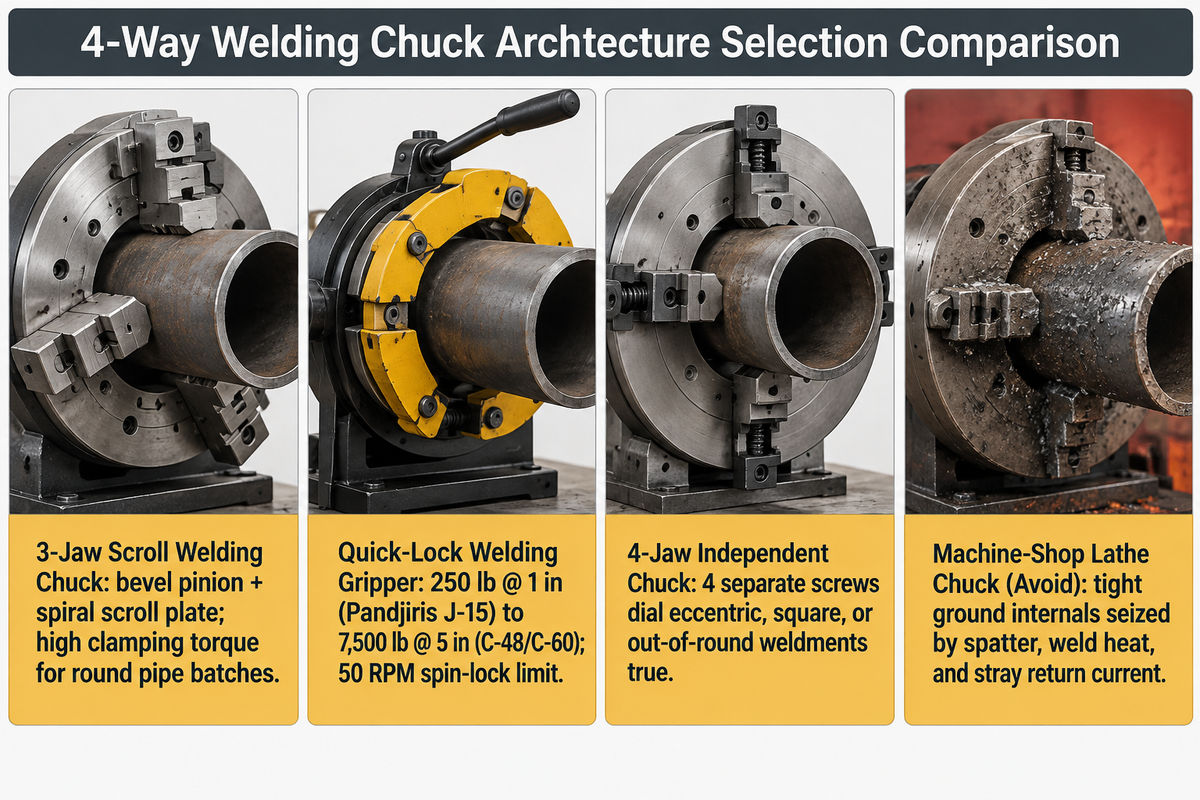
Choose a 3-jaw self-centering scroll welding chuck for high-clamping force pipe and flange batches, and a quick-lock welding gripper for heavy, rapid-changeover spatter zones. Switch to a 4-jaw independent chuck for square, rectangular, or eccentric weldments. Avoid bolting precision machine-shop lathe chucks onto welding positioners because spatter, heat, and return current destroy their tight ground internals.
Many buyers confuse welding grippers with soft-jaw irregular fixtures. In industrial catalogs, a gripper welding chuck is actually a heavy-duty, self-centering 3-jaw chuck with heavy construction and an enclosed face. Pandjiris Quickset and Preston Eastin PC-series models belong to this family. Pandjiris seals the face against flux and weld spatter, locks the jaws with three ball pins, and provides an over-torque protection device. That wrench-free actuation boosts bay efficiency across high-mix pipe shifts. Preston Eastin rates its PC-20A through PC-60C grippers from 1,000 lb up to 7,500 lb at 5 in overhang. Its Spin Lock chucks use weldable SAE 1018 jaws. Preston Eastin also publishes one strict speed ceiling: don’t run Spin Lock welding chucks faster than 50 RPM.
| Evaluation Criterion | 3-Jaw Scroll Welding Chuck | Quick-Lock Gripper Chuck | 4-Jaw Independent Chuck | Standard Machine Lathe Chuck |
|---|---|---|---|---|
| Actuation Mechanism | Bevel pinion + spiral scroll plate | Hand-spin ring + cam lock or ball pins | 4 separate leadscrews, one per jaw | Tight-clearance ground scroll + pinion |
| Clamping Speed | Fast (single key turn) | Fastest (wrench-free spin & lock) | Slow (dial each jaw individually) | Fast, but heavy wrenching torque |
| Supported Part Shapes | Round pipe, flanges, hex bar | Round pipe, vessels, rings (up to 68 in) | Square, rectangular, eccentric, irregular | Machined round/hex bar stock |
| Spatter & Flux Protection | High (open clearance or enclosed face) | Highest (completely enclosed faceplate) | Moderate (exposed screw slots need covers) | Poor (tight ways bind quickly with spatter) |
| Weight & Overhang Penalty | Low-profile; 39–320 lb (8–20 in) | Heavy-duty; 140–770 lb (PC-20A–PC-60C) | Heavy cast body; higher CG offset | Thick body + backplate eats tilt capacity |
| Speed Ceiling | Low rotary weld speeds (typically <20 RPM) | Max 50 RPM (Preston Eastin Spin Lock) | Low weld speeds; unbalance risk on eccentric parts | High lathe RPM (unneeded for welding) |
| Weld-Seam Dial-In | Fixed to gripped OD/ID surface | Fixed to gripped OD/ID surface | Can dial out eccentric weld bevels | Fixed to gripped surface |
| Stray-Current Vulnerability | Requires positioner rotary ground | Built for grounded positioner tables | Requires positioner rotary ground | High risk of arc-pitted scroll & bearings |
| Typical Buyer Fit | General pipe spool & flange shops | Heavy vessel, SAW flux & high-mix cells | Valve bodies, elbows, square tubes | Metal-cutting lathes only |
| Limitations / When Not to Use | Cannot center asymmetric castings; deforms thin walls if over-torqued | Not for speeds >50 RPM or heavy cutting loads; larger flange footprint | Too slow for 50-piece round pipe batches; adds operator setup time | Do not repurpose on arc welders; spatter & stray current ruin precision |
Repurposing an old 12-inch machine-shop lathe chuck looks cost-effective on day one, yet it rarely survives a busy fabrication floor. Hardened lathe scroll ways sit within thousandths of an inch, so hot weld spatter and grinding dust seize them rapidly. Worse, welding heat tempers hardened jaw guides, and stray return current micro-welds precision internals. For a detailed time study on switching between three-jaw and four-jaw tooling, see our 4-jaw versus 3-jaw welding chuck changeover tradeoffs.
What Are the Disadvantages of a 3-Jaw Self-Centering Welding Chuck?
A 3-jaw self-centering welding chuck can’t align an eccentric weldment on to the rotation axis. It can’t grip square or rectangular tubes cleanly. It concentrates clamping load at three narrow contact points. With thin walled stainless tubing, those three contact points flex the wall into a subtle triangle that springs back out of round after welding.
The second disadvantage due to scroll wear is practical. As grit or slag wears a scroll thread unevenly across its most used diameter band, all three jaws lose repeatability together. Unlike an independent 4-jaw chuck where an operator compensates for worn screws with a dial indicator, a worn 3-jaw scroll plate requires teardown or full unit replacement.
How to Size a Welding Positioner Chuck for Pipe Diameter, Thin-Wall Tubing, and Overhung Load
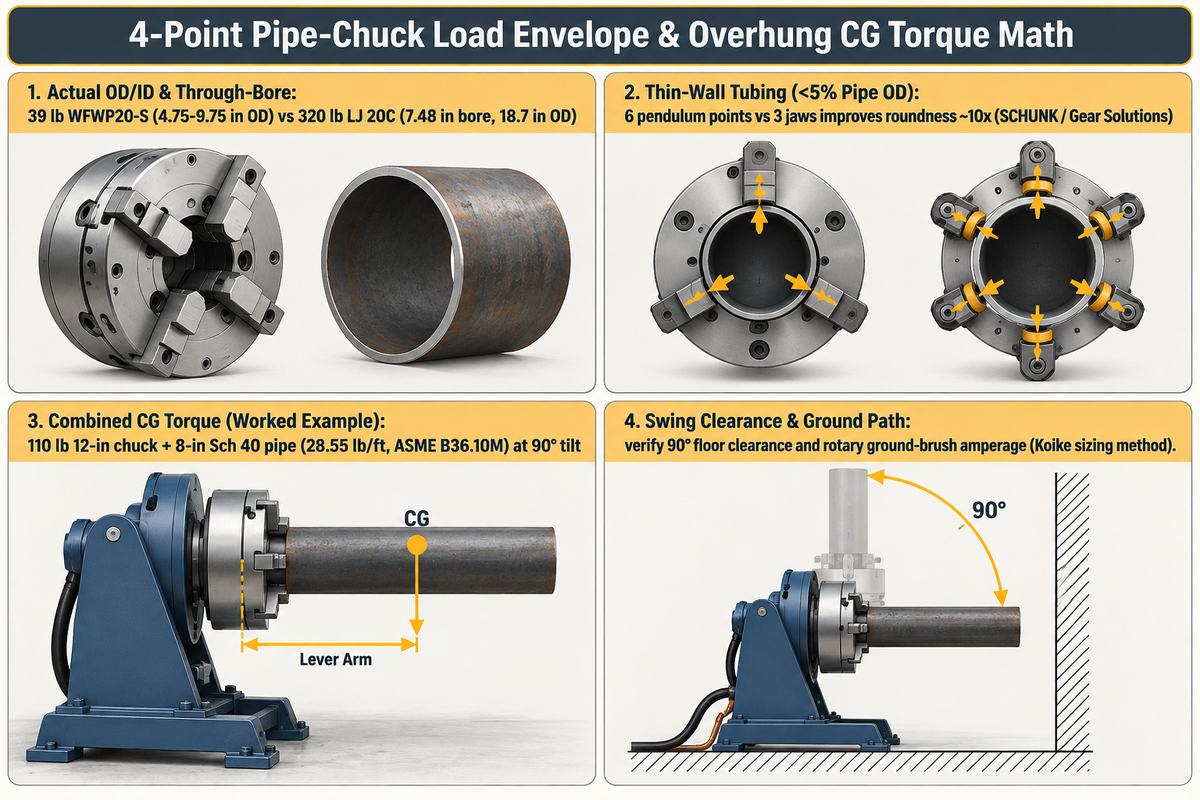
Industrial 8-inch to 20-inch scroll welding chucks weigh 39 to 320 lb, while Koike’s WP-400 weighs 48 lb. That deadweight subtracts directly from your positioner’s tilt capacity. Always size a welding positioner chuck by actual OD/ID jaw engagement, through-bore clearance, thin-wall contact arc, and combined center-of-gravity tilt torque.
Nominal chuck size misleads buyers because an “8-inch” or “20-inch” label describes the outer body, not the pipe it holds. A 20-inch Woodward Fab WFWP20-S weighs only 39 lb and grips 4.75 to 9.75 in OD (9.84 to 14.96 in ID). By contrast, an industrial 20-inch LJ Welding 20C weighs 320 lb, carries a 7.48 in through-bore, and grips up to 18.7 in OD. Apply the 4-Point Pipe-Chuck Load Envelope before issuing any purchase order:
- 1. Factor 1, Actual OD/ID Jaw Range & Through-Bore: Verify your smallest and largest pipe diameters sit well inside jaw travel without overhanging scroll teeth. Check through-bore clearance for rear pipe stick-out or purge lines.
- 2. Factor 2, Thin-Wall Contact Area: When wall thickness falls below 5% of pipe OD, swap narrow serrated hard jaws. Use wide wrap-around pie jaws, internal backing plugs, or 6-point pendulum jaws.
- 3. Factor 3, Combined Chuck + Pipe CG Tilt Moment: Sum chuck weight and workpiece weight at their exact lever arms from the tilt axis. Include the positioner’s inherent overhang distance.
- Factor 4, Rotary Ground Return & Swing Clearance: Check table swing clearance at 90° tilt so chuck jaws clear the floor and gear housing. Check rotary ground-brush amperage as well.
| OEM & Model | Through-Bore | OD Clamp Range | ID Clamp Range | Chuck Weight |
|---|---|---|---|---|
| Koike Aronson WP-200 | Open-center | 0.8–5.1 in | 3.1–8.7 in | Benchtop light class |
| Koike Aronson WP-300 | Open-center | 2.0–7.9 in | 4.7–11.8 in | Benchtop medium class |
| Koike Aronson WP-400 | Open-center | 3.5–12.2 in | 6.5–15.0 in | 48 lb (21.8 kg) |
| Woodward Fab WFWP20-S | Not published | 4.75–9.75 in | 9.84–14.96 in | 39 lb (17.7 kg) |
| LJ Welding 8C | 2.17 in | Up to 7.95 in | Reversible jaws | 39 lb (17.7 kg) |
| LJ Welding 12C | 4.06 in | Up to 11.8 in | Reversible jaws | 110 lb (49.9 kg) |
| LJ Welding 16C | 5.35 in | Up to 15.0 in | Reversible jaws | 187 lb (84.8 kg) |
| LJ Welding 20C | 7.48 in | Up to 18.7 in | Reversible jaws | 320 lb (145.1 kg) |
Worked Example: Overhung Center-of-Gravity Tilt Moment Check
Many buyers check only static weight and overload their tilt gearbox when a long pipe shifts the center of gravity outward. Per Koike Aronson’s positioner sizing method, tilt torque equals total load times the effective overhang arm. That arm sums the positioner’s inherent overhang plus the perpendicular CG distance from the table face. For full positioner load-curve formulas, review how to size a welding positioner for center-of-gravity loads.
Assumed inputs (worked example): A 12-inch scroll chuck weighs 110 lb (LJ Welding 12C class). Its CG sits 3.0 in from the tabletop, and its jaw face sits 6.0 in out. It clamps plain-end NPS 8 Schedule 40 steel pipe (8.625 in OD, 0.322 in wall, 28.58 lb/ft per ASME B36.10M-2018 Table 2.1) tilted horizontally at 90°. Static table-face moment equals Mtotal = (Wchuck × Lchuck) + (Wpipe × Lpipe). Here Lpipe equals 6.0 in plus half the pipe length.
| Pipe Overhang | Pipe Weight (Wpipe) | Pipe CG Arm (Lpipe) | Chuck Moment | Pipe Moment | Combined Static Moment |
|---|---|---|---|---|---|
| 2 ft (24 in) | 57.16 lb (25.9 kg) | 18.0 in (457 mm) | 330.0 lb-in | 1,028.9 lb-in | 1,358.9 lb-in (153.5 N-m) |
| 4 ft (48 in) | 114.32 lb (51.9 kg) | 30.0 in (762 mm) | 330.0 lb-in | 3,429.6 lb-in | 3,759.6 lb-in (424.8 N-m) |
| 6 ft (72 in) | 171.48 lb (77.8 kg) | 42.0 in (1,067 mm) | 330.0 lb-in | 7,202.2 lb-in | 7,532.2 lb-in (851.0 N-m) |
On these inputs, tripling pipe stick-out from 2 ft to 6 ft raises static load from 167.2 lb to 281.5 lb. Over the same span, table-face tilt moment jumps 5.5 times, from 1,358.9 lb-in to 7,532.2 lb-in. That table compares static overhang moments at the table surface only. It isn’t a full gearbox assessment. Buyers must still add the positioner’s inherent overhang term (Wtotal × inherent overhang) plus braking and eccentric elbow loads.
Why Does a 3-Jaw Self-Centering Chuck Deform Thin-Wall Stainless Tubing?
Three narrow jaws push radially inward at 120° intervals, and the unsupported wall spans between the jaws are free to bulge outward. This creates an uneven elastic stress that lobes in a triangular shape during clamping. Once the welder finishes the circumferential seam and releases the chuck, elastic springback leaves the finished thin-wall tube visibly out of round.
Workholding research from IFW Leibniz University Hannover und American Machinist documents how localized three-point clamping force distorts thin rings and cylinders. Workholding data from SCHUNK published in Gear Solutions for thin-walled machining rings quantifies the fix. Doubling clamping contact points from three jaws to six pendulum points at identical force improves roundness accuracy by roughly 10 times. For sanitary stainless or thin-gauge manifolds, wrap the pipe with bored aluminum pie jaws, insert an internal backing mandrel, or switch to a 6-point low-deformation chuck.
Mounting, Grounding Current Paths, and Positioner Integration Requirements
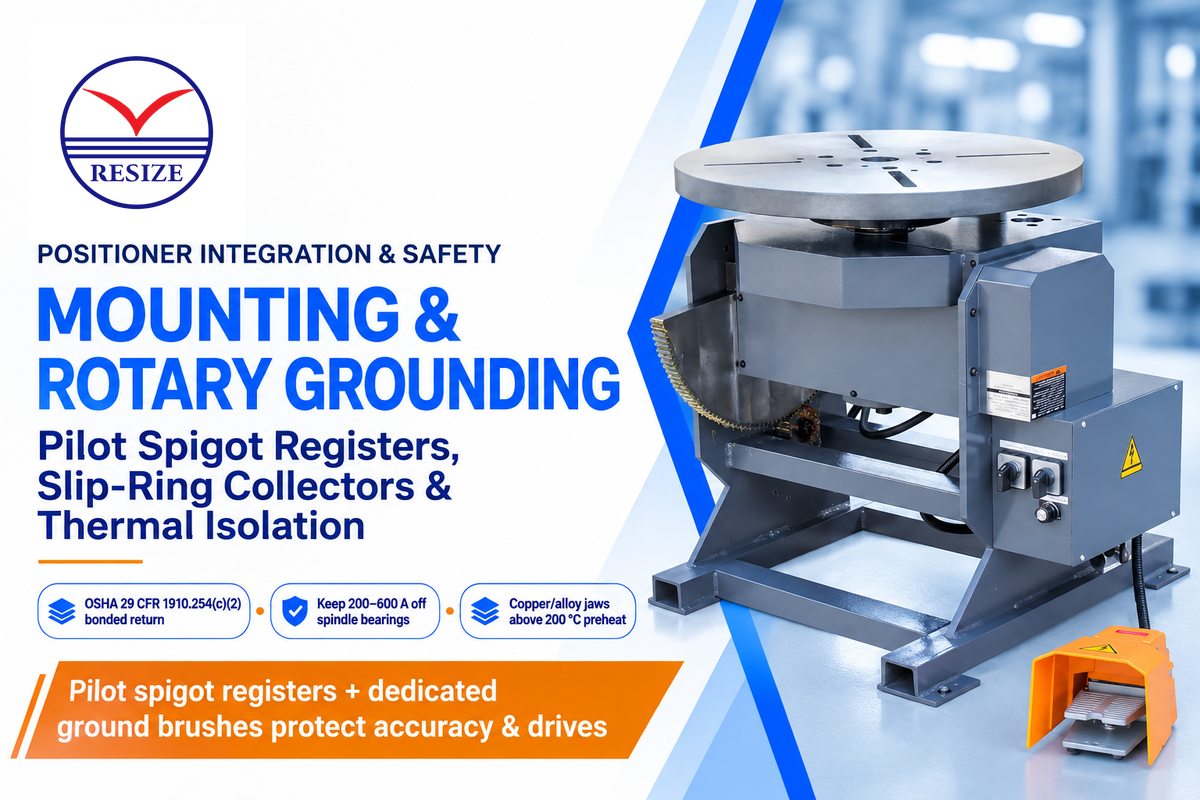
All self-centering welding chucks should be installed onto a rotary positioner using a centered pilot register or bolt-circle adapter plate. Under OSHA 29 CFR 1910.254(c)(2), fixtures regularly used as welding return circuits require bonded joints or adequate current-collecting devices.
Both repeatability and payload capacity are determined by table interface design. Direct bolt-circle mounting seats the chuck body against the table face, decreasing overhang height. When mounting an aftermarket chuck onto slotted rotary welding positioners, treat a steel adapter plate with a concentric locating spigot as a mandatory accessory. Omitting that pilot spigot feature can require operators to tap the chuck true with a dead-blow hammer after reinstallation. Keep the adapter plate as thin as bolt-head clearance allows to avoid increasing the overhung center of gravity (CG) lever arm. Also, make certain the adapter center bore matches the positioner’s hollow spindle so that back-purge gas lines aren’t obstructed.
Electrical grounding is the second non-negotiable integration check. OSHA 29 CFR 1910.254(c)(2)(iii) bans chains, wire ropes, cranes, hoists, and elevators from carrying welding current. Paragraph (c)(2)(iv) requires bonded joints or dedicated current-collecting devices on rotary fixtures. Industrial positioner features therefore include spring-loaded copper brushes or brass slip-ring collectors wired straight to the table shaft. Never clamp the welder ground lead to the stationary base frame and let 200 to 600 A flow through spindle ball bearings.
Practitioner failure reports on the Practical Machinist forum document real damage from missing rotary grounds. One fabricator forgot the return clamp during rotary TIG welding and instantly blew a speed-control transistor. Machinists in the same thread state that stray current can micro-weld ball-bearing contact points and arc strikes can disrupt ungrounded DC speed controllers. Two-piece rotary assemblies also require dedicated grounding on both sides of the weld joint to prevent return current from arcing across joints.
Thermal isolation also protects the chuck scroll during heavy preheat. When welding chrome-moly or thick-wall pressure pipe preheated above 200 °C, radiant and conductive heat migrates through steel jaw faces into the scroll cavity. In that case, use a heat resistant alloy or a copper faced jaw and check grease condition.
Where Self-Centering Welding Chucks Excel: Pipe Spools, Flanges, Shafts, and Automated Cells
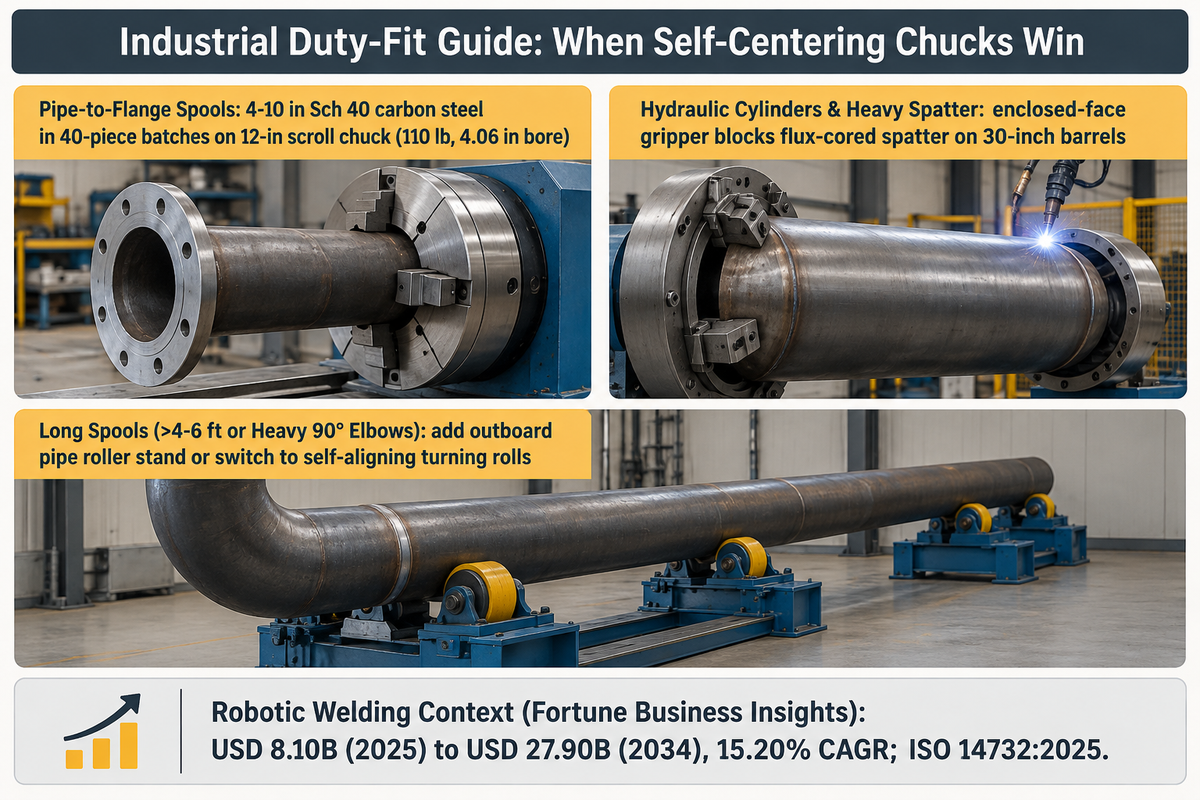
Self-centering welding chucks deliver their biggest payback on short-to-medium cylindrical weldments where repeatable setup speed keeps arc-on time high. The primary applications are pipe-to-flange spools, hydraulic cylinder barrels, pressure-vessel nozzles, hardfacing of shafts, and mechanized rotary TIG/MIG. Once shell length pushes overhung tilt moment past the positioner rating, add an outboard pipe stand or switch to turning rolls.
Growing adoption of mechanized welding cells keeps demand steady for fast, repeatable rotary workholding. Fortune Business Insights valued the global robotic welding market at USD 8.10 billion in 2025. That broader market is projected to climb from USD 9.00 billion in 2026 to USD 27.90 billion by 2034 at a 15.20% CAGR. Those figures track total robotic welding systems rather than standalone chuck sales. Even so, they reflect why shops pair quick-change chucks with ISO 14732:2025 qualified mechanized operators and weld setters.
| Workpiece / Project Type | Recommended Chuck Setup | Outboard Support Trigger | When to Switch Equipment |
|---|---|---|---|
| 1. Pipe-to-Slip-On Flanges (2–12 in) | 12-in 3-jaw scroll chuck, OD grip on pipe | Pipe length >3 ft or tilt moment near limit | Switch to pipe stand + positioner on 6–10 ft spools |
| 2. Weld-Neck Flange Subassemblies | ID expanding reversible jaws inside flange bore | Cantilevered elbow adds eccentric torque | Switch to 4-jaw independent for eccentric tees |
| 3. Hydraulic Cylinder End Caps | 12-in or 16-in heavy scroll chuck on 2-axis table | Barrel length >36 in requires steady rest | Switch to headstock-tailstock rig for 6+ ft barrels |
| 4. Pressure Vessel Nozzles & Collars | Enclosed-face gripper (Pandjiris / Preston Eastin) | Submerged-arc flux weight + heavy nozzle neck | Switch to turning rolls for complete vessel shells |
| 5. Hardfacing Shafts & Roll Journals | Through-bore scroll chuck + brass/copper jaws | Shaft overhang >4× diameter | Add tailstock live center to stop droop |
| 6. Sanitary Thin-Wall Stainless Tubes | 3-jaw chuck with wrap-around pie jaws + purge plug | Light tube; support every 4–5 ft against sag | Switch to 6-point pendulum chuck or orbital head |
| 7. Robotic MIG/TIG Circumferential Cells | Servo-indexed positioner + quick-lock 3-jaw chuck | Dial-verified seam runout exceeds torch tolerance | Add laser seam tracking or pneumatic collet fixture |
| 8. Heavy Ring & Bearing Housing Cladding | 16-in to 20-in heavy scroll or C-series gripper | Short axial length usually needs no tailstock | Verify table rotation torque on flat 1G cladding |
| 9. Long Boiler & Tank Shells (>8 ft) | Not ideal for single-end chuck cantilever | Mandatory dual-point shell support | Switch to self-aligning welding rotators |
Consider three concrete shop applications. First, suppose a pipe spool shop welds 4-inch to 10-inch Schedule 40 carbon-steel slip-on flanges in 40-piece batches. A 12-inch scroll chuck (110 lb, 4.06 in bore) mounted on a tilted table clamps each spool in one turn. The welder then runs a full 360° bead in the flat 1G position without stopping. Second, suppose a hydraulic cylinder builder welds thick end caps onto 30-inch barrels using flux-cored wire. An enclosed-face gripper chuck blocks spatter from fouling the clamping screw while holding concentricity across repetitive high-quality circumferential passes. Third, suppose a precision robotic TIG cell runs 200 stainless manifold collars per week. Following The Fabricator’s positioner guidance, steady rotation speed and repeatable torch angle hold bead width constant once best- and worst-tolerance collars pass dial-indicator runout.
When spools exceed 4 to 6 ft or carry heavy 90° elbows, pair your chuck with a dedicated pipe welding positioner configuration using a height-adjustable roller stand. When cylindrical shells reach multi-ton tank or boiler lengths, move entirely off cantilevered chucks, and use welding rotators for long cylindrical shells instead.
Maintenance, Spatter Control, and Troubleshooting Jaw Binding or Centering Drift
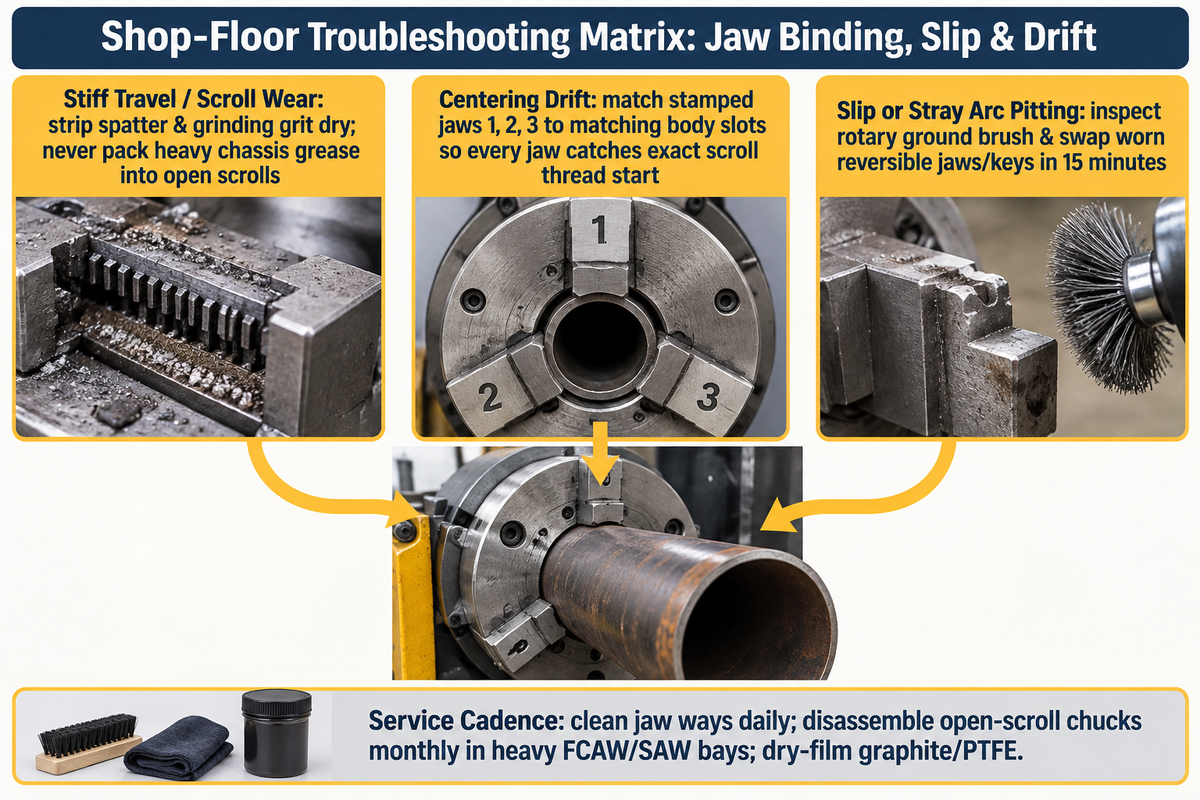
Most jaw binding and centering drift can be traced to four shop causes. Weld spatter jams open jaw ways, sticky grease traps abrasive grinding dust, numbered jaws go in out of sequence, or stray current pits internal teeth. Never pack heavy grease into a jammed scroll; tear down the chuck, strip debris dry, and check tooth geometry first.
| Observed Symptom | Primary Root Cause | Corrective Action | Replace Criteria |
|---|---|---|---|
| Stiff or seized jaw travel | Slag, flux, or spatter packed inside open jaw guides; wet grease grinding paste | Remove jaws, blow dry with air, solvent-wash scroll, apply dry graphite or PTFE lube | Chipped scroll spiral rib or galled master-jaw slot |
| Sudden 2–5 mm runout jump after jaw flip | Jaws 1, 2, and 3 installed in wrong slots or started one spiral thread off | Remove all three jaws; feed jaw #1, then #2, then #3 strictly in numerical sequence | None if caught immediately before tightening under load |
| Workpiece slips during 90° tilt | Worn smooth serrations, loose lock lever, or pipe weight exceeds grip force | Replace top jaw inserts, inspect ball-lock pins, verify torque wrench tightening | Cracked jaw carrier or sheared pinion square drive |
| Rough ratchet feel when turning pinion | Arc-pitted pinion gear or scroll back from missing rotary ground return | Repair positioner ground brush immediately; inspect bevel pinion teeth | Deep electrical pitting across scroll face requires chuck replacement |
| Gradual repeatability drift on one pipe size | Localized scroll tooth wear in the shop’s highest-volume diameter band | Verify with two-location dial check on test bar; test an alternate diameter band | TIR exceeds weld-procedure tolerance after cleaning & new jaws |
Grinding grit inside the scroll can wear it irregularly and cause scroll teeth to bind inside the cast housing. Pumping heavy chassis grease into an open welding chuck traps angle-grinder grit and submerged-arc flux in an abrasive lapping compound that wears down the scroll plate in months. Always wipe exposed slides dry and use dry-film graphite or molybdenum disulfide lubricant in high-spatter bays. When reversing jaws for internal clamping, match stamped numbers 1, 2, and 3 to their matching body slots so every jaw catches the exact start of the scroll thread.
Can a Self-Centering Welding Chuck Be Repaired When Repeatability Drifts?
Yes, if the drift is caused by spatter build-up, worn reversible top jaws, a rounded pinion key, or loose bolts. However, if the internal scroll plate wears irregularly, or the housing breaks, full chuck replacement is safer and more economical.
Because scroll teeth are precision-matched to the master-jaw pitch, re-machining a worn scroll costs more than buying a replacement industrial unit in the 8-inch to 16-inch size class. For what’s generally considered the small 8-inch to 16-inch size class scrolls, an aftermarket replacement is often the better financial alternative. To keep maintenance cost-effective, stock one spare set of reversible jaws and spare pinion keys per shift so maintenance crews can swap wear parts in 15 minutes instead of scrapping a whole shift.
12-Inch to 20-Inch Self-Centering Welding Chuck Pricing, Lead Times, and Total Installed Cost
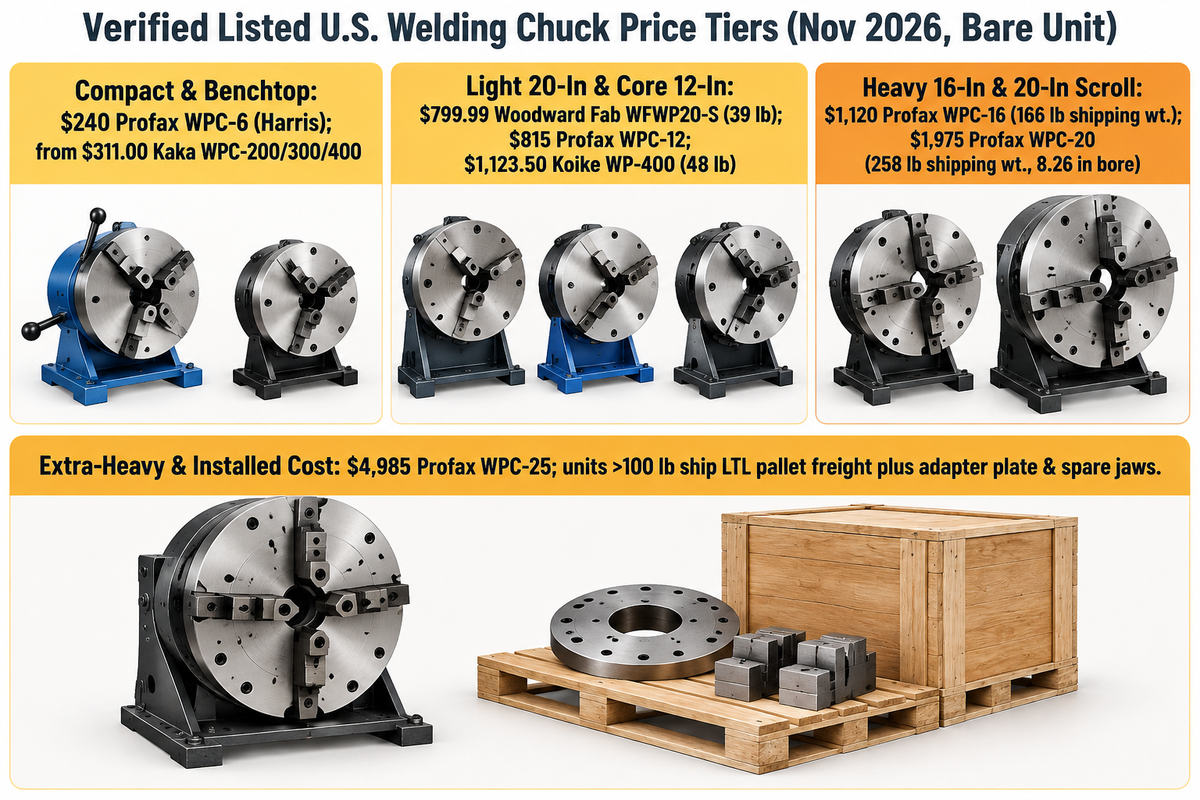
Listed U.S. online prices for standalone welding chucks span $240 (Profax WPC-6) to $4,985 (Profax WPC-25) at Harris Welding Supplies in November 2026. Core 12-inch to 20-inch light-duty and industrial models list between $799.99 and $1,975 for the bare chuck unit before adapter plates, specialty jaws, and freight.
Buyers often get tripped up looking through online catalog listings showing precision multi-jaw CNC machining lathe chucks beside entry-level utility positioner chucks. Precision high RPM metal cutting chucks can cost more because they’re ground for lathe turning, rather than arc-welding bays. Within dedicated welding workholding, listed online product prices separate cleanly by structural weight, jaw-closing hardware, and freight class:
| Duty Tier & Model | Size / Weight | Listed Online Price | Published Source & Scope |
|---|---|---|---|
| Compact Utility, Profax WPC-6 | 6 in class | $240 ($295 list) | Listed at Harris Welding Supplies (Nov 2026), chuck only |
| Entry Benchtop, Kaka Industrial WPC-200/300/400 | 200–400 mm class | From $311.00 | Listed on Kaka Industrial (Nov 2026); units >100 lb ship LTL freight |
| Light-Duty 20-In, Woodward Fab WFWP20-S | 20 in / 39 lb | $799.99 | Listed on Woodward Fab (Nov 2026); light benchtop scroll |
| Industrial 12-In, Profax WPC-12 | 12 in class | $815 ($835 list) | Listed at Harris Welding Supplies (Nov 2026), chuck only |
| OEM Enclosed Benchtop, Koike WP-400 | WP-400 / 48 lb | $1,123.50 | Listed on Koike Aronson (Nov 2026), SKU W0300310 |
| Industrial 16-In, Profax WPC-16 | 15.75 in / 166 lb shipping wt. | $1,120 ($1,280 list) | Listed at Harris Welding Supplies (Nov 2026), 5.70 in bore |
| Heavy 20-In, Profax WPC-20 | 19.625 in / 258 lb shipping wt. | $1,975 ($2,255 list) | Listed at Harris Welding Supplies (Nov 2026), 8.26 in bore |
| Extra-Heavy 25-In, Profax WPC-25 | 25 in class | $4,985 ($5,315 list) | Listed at Harris Welding Supplies (Nov 2026), chuck only |
| Heavy Grippers & OEM Packages | 140–770 lb / up to 68 in | RFQ required | Pandjiris, Preston Eastin, LJ Welding, RESIZE custom quotes |
The total installed cost is always greater than the catalog sticker price. Budget for three integration items upfront: a machined steel adapter plate with pilot spigot, spare reversible or copper/brass top jaws, and LTL pallet freight. As Kaka Industrial mentions on their listings, chucks above 100 lb ship via LTL freight and require a forklift or lift-gate at delivery. For short shutdown contracts or one-off turnarounds, suppliers like LJ Welding offer a practical rental option. Shops can rent a weld positioner 3-jaw self-centering scroll package instead of tying up capital.
Evaluating Industrial Self-Centering Welding Chuck Manufacturers and RFQ Specification Checklist
Industrial buyers have two procurement paths: ordering a direct-mounted OEM chuck bundled with a welding positioner, or sourcing a standalone aftermarket chuck and a custom adapter plate. Bundled OEM packages can avoid bolt-circle surprises and may include factory centering. Standalone aftermarket chucks offer fast replacement for existing shop tables.
In the catalogs published by established welding chuck brands, each covers a distinct weight and diameter tier for industrial product lines:
| Manufacturer | Published Chuck Series | Weight / Capacity Scope | Key Catalog Distinction |
|---|---|---|---|
| Pandjiris | Quickset Grippers (J-15 to C-60) | 250 lb @ 1 in to 7,500 lb @ 5 in (up to 68 in) | Enclosed face, 3 ball-lock pins, over-torque safety |
| Preston Eastin | PC-20A–PC-60C Grippers & Spin Lock | 1,000–7,500 lb @ 5 in; 140–770 lb deadweight | 50 RPM max on Spin Lock; free mounting with positioner |
| Koike Aronson | WP-200, WP-300, WP-400 | WP-400: 48 lb, 3.5–12.2 in OD / 6.5–15 in ID | Open-center enclosed faceplate for benchtop tables |
| LJ Welding Automation | 8C, 12C, 16C, 20C Scroll Chucks | 39–320 lb; 2.17–7.48 in bore; up to 18.7 in OD | Available for purchase or short-term project rent |
| Profax, Woodward Fab & Kaka Industrial | WPC-6–WPC-25, WFWP20-S, WPC-200–400 | 39 lb benchtop to 258 lb heavy 20-in scroll | Published U.S. distributor pricing for standalone retrofits |
| RESIZE (Wuxi Yuanpeng Machinery Equipment Factory) | industrial self-centering welding chucks | Scroll, spin-lock, and heavy gripper configurations | Direct-matched to RESIZE rotary, 2-axis, pipe, and head-tailstock positioners |
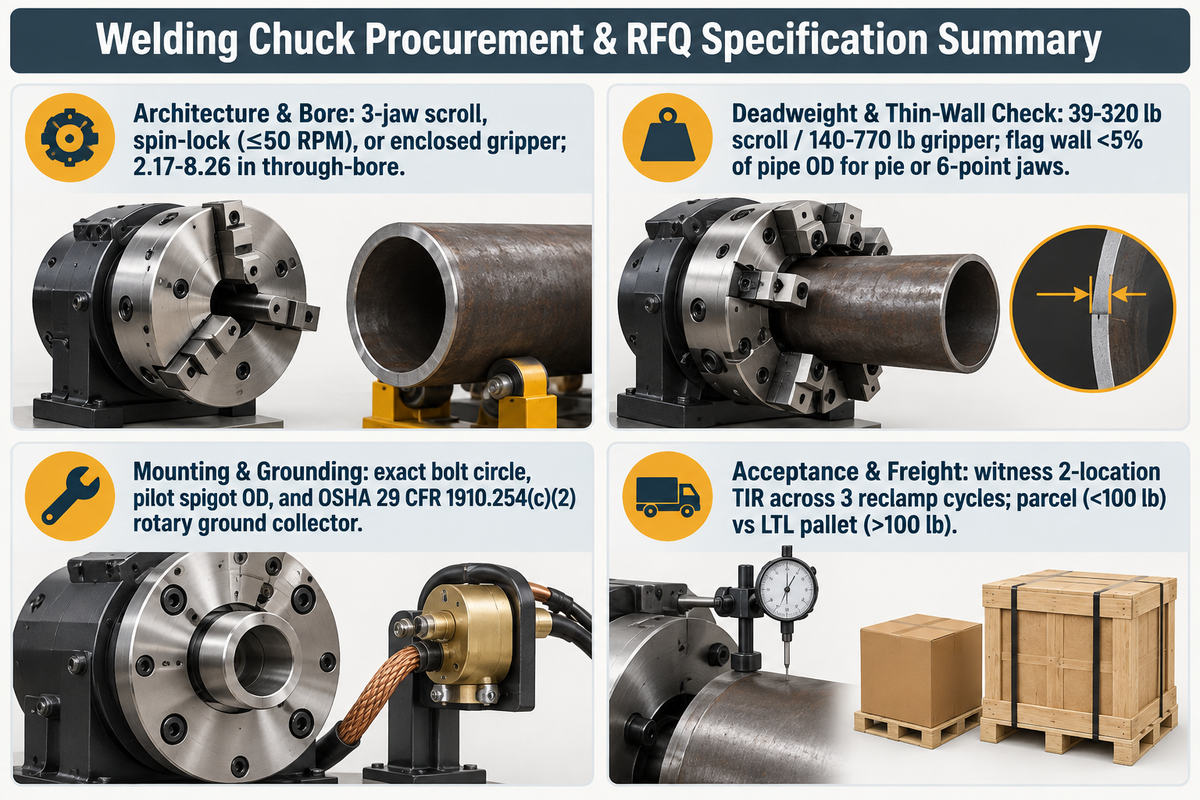
Send the 10-line RFQ table below whether you purchase a stand-alone positioner 3-jaw self-centering scroll chuck or a turnkey rotary table and similar equipment. Once your exact pipe envelopes, adapter flanges, and ground amperage are received, quotes will be submitted.
RFQ checklist — copy these 10 specifications into your quote request:
| Parameter | Starting spec / range | Why it matters | How to verify |
|---|---|---|---|
| Chuck architecture | 3-jaw scroll, spin-lock (50 RPM maximum recommended on Preston Eastin Spin Lock models), or enclosed gripper | Matches changeover speed, clamping torque, and flux/spatter exposure | Confirm actuation drawing and faceplate seal design on vendor quote |
| Actual OD & ID grip range | Min/max pipe OD & bore (e.g., 3.5–12.2 in OD / 6.5–15 in ID) | Nominal body size does not equal usable jaw clamping stroke | Check published hard-jaw & reversed-jaw travel table |
| Center through-bore | 2.17–8.26 in (matched to max shaft & purge hose) | Allows rear pipe pass-through and internal argon purge lines | Compare chuck bore against positioner hollow-spindle ID |
| Chuck deadweight & height | 39–320 lb (scroll) or 140–770 lb (heavy gripper) | Deadweight & jaw-face offset consume positioner tilt torque | Run combined chuck + pipe CG calculation at 90° tilt |
| Workpiece wall thickness | Flag wall <5% of pipe OD for thin-wall tooling | Prevents 3-point elastic lobing on stainless or thin-gauge rings | Specify wrap-around pie jaws, internal plug, or 6-point jaws |
| Jaw material & spares | Reversible steel, weldable SAE 1018, or brass/copper | Prevents carbon contamination on stainless & allows fast wear swaps | Include 1 extra reversible jaw set & spare pinion key in PO |
| Positioner mounting interface | Exact bolt circle, T-slot spacing, & pilot spigot OD | Avoids manual hammer-truing and thick overhang adapters | Request machined adapter drawing or factory-centered mounting |
| Rotary ground return rating | Match max weld amperage (bonded brush / slip ring) | Stops stray current from pitting bearings & blowing drive controls | Confirm dedicated collector per OSHA 29 CFR 1910.254(c)(2) |
| Runout & acceptance test | Two-location dial check across 3 reclamp cycles | Verifies actual seam wobble on worst-tolerance production pipe | Witness near-jaw and weld-plane TIR test before final sign-off |
| Freight & delivery terms | Parcel (<100 lb) vs LTL pallet (>100 lb) + lead time | Heavy 16–25 in chucks require dock forklift or lift-gate delivery | Confirm crated shipping weight, Incoterms, and spare availability |
Need a Matched Welding Chuck and Rotary Positioner Package?
Send your pipe OD, wall thickness, maximum spool length and the existing table bolt circle for a combined CG torque check and direct-mount chuck quote.
Frequently Asked Questions About Self-Centering Welding Chucks
Which chuck is self-centering for welding positioners?
A 3-jaw scroll welding chuck or quick-lock 3-jaw welding gripper is self-centering on rotary welding positioners. Turning a bevel pinion key or hand-spun cam ring moves all three jaws radially at equal distances from the center axis.
That synchronized travel clamps round pipe, couplings, flanges, and hexagonal bar stock rapidly without dialing each jaw separately between repeat weld cycles.
Is a 4-jaw chuck better than a 3-jaw chuck for pipe welding?
A 3-jaw self-centering welding chuck is quicker and better for pipe batches that are round and concentric, whereas a 4-jaw independent chuck is better for out-of-round, eccentric, and square parts. Each jaw on an independent 4-jaw chuck adjusts on its own screw, allowing a welder to dial a misaligned weld bevel true with an indicator.
However, repeating that four-screw setup on every piece slows batch pipe spool production dramatically compared to single-turn 3-jaw clamping.
What self-centering welding chuck sizes fit common pipe diameters?
Always match your pipe OD and ID against published jaw-travel charts rather than nominal chuck diameter.
As published reference points, an 8-inch LJ Welding 8C grips up to 7.95 in OD (2.17 in bore), and a 12-inch 12C grips up to 11.8 in OD (4.06 in bore). A 16-inch 16C handles up to 15.0 in OD, while a 20-inch 20C grips up to 18.7 in OD (7.48 in bore). Enclosed grippers extend up to 68 in.
Can a self-centering welding chuck be removed and swapped between positioners?
Yes, as long as both positioner tables have the same bolt circle pattern or a machined adapter plate with a centering pilot spigot. Always re-indicate the chuck outer rim after removing it from one positioner table and reinstalling it on the other to eliminate flange mounting eccentricity.
Do welding positioner chucks require special grounding for high-amperage welding?
Yes. High-amperage rotary welding requires a dedicated rotary ground brush or a brass slip ring collector wired directly to the rotating spindle or workpiece table.
Under OSHA 29 CFR 1910.254(c)(2)(iv), fixtures regularly used as welding return circuits must have bonded joints or adequate current-collecting devices. Paragraph (c)(2)(iii) also bans routing return current through chains, hoists, or cranes. When the work lead is clamped to the stationary positioner frame, welding amperage is forced through spindle ball bearings and chuck scroll teeth. Shop-floor reports confirm stray current micro-welds bearing raceways and blows variable-speed drive transistors, especially during high-frequency TIG starts. Always inspect copper ground brushes regularly and ground both sides of two-piece rotary assemblies.
How often should a shop clean and lubricate a scroll welding chuck?
Jaw ways should be cleaned daily, and open-scroll chucks should be disassembled monthly in heavy flux-cored or submerged-arc bays. Apply dry-film graphite or PTFE lubricant in place of sticky grease.
About This Guide
Wuxi Yuanpeng Machinery Equipment Factory (RESIZE) manufactures self-centering welding chucks, rotary welding positioners, and turning rolls for industrial pipe and vessel shops. Standards, OEM weight specs, and pipe calculations in this guide cross-reference ISO, OSHA, ASME B36.10M, and published manufacturer catalogs. The guide was reviewed by the Wuxi Yuanpeng Machinery Equipment Factory technical team.
Referenzen und Quellen
- 29 CFR 1910.254: Arc Welding and Cutting, Installation and Work-Return Grounding Occupational Safety and Health Administration (OSHA)
- ISO 3089:2005 (Confirmed 2025): Machine Tools, Test Conditions for Self-Centring, Manually Operated Chucks with One-Piece Jaws International Organization for Standardization (ISO)
- ISO 14732:2025: Welding Personnel, Qualification Testing of Welding Operators and Weld Setters for Mechanized and Automatic Welding International Organization for Standardization (ISO)
- US Patent US6220608B1: Four-Jaw Dual Cam-Plate Self-Centering Chucking System USPTO / Google Patents
- Considerations for Your First Welding Robot (Welding Digest, October 2025, Adam White CWI/CRAW-T) American Welding Society (AWS)
- Manufacturing Processes: Unit 3, Three-Jaw Universal and Four-Jaw Independent Chucks Open Oregon Educational Resources
- Introductory Machining: Dial-Indicator Two-Location Runout Inspection Procedure Open Washington (OpenWA)
- Deformation Control to Increase Accuracy of Thin-Walled Workpieces Institute of Production Engineering and Machine Tools (IFW), Leibniz University Hannover
- Tooling & Workholding: Low-Deformation Workpiece Clamping (6-Point vs 3-Point Roundness) Gear Solutions
- No-Squeeze Workholding: Managing Thin-Wall Springback in 3-Jaw Chucks American Machinist
- 5 Things Welders Need to Know About Weld Positioners Der Hersteller
- Innovative Weld Positioning Boosts Throughput at Team Industries (2+2 Paired Chucks) Der Hersteller
- ASME B36.10M-2018 Table 2.1: Welded and Seamless Wrought Steel Pipe Weights and Dimensions Flange Bolt Chart Engineering Reference
- Global Robotic Welding Market Size, Share & Growth Forecast (2025–2034) Fortune Business Insights