When it comes to welding equipment, the name Lincoln Electric is synonymous with quality, innovation, and reliability. For professional welders, manufacturing specialists, or hobbyists undertaking various metalworking projects, Lincoln Electric welders offer numerous solutions tailored to their needs and abilities. This comprehensive guide aims to help you make an informed decision by highlighting some of the key features, benefits, and applications of Lincoln welders currently available for sale. From MIG and TIG welders, which set standards in the industry, to multi-process ones, valuable insights are shared along with considerations for making the right choice for your purpose. Take a virtual tour with us through other varieties of welding machines by Lincoln Electric, which not only demystify their catalogues but also present reasons as to why they remain top choices of welders all over the globe.
Types of Lincoln Welders

Since welding machines are varied to suit different requirements or applications across industries by Lincoln Electric, they are commonly divided into the following:
米格焊工
These welders are high-speed welders that require a short amount of time for welding; hence, they are all user-friendly and generally operate on thin to medium-thickness metals, such as steel and aluminum.
TIG 焊接機
For welds that require more precision, TIG welding is used on stainless steel and non-ferrous metals. They make clean welds with minimum spatter.
焊條焊工
Stick welders are popular for their reliability and can be applied in various environments, where they also excel in welding thicker materials.
Multi-Process Welders
Machines that come with several welding functions (MIG, TIG, Stick) packed into a single-unit solution make them the most valuable and adaptable varieties, allowing users to avoid dealing with multiple devices for various applications.
Engine-Driven Welders
Designed with remote or outdoor projects in mind, these welders ensure reliable performance without the need for an external power source, filling the gap for fieldwork.
Every type is designed to provide optimal performance for specific welding tasks, offering a solution for any level of complexity and expertise.
米格焊工
MIG welding remains a welding process that needs precision and efficiency for almost any welding task. A Metal Inert Gas (MIG) machine produces welds by forming an electric arc between a consumable wire electrode and the workpiece, effectively melting both to create a solid join. From Argon to Carbon Dioxide or their mixtures, these gases are passed to shield the weld pool from atmospheric contamination, guaranteeing impeccably clean welds.
MIG welders are among the most versatile welding equipment and thus find great use in welding mild steel, stainless steel, and aluminum. Because these welders enable welders to produce consistent and high-quality welds quickly, they are highly valued in the automotive repair, construction, and manufacturing industries. Furthermore, modern MIG welders are equipped with advanced techniques, such as synergic controls and pulse modes, for finely controlled welding of various materials and joint geometries. Their unprecedented combination of speed, ease, and versatility makes MIG welding highly useful in both professional and hobby welding applications.
TIG 焊接機
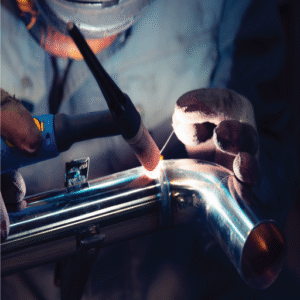
TIG (Tungsten Inert Gas) welding is an advanced and versatile welding process primarily used for welding thin sections of stainless steel, aluminum, and other non-ferrous metals. This welding process utilizes a non-consumable tungsten electrode to form the weld. At the same time, an inert shielding gas, such as argon, is used to protect the cooled weld area from oxidation and contamination. TIG welders offer encouraging options in terms of weld quality, as the operator can fine-tune parameters such as amperage and shielding gas flow, thereby allowing for intricate and clean welds. Although it requires a high level of skill and is slower than other welds, its use is ideal for applications where aesthetics and ultimate gear precision are demanded by the aerospace, automotive, and arts fabrication industries.
焊條焊工
Stick welding is commonly referred to as Shielded Metal Arc Welding (SMAW). The electric current causes the flux-coated consumable electrode to arc against the surface of the metals, joining them. This arc heating melts both the electrode and the base metal; upon solidification, they forge a strong joint. During welding, the flux coating turns to vapor that shields the molten metal weld pool from contamination by the atmosphere.
They fall into the category of highly useful and are used in outdoor, heavy-duty applications where they are exposed to adverse conditions, such as wind, rain, and rust. The procedure is commonly used in the construction industry, shipbuilding, and pipeline maintenance industries. Although it creates spatter, which requires cleaning, this process offers low equipment costs and great portability, allowing workers to weld a wide variety of materials, including steel, cast iron, and aluminum. It is used by many professionals when precision is merely secondary and structural strength is paramount.
Key Features of Lincoln Welding Machines

- Durability and Reliability: Lincoln welding machines are constructed of tough materials to withstand wear and tear presented by demanding job site environments.
- Control Advanced Options: This feature provides precision controls that enable operators to adjust settings for various welding processes, including MIG, TIG, and Stick welding.
- 能源效率: Lincoln features exist in many welding machines, where energy-saving inverter technology helps to reduce consumption while maintaining a consistent output quality.
- Use Industries: These machines are suitable for a variety of materials and thicknesses, making them ideal for automotive, fabrication, and heavy manufacturing applications.
- 便攜性: These features offer compact and lightweight options for easy transportation and use, whether in workshops or on-site.
Amperage and Voltage Specifications
Lincoln welding machines are designed for precise and dependable performance in a wide range of welding tasks. The amperage and voltage range offered by a particular unit differ depending on the model and the application. Standard Lincoln arc-welding machines, for instance, typically provide an amperage range of 30A to 500A, sufficient for welding applications ranging from light to fairly heavy. Voltage settings vary from 10V to 40V in many applications, depending on the kind of power source and the thickness of materials.
Other models with adjustable output controls allow operators to make adjustments for maximum efficiency and weld quality. Powerful industrial-grade machines can provide up to 800A for heavy applications, such as shipbuilding or structural fabrication. Additionally, inverter-based Lincoln machines typically support both single-phase and three-phase inputs, providing greater flexibility in terms of voltage compatibility while maintaining high energy efficiency. These detailed specifications highlight the versatility and adaptability of Lincoln welding machines for professional and industrial welding applications.
Engine-Driven vs. Electric Welders
Engine-driven welders offer portability and independence from external power sources, while electric welders provide consistent performance for stationary use with access to an electrical connection.
Durability and Portability
Lincoln welding machines are known for robust durability and versatile portability. This makes them highly dependable in different working environments. These machines are made from rugged components and high-quality materials to protect them from harsh job conditions, many of which involve extreme temperatures, dust, and impact. Many models feature protective enclosures or reinforced frames to ensure they can withstand longer, even with increased usage.
When it comes to portability, Lincoln offers a full range of welding machines to meet all specifications. Engine-driven ones tend to be highly portable, especially to remote sites where electricity is scarce, as they also serve as generators of power. Conversely, electric ones are generally not geared for high portability, given their reliance on power sources, but are an option for those seeking something very compact and lightweight for a workshop application. This delicate yet balanced harmony of ruggedness and portability makes Lincoln welding machines a favorite among both field welders and shop-floor welders.
Advantages of Using Lincoln Welders

🛡️ Exceptional Durability
Lincoln welders are built using high-grade materials, which ensure the greatest longevity even in extreme industrial environments.
⚡ Advanced Technology Integration
Featuring state-of-the-art advances such as accurate arc control, digital display, and multi-process capabilities, these welding machines present a newer way of doing things more efficiently.
🔧 Versatility
Able to tackle several types of welding, Lincoln welders offer production-side allowance to application-side tectonics-for-MIG, for-TIG, stick, and flux-cored welding.
💡 Energy Efficiency
Most models feature an ingenious design that optimizes power consumption to reduce utility costs while maintaining superb performance.
🤝 Unparalleled Support and Warranty
The Electric Lincoln now offers comprehensive customer support, training resources, and robust warranties to ensure user trust and satisfaction.
Efficiency in Various Welding Scenarios
Since Lincoln welders possess a high level of situational adaptability in welding, they excel in various welding scenarios due to their robust build, reliability, and precision. In industrial applications, one practically needs a high-duty cycle to guarantee performance over long operational periods that require minimal downtime. On construction projects, their ruggedness and portability enable the welder to be utilized efficiently on-site and in demanding working environments. For more minor repair work and automotive tasks, a certain level of precision and control is required to ensure that detailed welding can be carried out on thinner materials. This is what makes Lincoln welders such an adaptable tool for a wide variety of welding applications.
Ease of Use for Different Skill Levels
Lincoln welders are designed to be equally attractive to and usable by both amateur and experienced welders. Many models come with intuitive controls, preset settings, and an easy-to-understand manual for training, enabling simple teaching of beginners on how to operate them. A more experienced welder could utilize these settings through customization and fine adjustments, which are hallmarks of a professional operation. Training materials and support would have definitely complemented the process throughout to ensure that every welder, irrespective of their skill level, operates the gear sufficiently. With a Fine balance maintained between ease and functionality, Lincoln welders are positioned to be used for the entire spectrum of users.
Versatility Across Industries
Combining technology innovation with dependable performance, Lincoln welders have been designed to meet the varied requirements of many industries. In the construction sector, it is used for structural welding, repairs of heavy machinery, and fabrication of strong frameworks. Automotive welding with Lincoln welders helps in spot welding during vehicle assembly, custom work, and repair processes. These welders are equally great for the shipbuilding industry, aiding in laying down, welding, and inching massive sea vessels while retaining their strength and integrity even in adverse conditions. In addition, the energy sector, including the oil and gas and renewable energy industries, utilizes Lincoln welders for piping work, equipment fabrication, and infrastructure maintenance. In essence, these welders are suitable for even the most complex artistic welding and minor repair jobs, serving as a standard tool for both larger industrial projects and smaller, specialized jobs. Lincoln welders are at the forefront of all-welding technologies, combining advanced features with consistently reliable performance to support a wide range of industries effectively and efficiently.
Choosing the Right Lincoln Welder

When selecting the right Lincoln welder, the first factor to consider is application-based. What do you weld? Are you welding steel, aluminum, or stainless? Consider that a welder excels at specific jobs more than others. What process do you use? Lincoln has models for MIG, TIG, Stick, and multi-process welders. Consider the power and duty cycle, depending on whether the application requires light-duty or industrial work. Also, consider portability and ease of use much more if you are working on a site or DIY-type project. By correlating practicality and needs with the product, Lincoln will have a versatile range that serves as the best advocacy for any welding application.
Assessing Your Welding Needs
Before choosing welding equipment, be clear about the materials you’ll be working with and their thickness. This determines what welding process will be used: MIG for thin materials, TIG for precision work, or Stick welding for heavy-duty applications. Next, consider the power source you can use, as welders may require a 220-volt connection, while others can operate from a standard 110-volt outlet.
Analyze how often you will be welding and for how long to ensure you get a welder with an appropriate duty cycle that can provide consistent performance without overheating. Lastly, in cases where portability is an issue, go for lighter and smaller units.
When all these factors are aligned with your project’s needs, you can be assured of consistent welding results.
Understanding Equipment Specifications
Being durable, high-performing, innovative, and catering to diversified welding needs in different industries, Lincoln welding machines enjoy the reputation of being top machines. To compare the equipment specifications of such machines, key features to consider include input power, output range, duty cycle, and process compatibility. Lincoln welders can be purchased with either 110 V or 220 V input selections, allowing them to adjust to the available power.
Output-wise, some models can operate as low as 30A for fine work, while others can reach up to 500A for industrial applications. The duty cycle is also a crucial factor, as it determines how long the machine can operate continuously at its rated output for 10 minutes without overheating. When other machines operate at a lower duty cycle, Lincoln Power MIG machines boast a higher one, making them well-suited for environments where productivity is a priority.
Furthermore, Lincoln machines employ various welding processes, including MIG, TIG, stick, and flux-cored welding. Settings adjustments, advanced arc control technologies, and optional portability are features that confer additional versatility, and these features are found within industries such as the Lincoln Ranger series. For professional users, a built-in digital display and preset memories deliver applications with utmost precision and speed. Matching and evaluating these features against the project’s requirements will enable maximum output in the field or shop, yielding satisfactory results.
Comparing Used Lincoln Welders vs. New Models
When comparing used Lincoln welders to new models, the key factors to consider include cost, warranty, technology, durability, and maintenance.
林肯焊工的應用

【工業製造】
林肯焊工廣泛應用於重工業,用於製造機械、結構部件和高強度框架。.
【汽車維修製造】
汽車車間使用的焊工用於車架焊接、排氣焊接和客製化改裝。.
#管道安裝和維護
管道焊接的基礎是為石油和天然氣等各個行業提供強度和長期耐用性。.
魏爾倫造船
用於組裝和修理需要精度和強度的船舶。.
* 一般金屬製品
焊工非常適合從事金屬製造專案(例如製作家具和設計藝術雕塑)的愛好者和專業人士。.
汽車工業
林肯電焊機是汽車世界不可或缺的一部分,提供滿足車輛製造和維修嚴格要求的解決方案。這些焊工因其可靠性、精度和適應性而備受推崇,這使得他們能夠適應鋁、鋼或各種其他合金上的焊接。林肯焊工配備了基於逆變器的電源和協同控制系統等現代技術,能夠生產幾乎無缺陷的焊接,具有汽車零件的結構完整性和所需的性能。.
這培養了車間林肯焊工修復和維護複雜操作的能力,例如焊接車身面板更換、框架維修和焊接排氣系統。人體工學設計和用戶友好的介面提高了工作效率和焊接精度,從而減少了車間停機時間。因此,從製造商和服務提供者的角度來看,林肯電氣仍然是追求卓越的行業的首選。.
建設項目
林肯焊工在建築業尤其重要,它為各種工作提供可靠的解決方案,包括鋼結構焊接、管道連接和重型設備維修。它們具有良好的耐用性和焊接質量,可用於多種材料,使其成為工業必需品。它們專為在惡劣環境中使用而設計,在計算施工現場時可以可靠地工作。這提高了施工過程的效率和安全性。.
製造和維修
在製造方面,林肯焊接機在製造和維修工作中提供精密焊接和可靠性。它們能夠支援所有主要焊接工藝,包括 MIG 焊接、TIG 焊接和棒焊。林肯焊工專為高端製造而設計,還具有可變的焊工電壓和電流調整功能,允許操作員根據加工材料的類型(例如碳鋼、不銹鋼或鋁)來設定機器。它們的靈活性使它們對於製造具有嚴格公差的複雜結構和部件是不可或缺的。.
對於維修工作,林肯焊工可以處理輕微和重大的修復。由於其重型設計和穩定的電弧性能,它們只需修復設備的磨損表面或使受損的關鍵資產得以擴展。這些焊工採用了最先進的技術,例如數位顯示器和協同控制,透過減少安裝時間和簡化焊接參數的包含來幫助提高操作員的生產力。無論是在製造車間還是在崎嶇的現場使用,林肯焊工都能提供堅固且一致的性能,使其成為建築和製造業中不可或缺的一部分。.
常見問題(常見問題)
參考來源
- 林肯電氣官方網站
林肯電氣的官方網站提供有關其焊接機、配件和其他產品的全面資訊。. - 林肯電氣公司的焊接設備
林肯電氣網站的這一部分特別關注其焊接設備,包括各種類型的焊工,如 MIG、TIG 和多用途機器。. - Cyberweld 是林肯電氣設備公司
Cyberweld 提供一系列林肯電氣焊接機和配件,以及詳細的產品描述和規格。. - Amazon 借助 Lincoln Power MIG 140MP 多製程焊機
亞馬遜為林肯電氣焊工提供用戶評論、產品詳細資訊和評級,這可以幫助衡量客戶滿意度和可用性。. - 焊工銷售指南
準備好選擇您的林肯焊工了嗎?
無論您是專業焊工還是愛好者,林肯電氣都能為您的需求提供完美的焊接解決方案。探索他們的全面焊工範圍,找到適合您專案的理想選擇。.