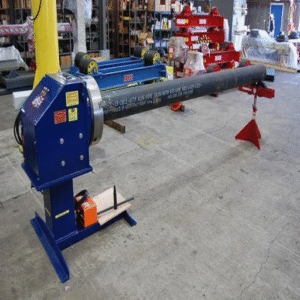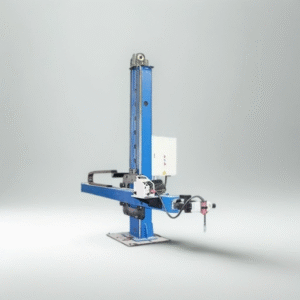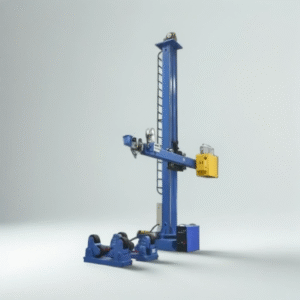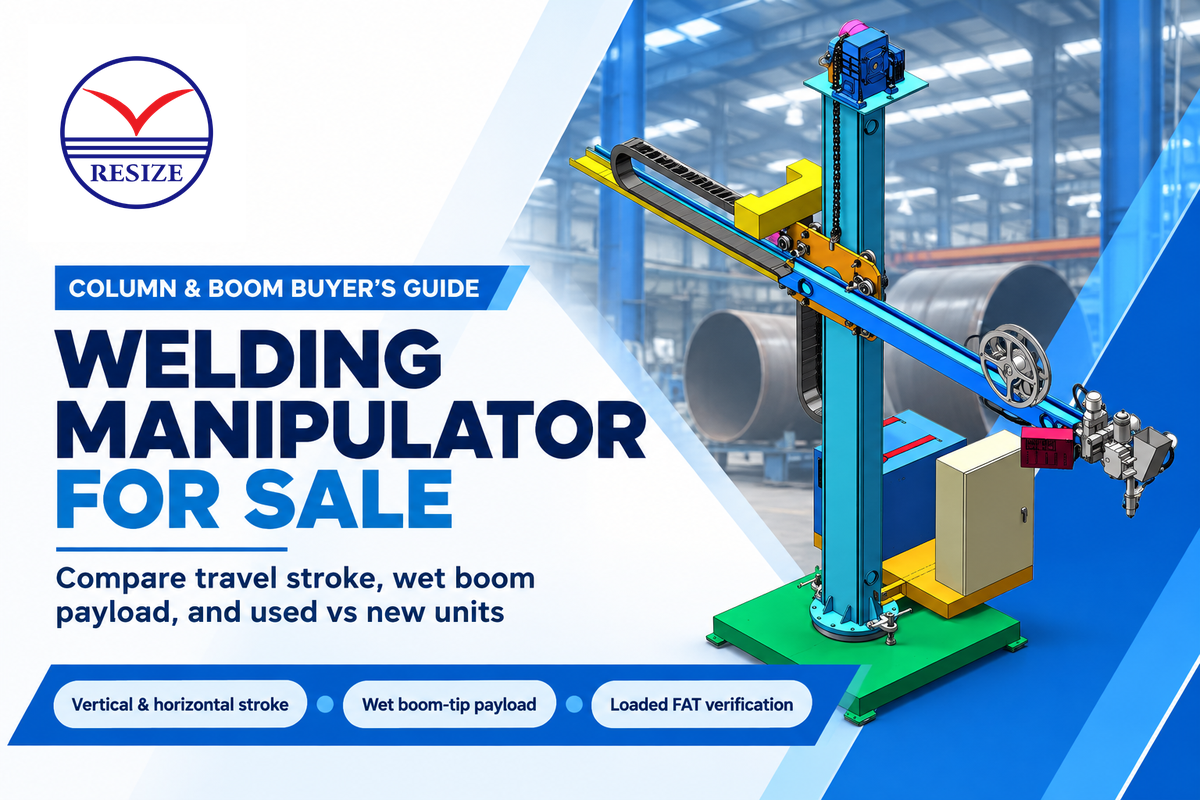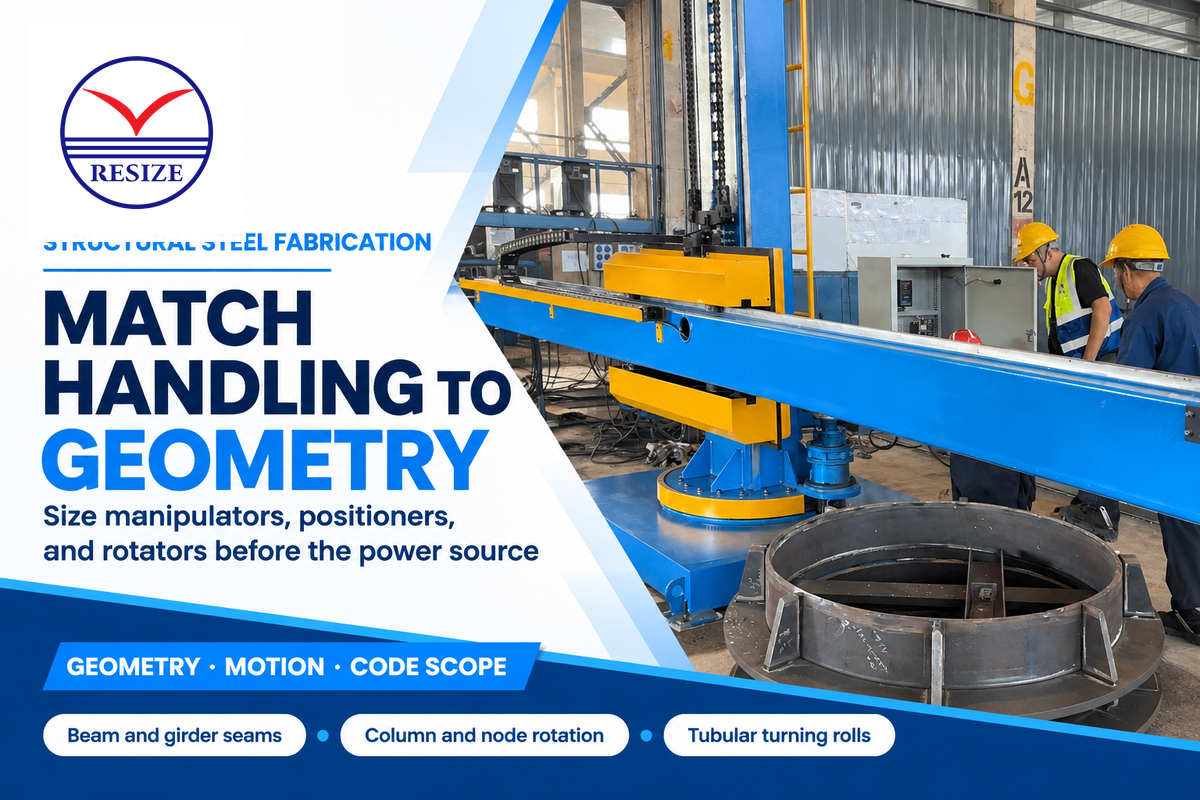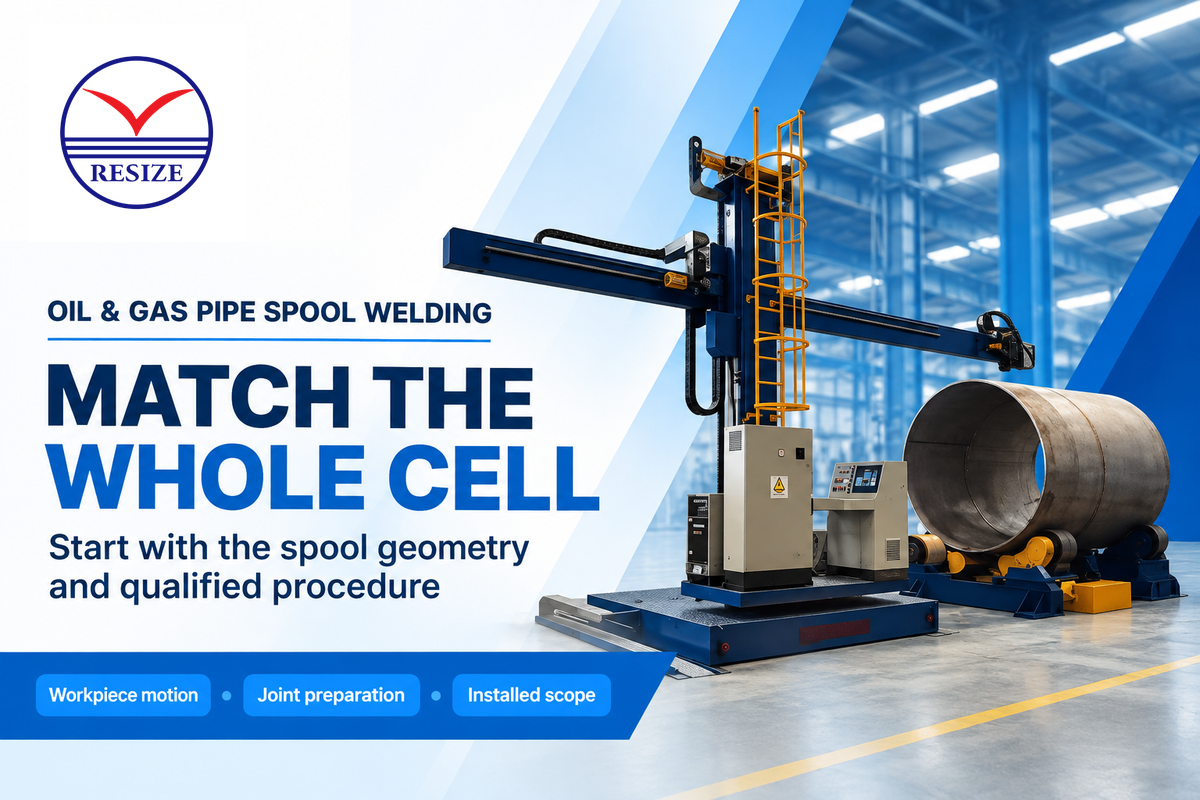
Evaluating a welding manipulator for sale starts with separating bare mechanical frames from complete submerged arc welding packages. Inexpensive automated welding solutions start at $20,000 in The Fabricator’s automation report. Bare mechanical 8×8 Pandjiris frames on the secondary market are shown on Practical Machinist at $2000 OBO, and an eBay listing shows a unit with a power supply for $12K. Factory-direct RESIZE column and boom welding manipulators provide up to 8,000 mm of horizontal and vertical travel in the standard series.
Neither a used domestic unit nor a new import is universally better for every fabrication bay. Used North American machines from Aronson, Pandjiris, Ransome, and Preston-Eastin suit buyers who can inspect mechanical ways in person and need immediate warehouse pickup. Dealer-rebuilt manipulators suit shops seeking upgraded electrical cabinets and tested drives from domestic stock. New China-made column and boom welding manipulators from RESIZE suit fabricators who require zero-hour guide ways, custom rail spans, and modern variable-frequency drives.
By GW · Updated November 2026
When Do You Need a Column and Boom Welding Manipulator Instead of a Welding Positioner or Turning Rolls?
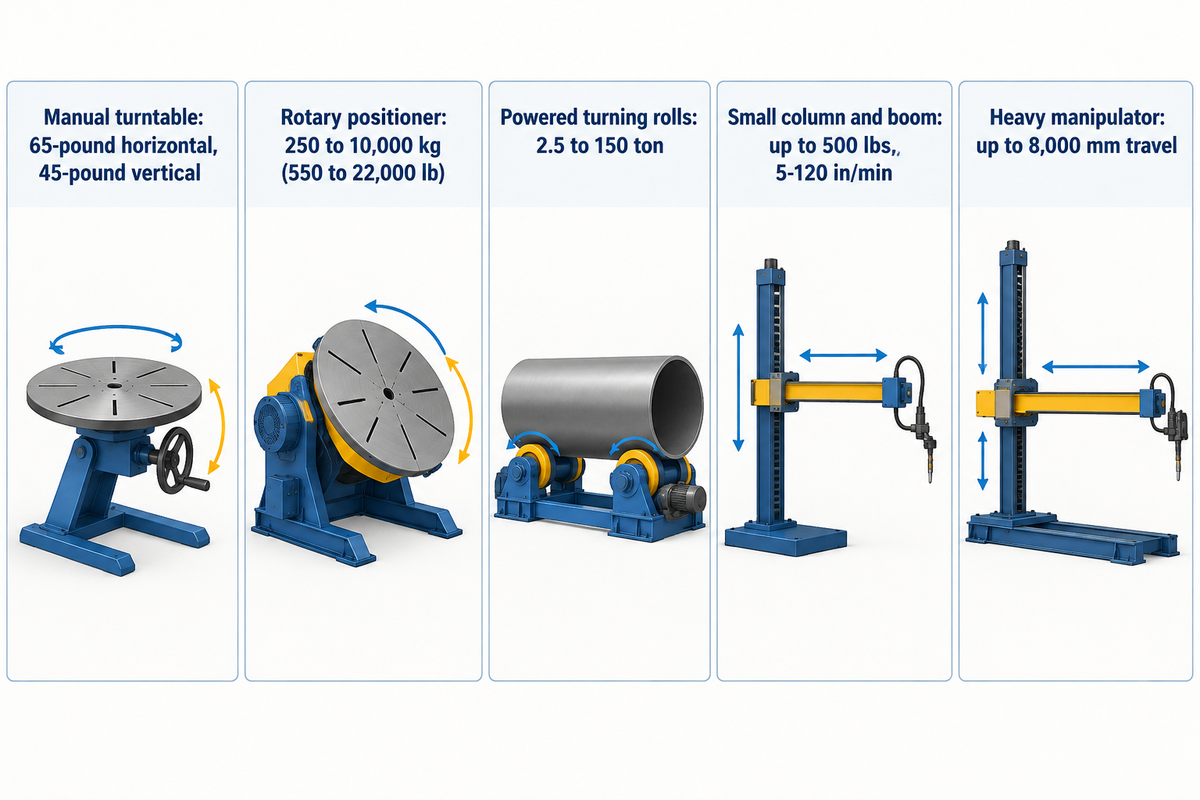
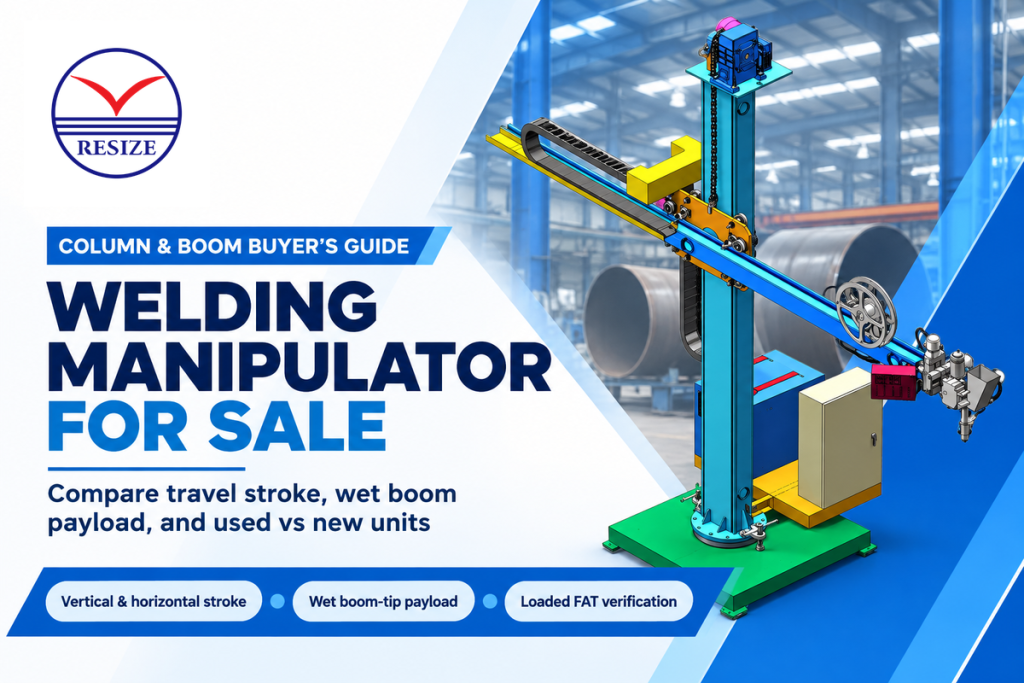
You can use a column and boom welding manipulator for long longitudinal seams or high joints. RESIZE lists up to 8,000 mm of vertical and horizontal travel on its standard manipulator series. A rotary welding positioner permits tilting and turning of workpieces in the 250 to 10,000 kg (550 to 22,000 lb) range. Powered turning rolls rotate cylindrical shells of 2.5 to 150 ton under a torch.
Each family of positioning equipment moves a different axis in the fabrication bay. On the RESIZE welding manipulator specification page, small benchtop turntables have a 10” table and 360-degree rotation on a 14” x 24” base. They can hold a 65-pound horizontal load and a 45-pound vertical load. Powered rotary positioners tilt flanges, elbows, and structural brackets into the flat 1F or 1G welding attitude. Heavy welding head manipulators hold the torch, wire reels, and flux hopper steady over large, stationary or moving weldments.
Replacing manual torch handling with mechanized boom travel directly cuts shop floor idle time. In The Fabricator’s report on automating welding operations, Pemamek application manager Christian Lefebvre notes that manual welding achieves only 10% to 15% arc-on time. Typical manual shops stay within a 5% to 20% arc-on range. Mechanized boom travel and powered part rotation reduce manual torch repositioning between passes to improve weld quality across long vessel seams.
| Equipment category | Primary motion axis | Published capacity or travel range | Target workpiece geometry | Primary shop boundary |
|---|---|---|---|---|
| Manual turntable positioner | 360-degree flat rotation | 65 pounds horizontal / 45 pounds vertical on 10-inch table (RESIZE) | Small pipe flanges, fittings, and benchtop brackets | Does not tilt heavy eccentric hubs or carry overhead subarc heads |
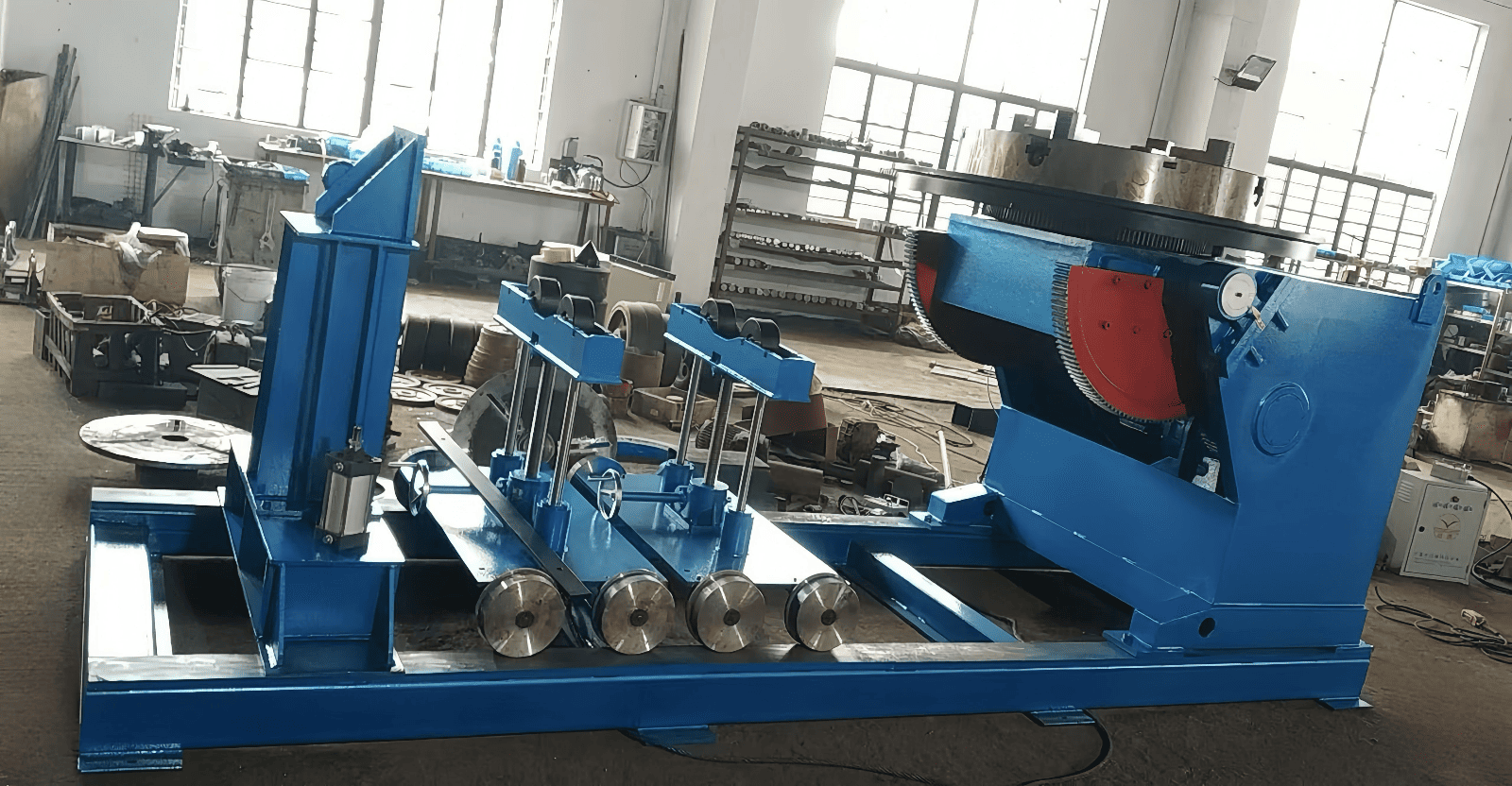
| Powered tilting welding positioner | Motorized table rotation and 135-degree tilt | 550 to 22,000 lb / 250 to 10,000 kg (AMET) | Valve bodies, pipe spools, and offset structural nodes | Requires headstock-tailstock support when long beams strike the floor |
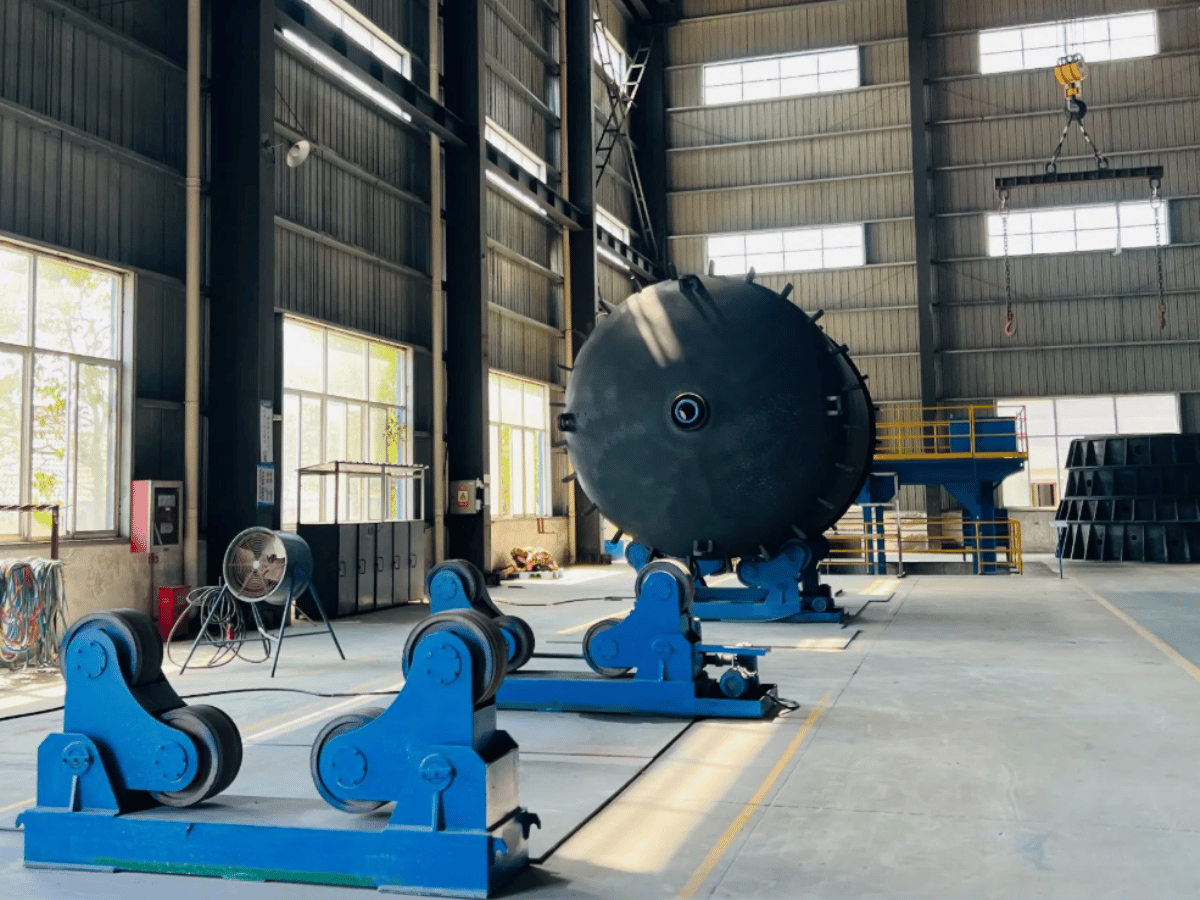
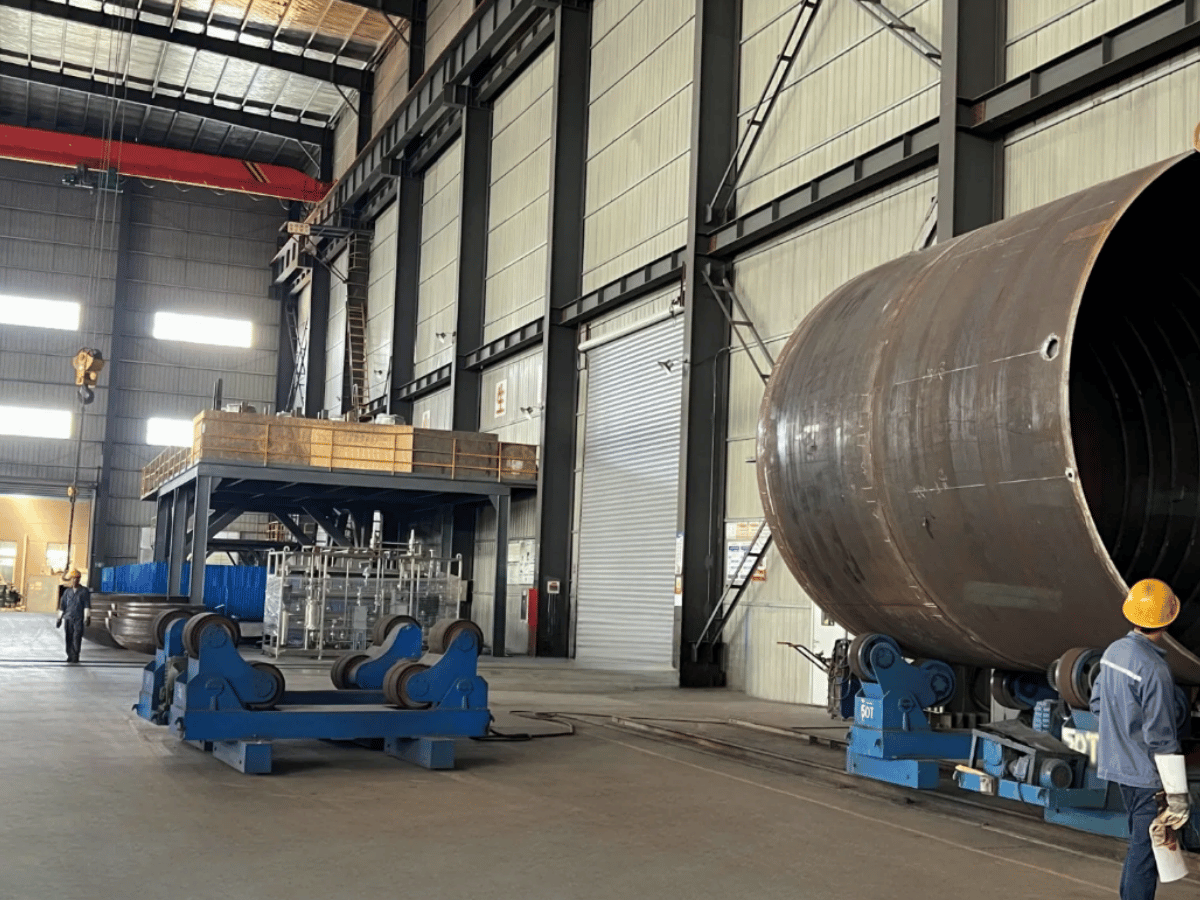
| Vessel and pipe turning rolls | Tractive roller rotation for cylindrical shells | 2.5 to 150 ton (AMET) | Cylindrical pressure vessels, wind towers, and pipe shells | Rotates circumferential girth seams only; requires a boom manipulator or longitudinal tractor to move the welding head along axial seams |
| Small column and boom manipulator | Vertical lift and powered horizontal reach | Up to 500 lbs boom load; 5–120 in/min traverse at 480 V (RESIZE) | Medium tanks, heat exchangers, and pipe welding stations | Approx. 4,400 lbs machine mass requires anchored floor slab or counterweighted base |
| Heavy column and boom manipulator | Up to 8,000 mm travel and 300–3,000 mm/min boom speed | 300 to 650 kg at 300 mm tip offset (AMET); up to 8,000 mm travel (RESIZE) | Thick-wall boilers, offshore monopiles, and shipbuilding panels | Requires crane hook clearance above the full column mast height |
How Do You Size Vertical Travel, Horizontal Reach, and Boom-Tip Payload on a Manipulator Model?
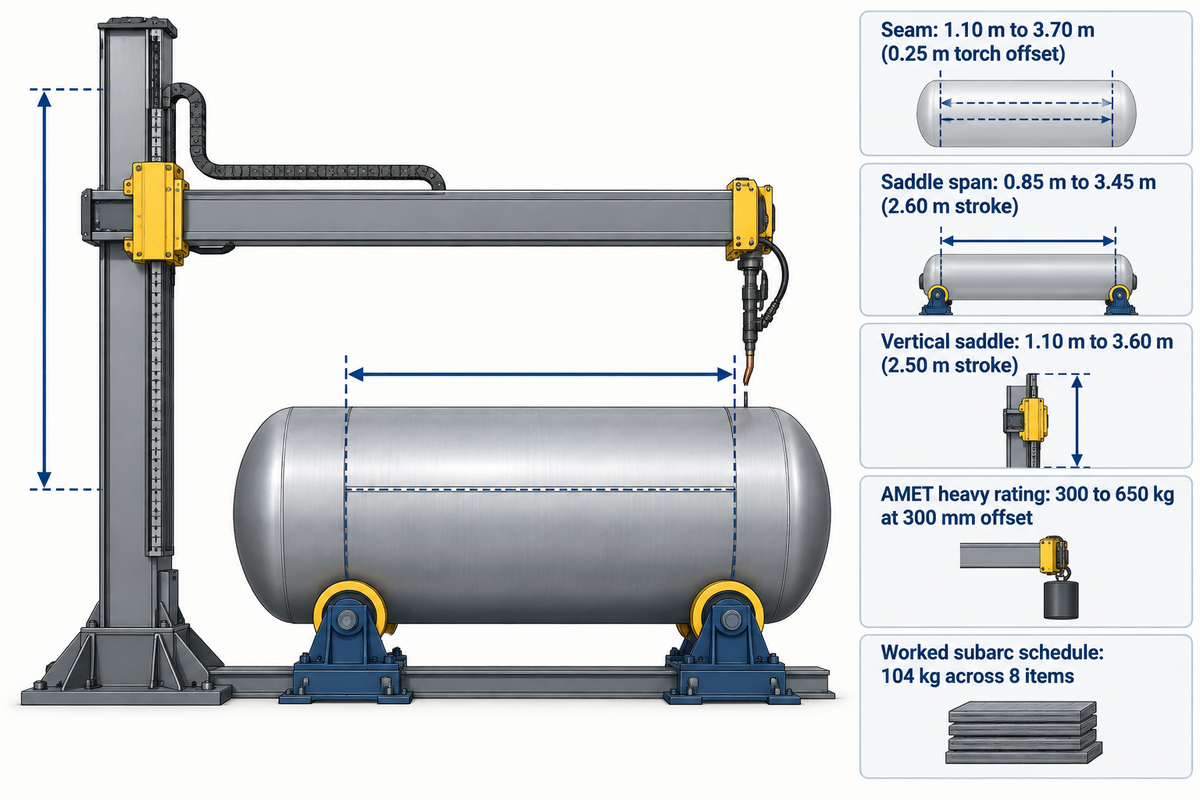
Size a manipulator model by plotting the highest and lowest torch heights from the floor datum and calculating the net horizontal boom stroke after accounting for torch offset. Determine the operating mass of the boom-mounted equipment and consumables and calculate their combined center-of-gravity offset from the boom end. AMET calculates its 300 to 650 kg (660 to 1,400 lbs) ratings at 300 mm (11.8 in.) from the boom end. RESIZE rates compact pedestals up to 500 lbs.
Weld Plus uses 14 x 12 for 14 feet of maximum height and 12 feet of maximum reach. Conversely, Mitrowski Welding Equipment puts horizontal reach first and vertical travel second. North American distributors use inconsistent shorthand for weight and size. Always verify a dimensioned elevation drawing before ordering from a two-number catalog label such as 14 x 12 or 8 x 10. Mitrowski also cautions that a 14×14 column mast stands much taller than 14’ (14 feet) and needs to clear your shop crane hook.
Koike’s engineering guide on how to size a manipulator measures lift and reach from the centerlines of the upright mast and horizontal ram. To find maximum lift above turning rolls, Koike solves for triangle leg b = √(a² − c²). The calculation then adds roller axle height, vessel radius, and torch-to-boom centerline distance. In the RESIZE column and boom sizing guide, a worked horizontal example models a seam from 1.10 m to 3.70 m. Applying a 0.25 m forward torch offset shifts the saddle positions to 0.85 m and 3.45 m while keeping net horizontal stroke at 2.60 m. On the vertical axis, tip heights of 0.90 m to 3.40 m with a 0.20 m torch drop require saddle heights of 1.10 m to 3.60 m (2.50 m stroke).
Boom payload calculations must include every wet component mounted on the crossbeam. AMET’s heavy-duty column and boom specification rates boom-end capacity from 300 to 650 kg (660 to 1,400 lbs) at 300 mm (11.8 in.) from the boom tip. AMET also states that up to 50 kg (110 lbs) can be added to capacity when equipment is counter-mounted on the opposite end of its boom. A worked single-head subarc schedule in the RESIZE sizing guide totals 104 kg across 8 items. That 104 kg schedule includes a 30 kg welding head, 12 kg cross-slides, 8 kg sensor, and 15 kg feeder and spool. It then adds a 10 kg hopper, 20 kg flux, 5 kg brackets, and 4 kg cables. Those vendor capacities apply only to each manufacturer’s tested boom section and mounting offset.
How Do You Calculate Minimum Pipe or Vessel Bore Diameter for Internal Boom Welding?
Internal vessel bore diameter can be determined by checking the full two-dimensional cross-sectional envelope contained within the circular shell. This clearance check accounts for the combined vertical height of the boom and head, horizontal assembly width, chord constraints imposed by the curved pipe wall, and an assumed radial clearance of 50 to 75 mm. In the vertical offset example in RESIZE, the torch tip is placed 0.20 m (200 mm) below the boom saddle reference, before accounting for ram beam depth and top cable track. A fully dressed head must always be checked against the vessel’s internal cross-sectional envelope before an internal pass.
Fixed Base, Slewing Column, or Motorized Travel Car: Which Base Configuration Fits Your Fabrication Bay?
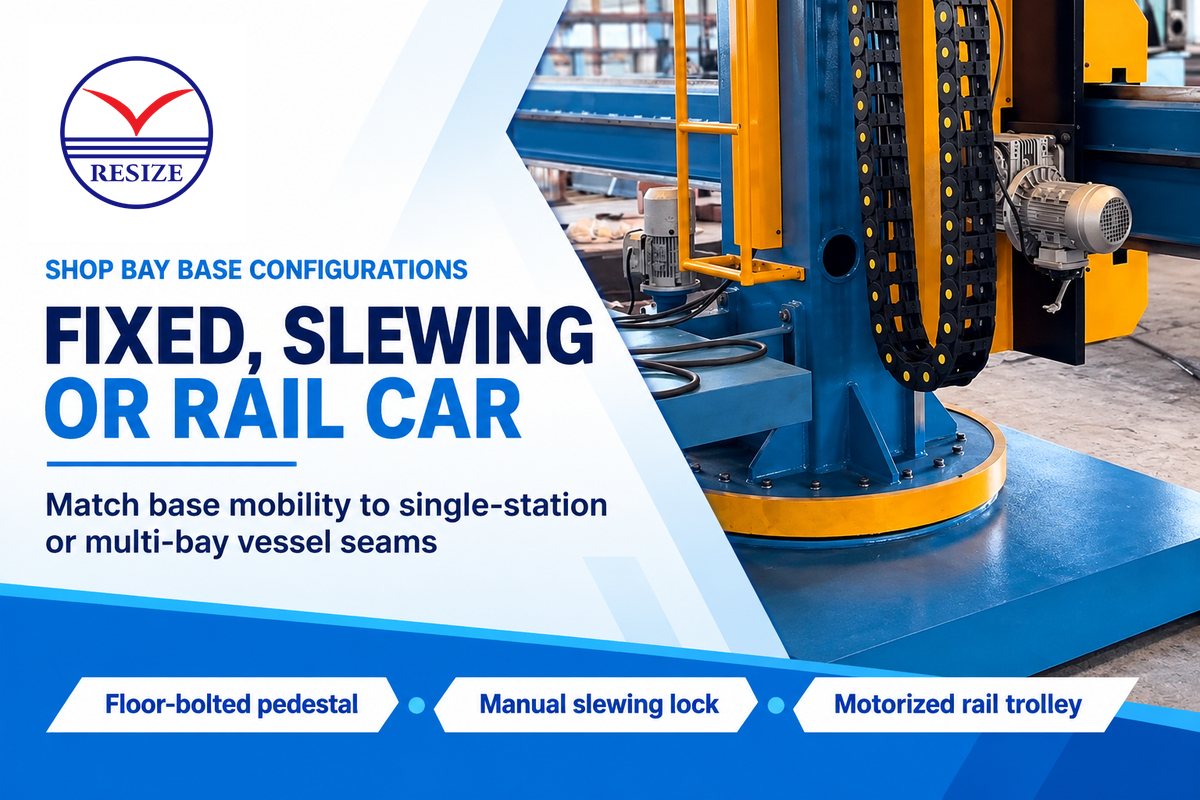
Select a fixed floor bolted base for a single turning-roll station or a manual ±180-degree slewing base for swinging one boom between two adjacent bays. Choose a motorized travel car on rails for welding long longitudinal seams of a vessel. RESIZE lists a trolley travel speed of 3 m/min, while Koike supplies modular track sections in 10 ft, 12 ft, 14 ft, and 16 ft lengths.
Choosing between a floor bolted pedestal and a rail guided carriage determines how your shop handles long multi-station weldments. Swedish patent SE532775C2 assigned to ESAB AB shows how rail-guided welding crane carriages and telescopic arms cover long longitudinal structures, without re-rigging the workpiece. On standard shop floors, RESIZE mounts the turning component above the chassis so the upper column body rotates ±180° and locks manually at the required welding position. For a motorized travel car carrying the column along a vessel bay, Koike states that the baseline track length is the required travel distance plus the travel car wheelbase. Buyers then add end-stop overtravel and braking clearance to that baseline track length.
| Specification parameter | RESIZE Small Pedestal Manipulator | RESIZE Standard Column & Boom | AMET Heavy-Duty Column & Boom | Engineering verification note |
|---|---|---|---|---|
| Published travel envelope | Compact pedestal envelope (RESIZE) | Up to 8,000 mm horizontal and vertical travel (RESIZE) | Custom heavy stroke by series (AMET) | Verify net torch reach after subtracting mounting offset |
| Horizontal boom traverse speed | 5–120 in/min variable speed (RESIZE) | 0.15–1.5 m/min (RESIZE) | 300–3,000 mm/min / 12–118 in/min (AMET) | Confirm smooth VFD tracking at minimum submerged arc speed |
| Vertical boom elevating speed | Powered vertical lift (RESIZE) | 1 m/min (RESIZE) | 1,000 mm/min / 39 in/min fixed (AMET) | Check mechanical anti-fall lock or dual ACME nut backup |
| Boom-end payload rating | Up to 500 lbs (RESIZE) | Sized per attachment schedule (104 kg across 8 items in RESIZE guide) | 300–650 kg / 660–1,400 lbs at 300 mm offset (AMET) | Include wet flux fill, wire reel, slides, and cable weight |
| Column rotation and trolley travel | 4,400 lbs equipment mass; 480 V, 3-phase (RESIZE) | ±180° manual lock; 3 m/min trolley speed (RESIZE) | Fixed, slewing, or rail travel car on 10, 12, 14, and 16 ft track (코이케) | Add travel car length and end-stop margins to total rail span |
Used Welding Manipulators (Aronson, Pandjiris, Ransome, Preston-Eastin) vs Rebuilt vs New China-Made Units
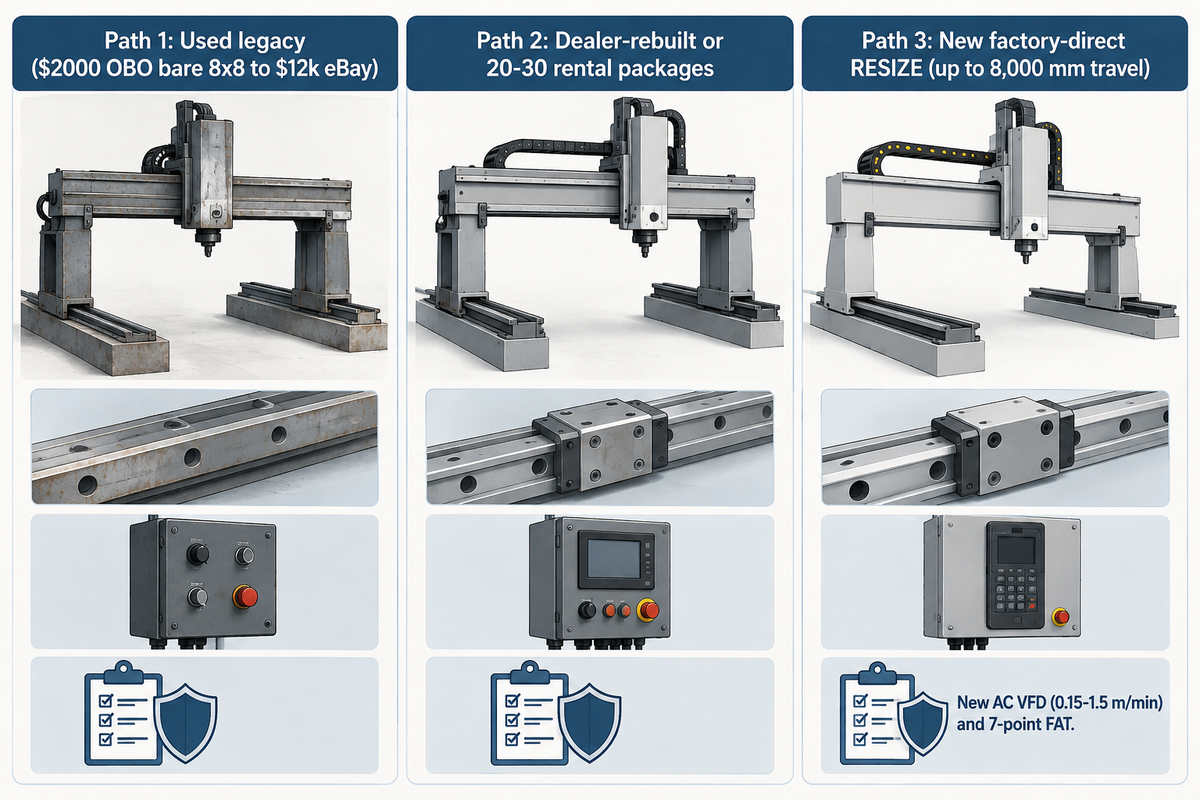
Neither a used North American manipulator nor a new China-made unit is universally better for every buyer. When a fast, warehouse pick-up is needed, choose the domestic used or rebuilt stock and for a quick fleet of 20-30 units, choose Mitrowski Welding. Choose a new factory-direct RESIZE unit when you require zero-hour guide ways, custom strokes, and modern AC variable-frequency controls.
Our welding manipulator manufacturers comparison profiles global OEMs across heavy industrial equipment lines. Buyers evaluating active listings for new and used welding manipulators balance legacy frame mass against control age. In a Practical Machinist thread on an 8×8 Pandjiris manipulator, a seller offered a bare 8×8 frame (measuring 10′ tall and 10′ wide with feeder) for $2000 OBO. That same thread noted a comparable unit with a power supply on eBay asking $12k. On Mohawk Machinery’s used welding manipulators archive, historical listings include Profax WM-66-4 (6′ x 6′) and Ransome Model 1212 Marksman (12′ x 12′ fixed base). Mohawk Machinery also lists heavy-duty Preston-Eastin VA-1212HD (12′ x 12′) subarc units. Those secondary listings reflect individual historical units and don’t include control cabinet retrofits or way re-scraping.
The 3-Path Manipulator Acquisition Ledger, below, evaluates nine factors across as-is used, dealer-rebuilt, and newly manufactured systems.
| Evaluation dimension | Path 1: Used as-is legacy (Aronson, Pandjiris, Ransome) | Path 2: Dealer-rebuilt or rental US stock (Weld Plus, Mitrowski) | Path 3: New factory-direct China-made (RESIZE) |
|---|---|---|---|
| Published price baseline | $2000 OBO bare 8×8 to $12k eBay unit with power supply (Practical Machinist) | Custom dealer quote; 20–30 rental packages available (Mitrowski) | Entry automation from $20,000 (제작사); custom strokes quoted per project |
| Representative models in market | Ransome Model 1212, Koike Aronson Scarab-I, Pandjiris 8×8 | Preston-Eastin VA-1212HD, Koike Cricket-II, Profax WM-66-4 | RESIZE LHQ, LHJ, NLH, and LHW series up to 8,000 mm travel |
| Delivery and lead time | Immediate warehouse pickup once rigging and domestic freight are booked | Scheduled around shop rebuild, wiring upgrade, and load testing scope | Built to order plus ocean container transit and customs clearance |
| Structural column and boom ways | Heavy vintage box castings; check cam rollers and rack wear | Cleaned, shimmed, and adjusted ways inspected by dealer technicians | New stress-relieved rectangular guide rails and zero-hour gear racks |
| Boom drive and speed control | Often legacy DC thyristor/SCR cards with obsolete spare parts | Upgraded variable-speed drives matched to customer power source | New AC variable-frequency drive (0.15–1.5 m/min) with reducer |
| Vertical anti-fall safety lock | Older counterbalance chains; verify independent mechanical catch | Inspected lift chains, brake motors, and limit switches | Electrical brake motor plus mechanical anti-fall locking device |
| Welding head and flux integration | Sold bare or with older Lincoln DC-600 / DC-1000 analog heads | Packaged with Lincoln DC-600, DC-1000, or Powerwave AC/DC 1000 SD | Factory-integrated SAW head and flux recovery, or split-scope local head |
| Electrical voltage and enclosure | Matched to prior owner’s shop voltage; verify transformer taps before hookup | Configured and tested to match buyer’s specified shop supply | Specify buyer shop voltage (e.g., 480 V, 3-phase) and enclosure rating on PO |
| Warranty and acceptance protection | Typically sold as-is; warranty terms follow individual seller agreement | Dealer satisfaction guarantee or rental trial option (Mitrowski) | Manufacturer warranty backed by loaded 7-point FAT video and report |
What Mechanical Wear Points and Variable Speed Drives Must You Inspect on Used Welding Manipulators?
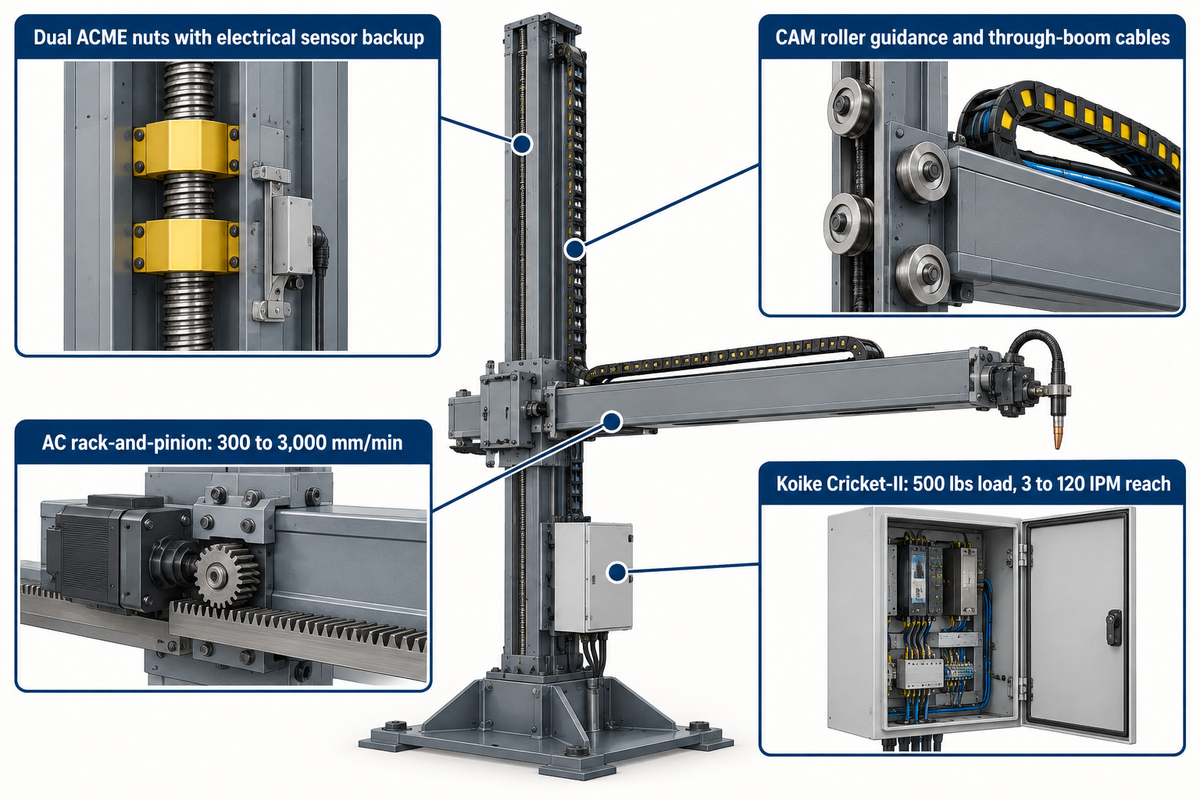
Before purchase, evaluate four main systems on used welding manipulators: an anti-fall lock or dual ACME nut backup, cam roller ways, backlash on rack and pinion, and NEMA-12 drive cabinets. Checking these welding manipulator features prevents unexpected rebuild expenses after rigging the frame into your bay.
In The Fabricator’s technical profile of the Koike Aronson Cricket-II manipulator, the unit carries a 500 lbs load capacity with a 20 IPM vertical lift speed. Its variable-speed powered reach spans 3 to 120 IPM. The machine uses CAM roller guidance, through-the-boom cable management, and NEMA-12 enclosures to protect internal controls from indoor shop dust, falling dirt, and dripping noncorrosive liquids. On larger frames, AMET’s heavy-duty series drives the horizontal boom at 300 to 3,000 mm/min (12 to 118 in/min) via an AC variable-speed motor and rack-and-pinion gear. It lifts the vertical carriage at 1,000 mm/min (39 in/min) on an ACME screw with two ACME nuts. The primary load nut is backed up by a second nut, and an electrical sensor, to prevent the vertical boom from lowering.
Why Does Stick-Slip Boom Travel Ruin Submerged Arc Weld Beads?
Stick-slip along the horizontal boom rack creates an uneven arc, entraps slag, and can cause undercut which requires costly rework. When inspecting a used Preston Eastin, Pandjiris, or Aronson Scarab boom manipulator, test the variable speed travel across its lowest setting. Variable velocity spikes will occur before you strike an arc. Worn cycloidal reducers will cause the same effect.
How Do You Integrate Lincoln Electric or Subarc Welding Heads, Flux Recovery, and Seam Tracking onto the Boom?
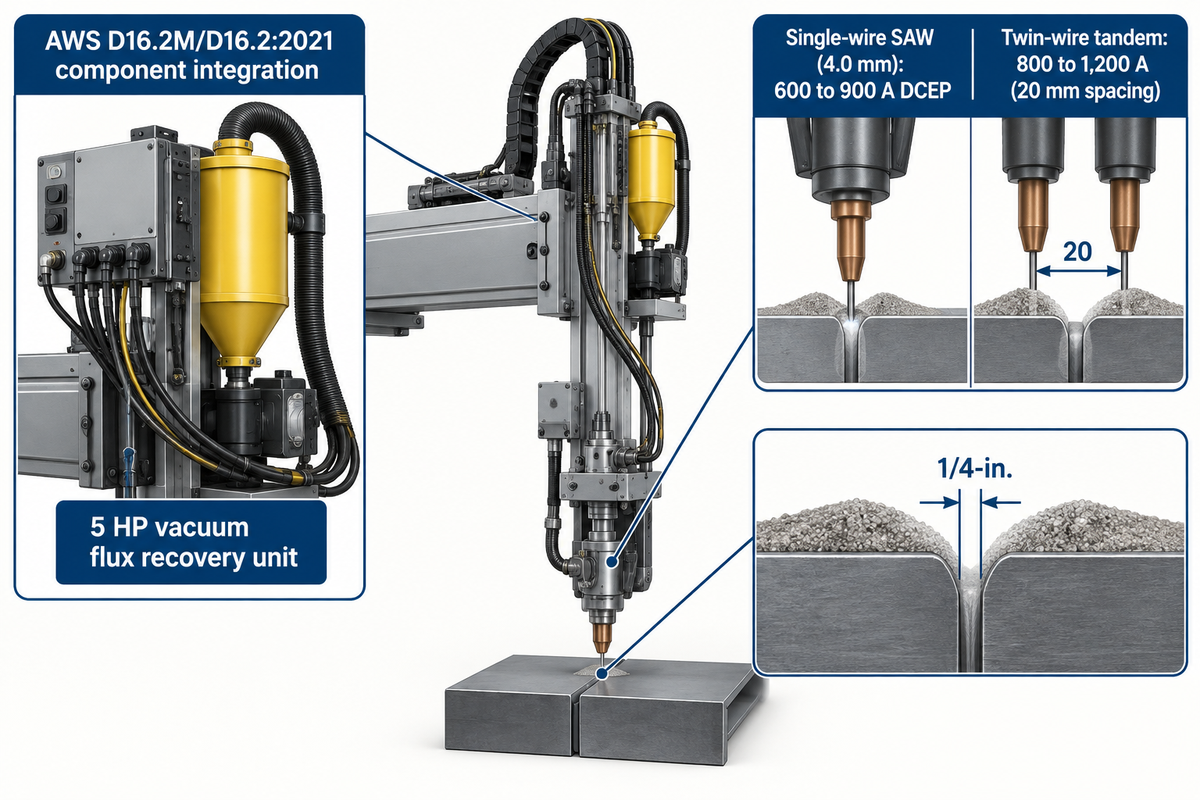
Integrate subarc welding heads onto the boom by matching power-source control harnesses under AWS D16.2M/D16.2:2021. Size the boom-tip capacity at the required extension to accommodate the combined operating weight and center-of-gravity offset of a 600 to 1,200 A welding system. Include the slides, 5 HP vacuum flux recovery unit, carried flux, and cables in the load check. Establish allowable joint fit-up gap and gap variation with the selected seam tracker and welding procedure.
Component integration follows established North American and international welding engineering guidelines. The AWS D16 Committee on Robotic and Automatic Welding publishes AWS D16.2M/D16.2:2021 for installing automatic arc welding components. Companion standards include AWS D16.1M/D16.1:2026 for system safety and AWS D16.3M/D16.3:2026 for hazard risk assessment. For heavy plate work, TWI’s Job Knowledge 016 guide on submerged arc welding equipment notes that mechanized single-wire systems (4.0 mm wire) run between 600 and 900 A on direct current electrode positive (DCEP). Twin-wire tandem systems operate between 800 and 1,200 A with wires spaced 20 mm apart. Running DCEP on the lead wire and alternating current (AC) on the trailing wire angled at 60 to 80 degrees produces high-quality welds and overcomes magnetic arc blow. TWI also notes that extending 4.0 mm wire stickout from 32 mm to 178 mm at 700 A raises deposition from 9 kg/hr to 14 kg/hr for cladding.
You can mount a Lincoln Electric DC-600, DC-1000, or Powerwave AC/DC 1000 SD subarc package or a Jetline Welding seam tracker and TIG head. AMET also integrates up to 10 wire weld heads for high-deposition cladding. Even with precision sensors, optical tracking can’t fix severe plate fit-up variation. In The Fabricator’s automation feature, Pemamek’s Christian Lefebvre identifies severe joint-gap variation as a reason to retain a human welder.
“Anything that goes from zero to a ¼-in. gap, something that’s a bit more challenging, then I would likely just keep a human there.”
How Do You Pair Column and Boom Welding Manipulators with Turning Rolls and Positioners for Pipe Welding?
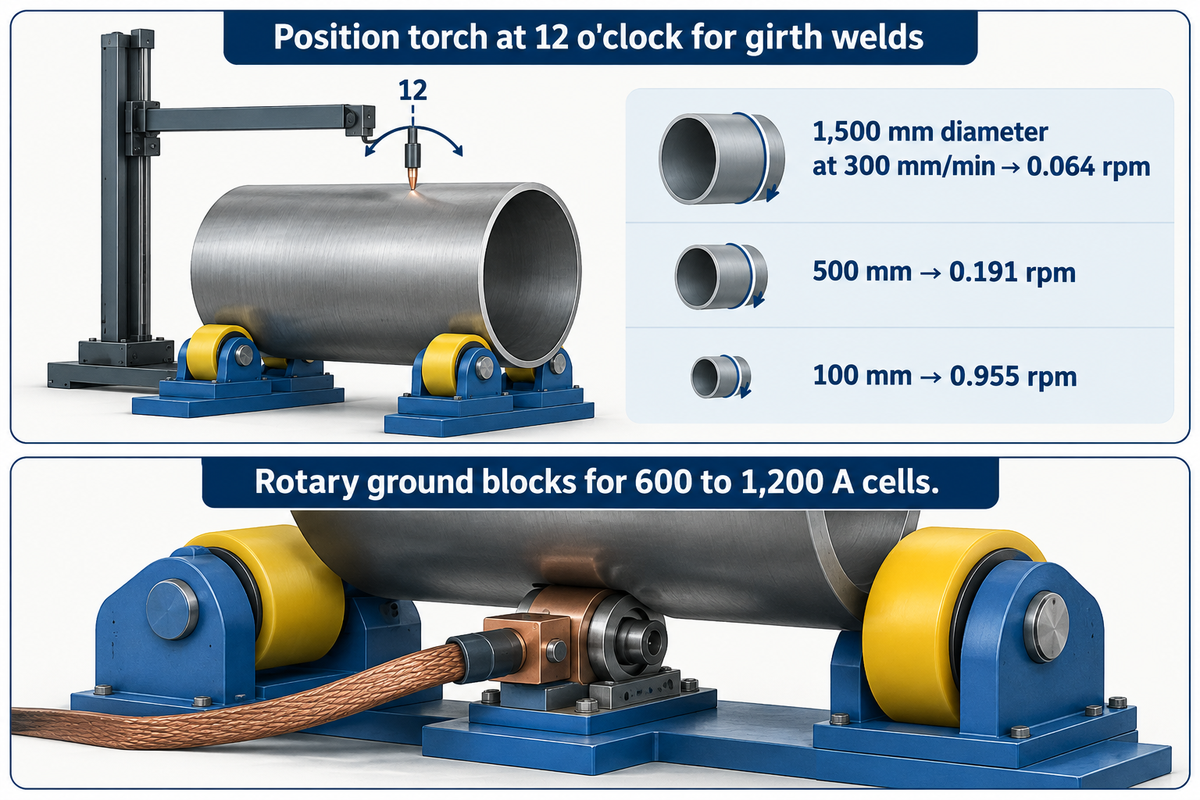
Pair a column and boom welding manipulator with powered turning rolls or a rotary positioner by positioning the torch at the 12 o’clock optimal position for circumferential girth welds. Drive longitudinal seams with the boom or travel car while holding the vessel stationary. Connect the weld return lead directly to the rotating shell through a rotary ground clamp or slip-ring assembly rated for the full weld current.
Synchronizing rotational speed with weld travel speed prevents cold lap and burn-through on pipe and vessel shells. As shown in the RESIZE welding positioner buying guide, concentric circular welds follow the equation rpm = travel speed (mm/min) ÷ (π × weld diameter in mm). At an assumed travel speed of 300 mm/min, a 1,500 mm circular weld diameter needs approximately 0.064 rpm. Applying that same formula at 300 mm/min, a 500 mm weld diameter calculates to 300 ÷ (π × 500) ≈ 0.191 rpm, and a 100 mm diameter calculates to 0.955 rpm. That 300 mm/min calculation illustrates geometry conversion rather than a universal weld procedure setting. Pairing an overhead boom with a self-aligning welding rotator or a tilting industrial welding positioner creates a synchronized welding solution for increased productivity. In AMET’s turning roll catalog and the RESIZE pipe turning rolls guide, heavy roller beds span 2.5 to 150 ton to support thick-wall shells.
Electrical return grounding is the most common oversight when integrating a boom manipulator with a rotator or positioner. In a Practical Machinist engineering thread on welding rotator grounding, shop fabricators describe damage from arcing across tapered roller bearings (such as a hub with 84 rollers across 2 bearings) when passing weld return current through them. One builder said he ran 300 amps through a NAPA ground strap, which he wrapped around a positioner shaft, using a 1 to 1.5 inch flat, copper-weave strap. High-amperage 600 to 1,200 A subarc cells require rotary ground blocks rated for the full procedure current.
Pressure Vessels, Structural Steel, and Pipe Spools: How Do Application Codes Govern Manipulator Setup?
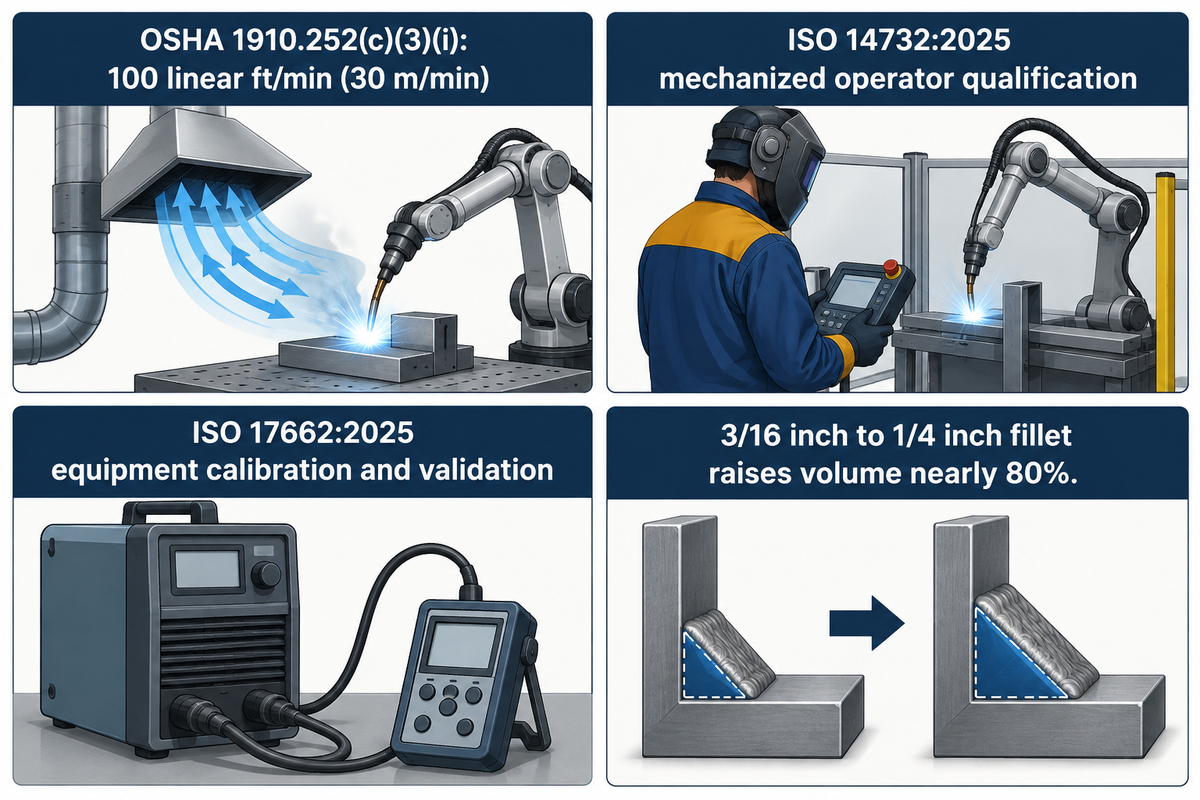
Application codes can govern manipulator cell ventilation, personnel qualification, and equipment calibration. Under OSHA 29 CFR 1910.252(c)(3)(i), a fixed enclosure with a top and at least two sides must maintain airflow away from the welder at 100 linear ft/min (30 m/min) or more. When invoked by the governing fabrication code or contract, ISO 14732:2025 sets qualification-testing requirements for mechanized welding operators and weld setters. Similarly, ISO 17662:2025 governs welding equipment calibration, verification, and validation.
For personnel and quality management, ISO 14732:2025 (Edition 3) covers qualification testing for mechanized welding personnel who set up or adjust parameters. Meanwhile, ISO 17662:2025 (Edition 3) specifies calibration, verification, and validation of welding equipment during production and Annex B acceptance testing.
Fit-up deficiencies during code-governed vessel welding, structural steel girders and offshore pipe fabrication attract cost penalties. In Voortman’s engineering analysis of automated versus manual welding costs, increasing a fillet weld leg size from 3/16 inch to 1/4 inch raises required weld volume by nearly 80%. In contrast, Voortman’s automated fabrication benchmark shows that for simple profiles with less than 4 subparts, manual welding is faster than automated welding. Mechanized flux-cored welding was 0.044% defective for 15,000 meters (260 tons) of duplex pipe in The Fabricator’s offshore energy welding report, while baseline pipework showed a 0.59% defect rate.
How Much Do New and Used Welding Manipulators Cost from 6 x 6 to 14×14, and What Is the Rebuild Expense?
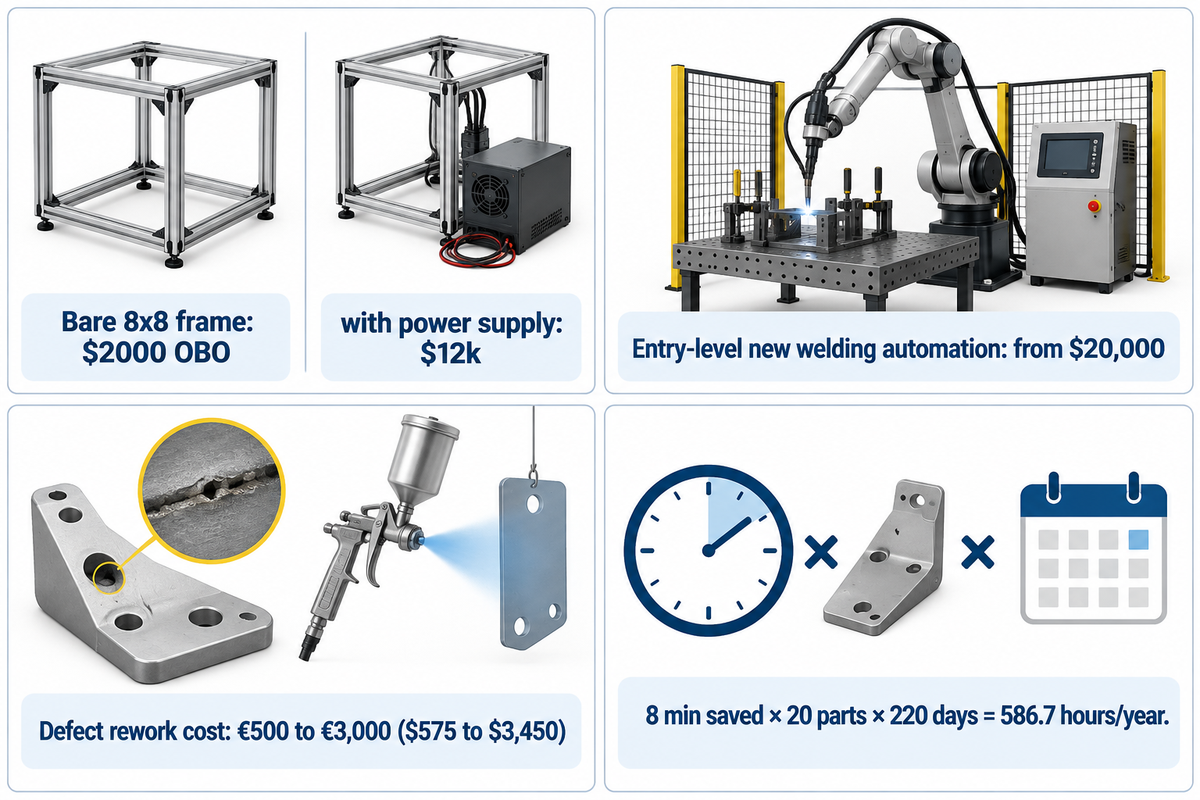
Used welding manipulators for sale start at $2000 OBO for a bare private-sale 8×8 Pandjiris frame and reach $12k on eBay with a welding power supply (Practical Machinist). Entry-level new welding automation starts at $20,000 (제작사). Custom heavy column and boom manipulators and dealer rebuilds require a project quote, with lead times governed by the scope of the rebuild and container transit time.
Secondary market records show why bare structural frames and complete welding cells sit in different price brackets for heavy industrial machinery. In a post on the Practical Machinist forum by the seller of a Pandjiris 8×8 manipulator, the seller said the 8×8 floor-bolted machine measured about 10′ tall and 10′ wide. That private seller priced the bare frame with feeder at $2000 OBO, compared to $12k on eBay for a unit with a welding power supply. At the dealer level, Mohawk Machinery’s used manipulator catalog lists 6′ x 6′ Profax WM-66-4 and 12′ x 12′ Ransome Model 1212 frames. Mohawk Machinery also lists 12′ x 12′ Preston-Eastin VA-1212HD subarc configurations quoted upon request. Custom new column and boom manipulators in the 6 x 6 ft through 14 x 14 ft size range require a quotation based on stroke, payload, and power-source scope. According to the manufacturer, RESIZE builds standard modular units and custom extra heavy units.
How Much Does It Cost to Retrofit Obsolete Controls on a Used 12 x 12 or 14×14 Manipulator?
For an older 12 x 12 or 14×14 used manipulator, budget for electrical and mechanical modernization separately from the bare frame purchase, as retrofit costs depend on VFD cabinet scope, AC motor replacement, and way re-scraping. By comparison, complete entry-level automation solutions start at $20,000 (제작사), and adding a power supply shifts secondary market listings from $2000 OBO to $12k (Practical Machinist). When an unrefurbished unit causes weld defects, Voortman’s cost study notes that return transport, rework, and recoating cost €500 to €3,000 ($575 to $3,450) per assembly. In the RESIZE positioner worksheet example, saving 8 labor minutes per part across 20 parts per day and 220 working days equals 586.7 person-hours per year.
Which Manufacturers and Dealers Supply Column and Boom Manipulators, and How Do You Audit a China-Made Unit?
Established North American manufacturers and used equipment dealers of Welding Automation equipment include: Koike Aronson / Ransome, Pandjiris, Preston-Eastin, LJ Welding Automation, AMET, Profax, Weld Plus, Mitrowski Welding, and MDNA member Mohawk Machinery. Factory direct China-made manufacturer RESIZE supplies column and boom welding manipulators across light, medium, and heavy series that buyers audit under a 7-point loaded Factory Acceptance Test.
Buyers can procure a complete package from a single domestic dealer with extensive inventory or opt for split-scope procurement. A split-scope buyer typically pairs a factory-direct RESIZE column and boom welding manipulator with locally serviced Lincoln Electric or Miller power sources. Regardless of source, require a loaded boom test at the far mounting position, rather than an unloaded, dry run, close to the column. Illustratively, the RESIZE sizing guide shows a check with a 104 kg load at a 3.45 m mounting position. In the October 2025 AWS Welding Digest guide, weld engineer and AWS D16 committee member Adam White states the golden rule for pre-shipment verification. In the AWS Welding Digest’s automation guide, it’s stated that automated cells require tighter part fit-up and fixturing tolerances compared to manual welding.
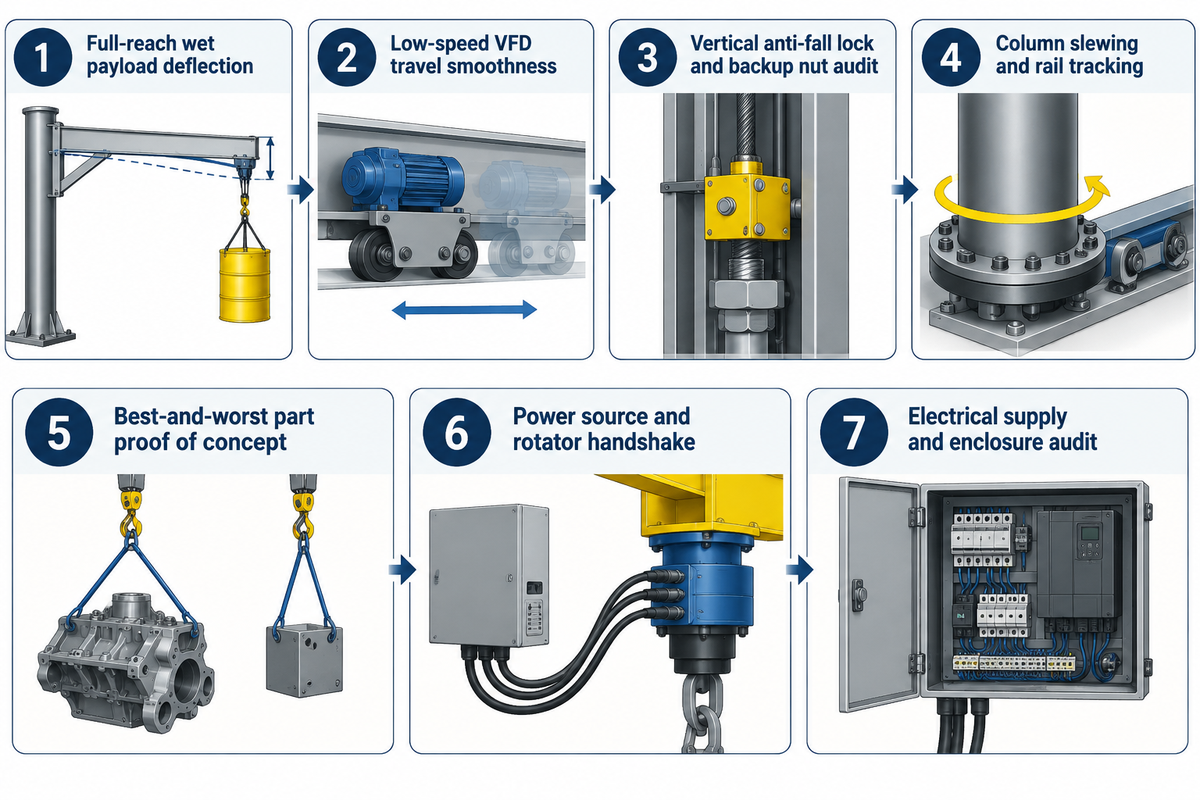
“When buying a robot and working with an integrator (they don’t need to be from the same company as the manufacturer), give them your best and worst parts and ask for a proof of concept. Make sure the system works before it ships.”
The 7-Point Loaded Boom Acceptance Protocol, below, can be used to verify the correct manipulator for your application and find the perfect manipulator. Before releasing final payment, adapt the seven checks to the machine’s rated payload, elevating side carriage, repeatability, speed ranges, and welding procedure.
7-Point Loaded Boom Acceptance Protocol for factory acceptance testing (FAT)
| Acceptance check | Test load and position condition | Target engineering benchmark | Required pre-shipment evidence |
|---|---|---|---|
| 1. Full-reach wet payload deflection | Apply the complete operating attachment load at its intended mounting position (e.g., 104 kg sample at 3.45 m in RESIZE; AMET rates 300–650 kg at 300 mm offset) | Record vertical droop from minimum to maximum reach (e.g., 0.85 m to 3.45 m saddle span) | Signed dial-indicator deflection log at maximum horizontal extension |
| 2. Low-speed VFD travel smoothness | Run horizontal boom across full stroke at minimum rated welding speed (e.g., 0.15 m/min on RESIZE or 3 IPM on Koike Cricket-II) under load | Measured travel speed and observed stick-slip or chatter recorded separately; velocity calibrated per ISO 17662:2025 | Continuous travel video with tachometer readings across the speed range |
| 3. Vertical anti-fall lock and backup nut audit | Verify manufacturer-controlled test of chain-lift mechanical anti-fall catch (RESIZE) or leadscrew dual ACME backup nut (AMET) | Independent mechanical locking device or secondary ACME nut engages within rated arrest distance | Factory anti-fall test certificate and electrical brake inspection log |
| 4. Column slewing and rail tracking | Rotate column through ±180° manual lock and run trolley at 3 m/min (RESIZE) across modular 10–16 ft track (Koike) | Zero rail binding across full track length with verified end-stop braking clearance | Laser alignment sheet across full modular track assembly |
| 5. Best-and-worst part proof of concept | Weld representative best and worst joint fit-up coupons per Adam White’s AWS Welding Digest recommendation | Consistent weld beads and penetration at 600–1,200 A SAW (TWI) without slag entrapment | Macro-etch coupon photos and weld parameter printout |
| 6. Power source and rotator handshake | Trigger start/stop interlock between boom controller, 5 HP flux vacuum (AMET), and turning rolls | Synchronized arc ignition and emergency stop across all axes under AWS D16.2M/D16.2:2021 | Dry-contact or fieldbus wiring schematic and live E-stop test video |
| 7. Electrical supply and enclosure audit | Inspect primary transformer tap (e.g., 480 V, 3-phase on RESIZE), VFD nameplate, and NEMA-12 dust enclosure | Verified match to buyer shop voltage, indoor dust/drip enclosure rating, and dedicated rotary work-lead ground | Component bill of materials with serial numbers and insulation test report |
자주 묻는 질문
Can you use a column and boom welding manipulator for MIG, TIG, and subarc welding processes?
Yes. A column and boom welding manipulator is a universal motion platform for submerged arc welding (subarc), gas metal arc welding (MIG), flux-cored arc welding, or gas tungsten arc welding (TIG) heads. Under AWS D16.2M/D16.2:2021, each welding process requires matching power-source interface cables, calibrated travel speed controls, and dedicated motorized torch mounting cross-slides.
What is the difference between a tabletop welding positioner and a floor-mounted column and boom manipulator?
A tabletop welding positioner rotates and tilts compact workpieces, such as pipe flanges, fittings, and small hubs, so the operator can weld circumferential joints in a flat downhand orientation. In the RESIZE manipulator catalog, a 10-inch benchtop turntable carries 65 pounds horizontally and 45 pounds vertically. By contrast, a floor-mounted column and boom welding manipulator carries up to 500 lbs of weld head equipment across 8,000 mm of vessel travel.
Why must a vertical column and boom welding manipulator have a mechanical anti-fall safety brake?
A vertical column and boom welding manipulator suspends heavy weld heads, cross-slides, wire reels, and flux hoppers high above the shop floor. Published loads span the 104 kg sample schedule in the RESIZE sizing guide and the 300 to 650 kg boom-end ratings in AMET’s heavy-duty series. A motor brake alone can’t arrest a free-falling carriage if a lift chain snaps. Chain-driven columns require an independent mechanical anti-fall catch, while leadscrew columns use a secondary backup ACME nut.
What electrical voltage do China-made welding manipulators use for North American shops?
For a North American fabrication shop, specify your exact primary facility supply, such as 480 V, 3-phase power listed on the RESIZE small welding manipulator specification, when ordering a China-made unit. Also specify NEMA-12 indoor dust enclosures for the control cabinet. Standard domestic Chinese industrial machinery defaults to 380 V, 50 Hz, 3-phase power unless the purchase order specifies a North American transformer and drive configuration.
When does it make sense to rent a welding manipulator instead of buying a new or used machine?
Renting a welding manipulator package from a 20-to-30 unit dealer rental fleet (Mitrowski Welding) makes financial sense for a short turnaround repair or single pipe spool contract. For multi-quarter vessel or structural production, cumulative rental fees plus round-trip rigging charges quickly approach the $20,000 entry price of new welding automation (제작사). Secondary market purchases also start at $2000 OBO to $12k (Practical Machinist).
Do operators running a mechanized welding manipulator need special certification?
Where a governing fabrication code or customer contract invokes ISO 14732:2025 (Edition 3, published June 2025), qualification requirements cover mechanized operators and weld setters. That scope applies to personnel who set up mechanized and automatic welding equipment or control and adjust welding parameters. Personnel who only load and unload parts without adjusting mechanized weld parameters do not fall under that operator qualification scope.
How are large 14×14 ft or heavy-duty welding manipulators packed and shipped for installation?
Manufacturers disassemble the vertical column, horizontal crossbeam, slewing base, and travel car into sub-assemblies for ocean or flatbed transport. Modular 10 ft, 12 ft, 14 ft, or 16 ft track sections (Koike) and standard RESIZE column assemblies ship as knocked-down structural components. Verify container door and internal length limits using the supplier’s disassembled packing dimensions. Before delivery, buyers also verify shop crane hook height against the erected mast elevation.
Specify the Right Welding Manipulator for Your Fabrication Shop
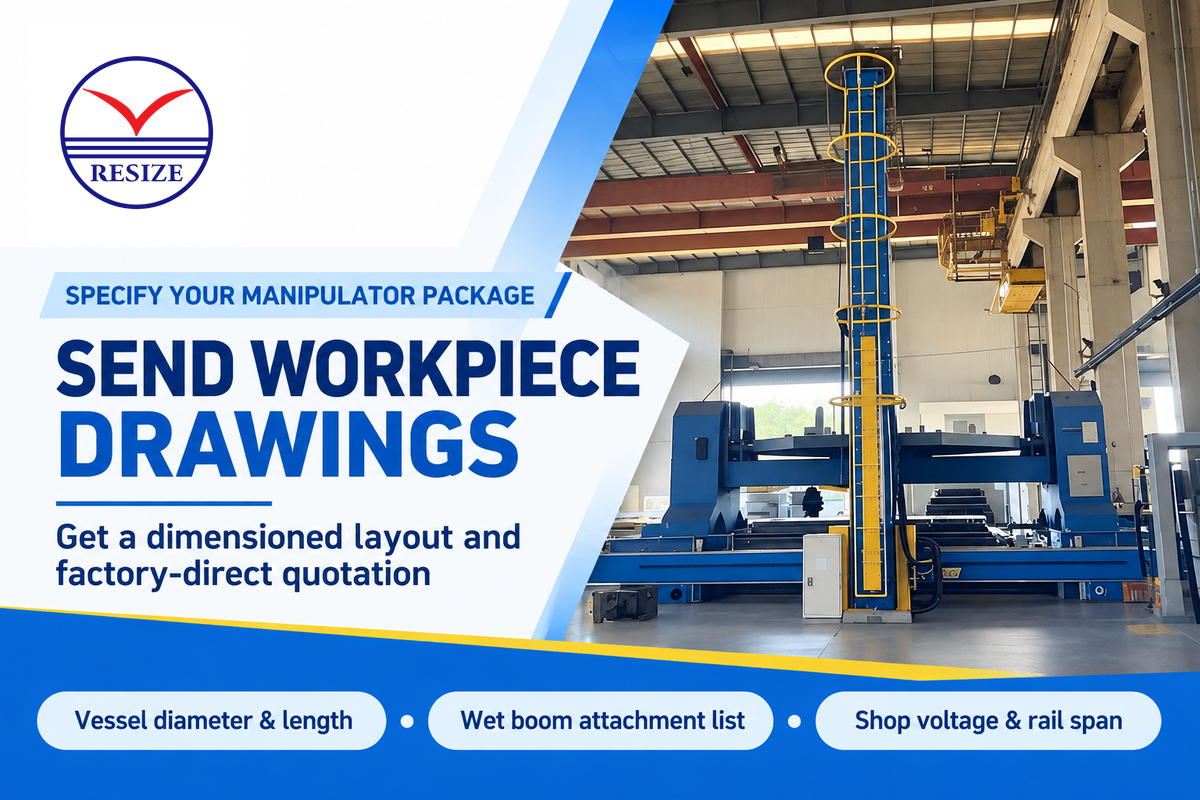
Selecting the right welding manipulator requires matching vertical stroke and horizontal reach to your vessel drawings. Verify full-reach wet boom payload at the manufacturer’s specified load-rating offset, such as AMET’s 300 mm heavy-duty reference point. Always calibrate welding equipment under ISO 17662:2025 and audit loaded boom travel smoothness before shipment. Send RESIZE your workpiece dimensions and attachment schedule to get a dimensioned layout drawing and a factory direct quotation.
Related Reading
참고자료 및 출처
- OSHA 29 CFR 1910.252 General Welding, Cutting, and Brazing Requirements
- AWS D16 Committee on Robotic and Automatic Welding (D16.1:2026, D16.2:2021, D16.3:2026, D16.4:2025)
- AWS Welding Digest: Considerations for Your First Welding Robot (Adam White, Oct 2025)
- AWS Welding Digest: A Guide to Welding Automation, Cobots and Robotic Welding
- ISO 14732:2025 Welding Personnel Qualification for Mechanized and Automatic Welding
- ISO 17662:2025 Calibration, Verification and Validation of Welding Equipment
- TWI Job Knowledge 016: Equipment for Submerged Arc Welding
- The Fabricator / The Welder: Koike Cricket-II Welding Manipulator Technical Profile
- The Fabricator: Automating Welding Starts with Asking the Right Questions
- The Fabricator / The Welder: Trends in Offshore Energy Fabrication
- Google Patents SE532775C2: ESAB AB Welding Crane for Large Structures