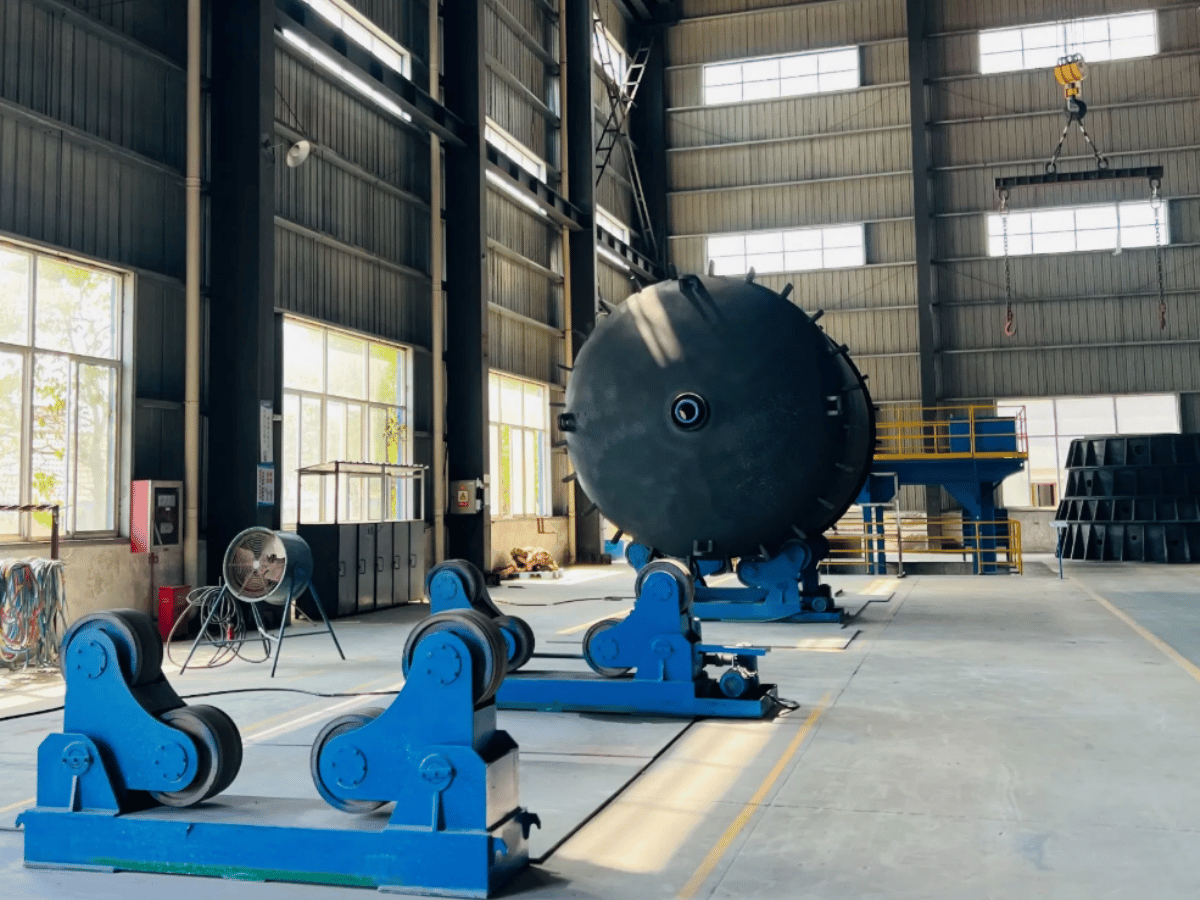
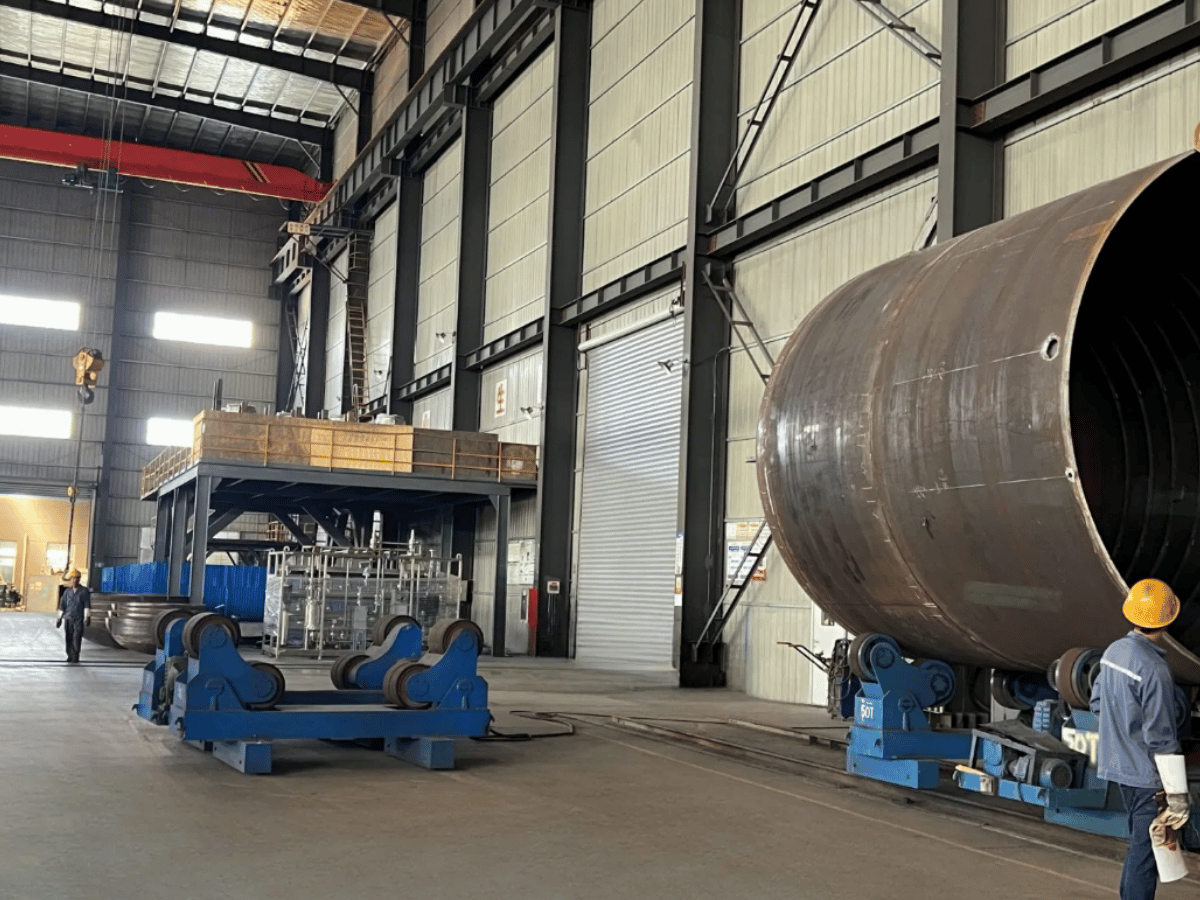
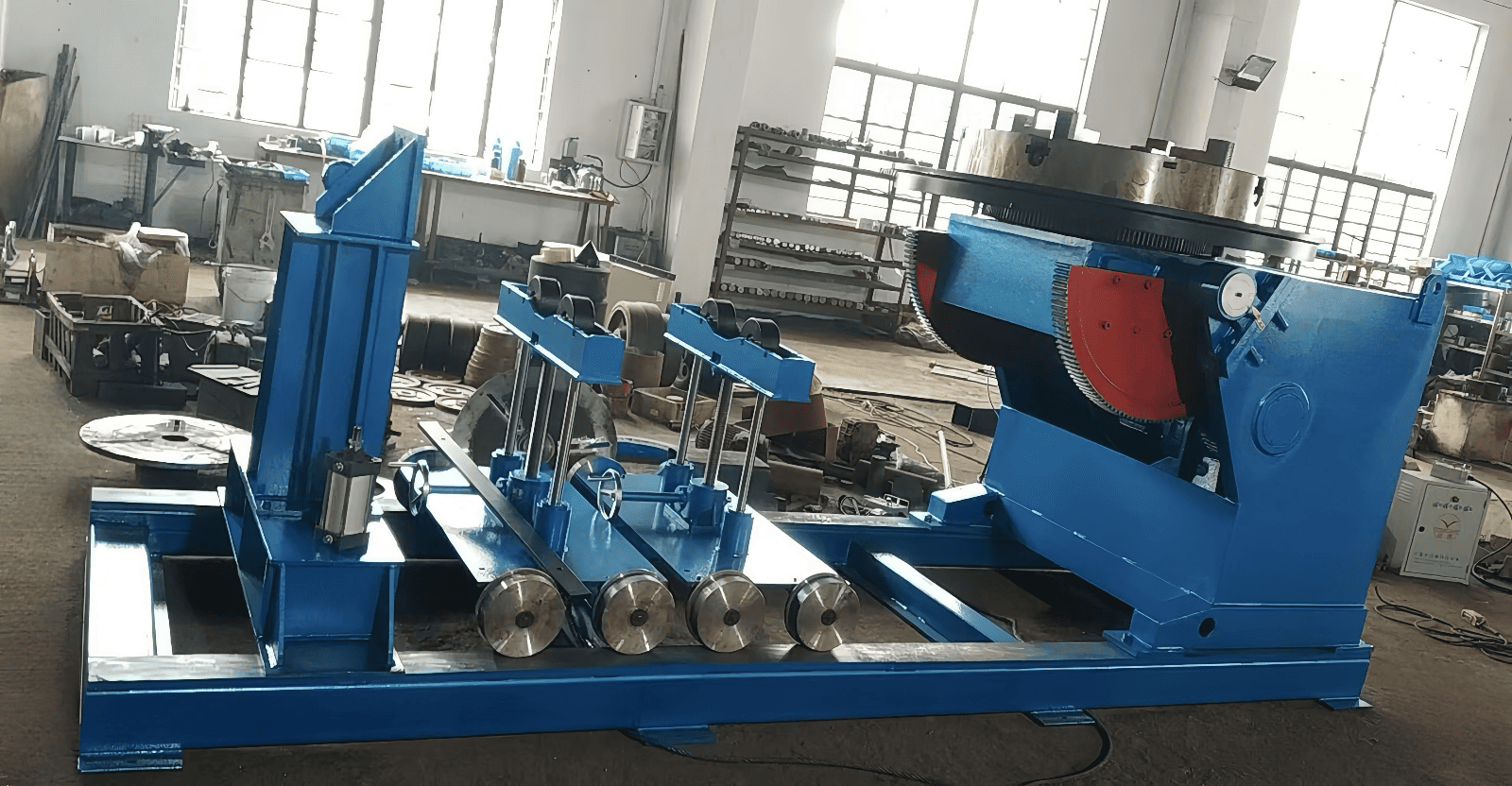
在焊接中,一切都歸結為準確性和效率。無論您從事重工業工作還是客製化精細工作,正確的工具都決定了整個遊戲。其中一種工具是革命性的雙柱旋轉焊接定位器,旨在使焊接操作更平滑、更準確、更安全。然後,本指南深入研究這款創新工具,研究其在各個行業中的功能、優勢和應用。無論是焊接技術的獸醫還是業餘愛好者,本文都將提供所需的見解,以了解為什麼雙柱旋轉焊接定位器是任何當代焊接項目的必備品。請繼續閱讀,準確了解它如何改變您的工作流程並增強焊接效果。.
雙柱旋轉焊接定位器簡介
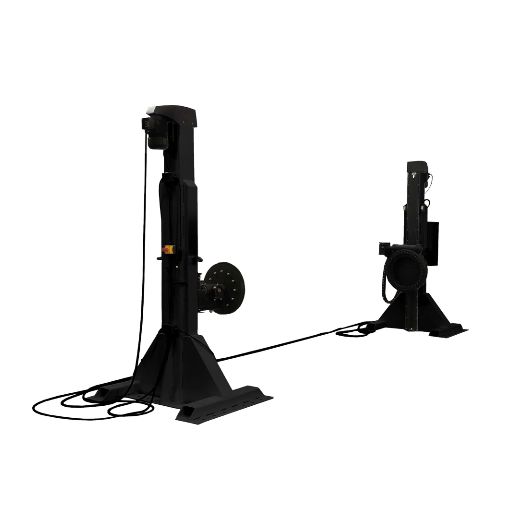
雙柱旋轉焊接定位器是確保焊接高效、精確和安全的稀有設備之一。它使操作員能夠牢固地握住工件並將其旋轉到所需的角度以進行精確焊接。例如,需要良好對準的大而重的零件將是此定位器的理想選擇。它可以方便地進入其他困難的焊接點或顯著減少焊工的身體不適;簡而言之,它提供了更快的焊接時間,同時確保一致、高品質的結果。.
什麼是雙柱旋轉焊接定位器?
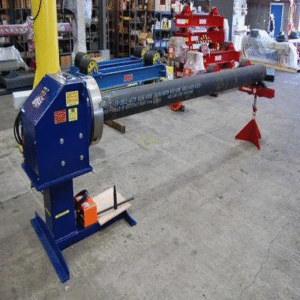
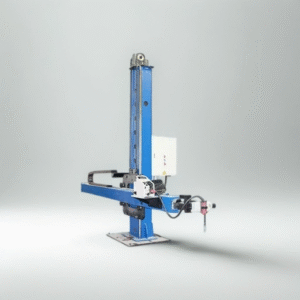
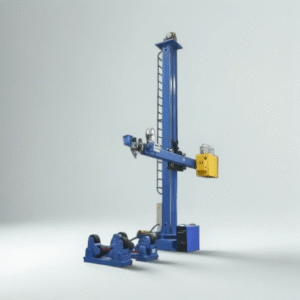
雙柱旋轉焊接定位器是一種高度先進的機器,透過旋轉焊接重型工件,提供製程精度和效率。這些機器具有堅固的雙柱結構,提供更高的穩定性,非常適合固定和加工大型零件。透過旋轉工作台和電動系統,這些機器可以使工件以不同角度平穩、受控地旋轉,從而使焊工能夠毫無困難地進入所有區域。這種人體工學設計顯著減少了體力消耗,從而提高了精度並縮短了生產時間。雙柱旋轉焊接定位器通常用於建築、製造和汽車行業,能夠在小型和大型專案上提供一致、高品質的焊接。.
雙柱旋轉焊接定位器的類型
- 固定高度雙柱旋轉焊接定位器
在這個 焊接定位器的類型, 2。高度固定,適合需要穩定工作高度的焊接應用。它具有出色的旋轉控制能力,通常用於均勻的工件應用。.
-
- 規格:
-
- 負載能力:最大10噸
- 旋轉速度範圍:0.05 × 1.5 rpm
- 操作模式:電控
- 可調式高度雙柱旋轉焊接定位器
此定位器具有可調高度機構,使焊工能夠調整工件的高度,提高舒適度和精度。這種類型用途廣泛,適用於各種焊接應用。.
-
- 規格:
-
- 負載能力:最大20噸
- 高度調整範圍:12 英吋至 48 英吋
- 操作方式:液壓或手動調整
- 傾斜雙柱旋轉焊接定位器
除了旋轉工件之外,這種類型還提供了傾斜工件的選項,以提高在具有挑戰性的焊接角度下的可及性。它廣泛應用於複雜的幾何形狀和大型專案。.
-
- 規格:
-
- 負載能力:最大15噸
- 傾斜角度範圍:0° 至135°
- 旋轉速度範圍:0.1 × 2.0 rpm
- 重型雙柱旋轉焊接定位器
這是一款適用於工業規模應用的定位器,可以精確且穩定地處理超大和重型工件。.
-
- 規格:
-
- 負載能力:最大50噸
- 旋轉速度範圍:0.02 × 1.0 rpm
- 結構材質:高強度鋼
- 緊湊型雙柱旋轉焊接定位器
較小的節省空間的設計非常適合地板空間緊急短缺的設施。它是專門為中小型工件應用而設計的,同時不會影響品質。.
-
- 規格:
-
- 負載能力:最大5噸
- 旋轉速度範圍:0.1 × 2.5 rpm
- 緊湊的佔地面積設計,易於安裝
雙柱旋轉焊接定位器概述
雙柱旋轉焊接定位器是任何需要精密焊接和多功能工作的行業中的重要工具。它們旨在夾緊和旋轉重型或形狀笨拙的工件,總的來說,它們可以透過提高安全性來提高生產率。焊工必須精確控制焊接的轉速和穩定定位,從而減少疲勞。簡而言之,這些新版本引入了自動控制系統、遠端操作能力和增加的承載能力等功能,以滿足更廣泛的製造要求。.
基於其可靠性和有效性,它們已在航空航太、汽車和建築業中得到廣泛應用。建築公司正在大力投資先進的焊接技術,以維持嚴格的品質標準並縮短生產時間。雙柱旋轉焊接定位器仍然處於這一行業趨勢的最前沿,為具有挑戰性的焊接需求提供實用的解決方案。.
雙柱旋轉焊接定位器的主要特點
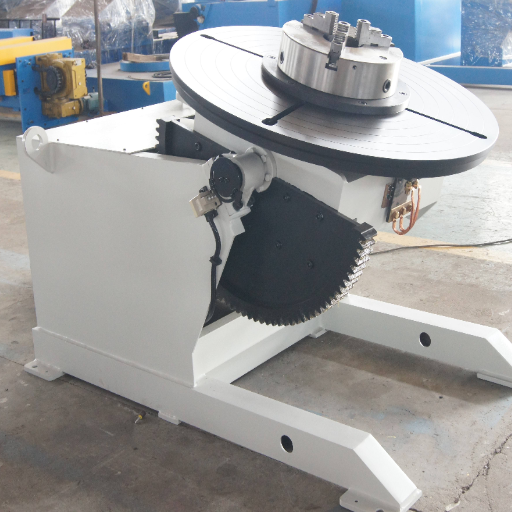
雙柱旋轉焊接定位器徹底改變了焊接行業,重新定義了製造商在處理複雜零件時如何實現精度、效率和安全性。這些巧妙的工具現已成為汽車和航空航天設計以及重型機械製造等行業不可或缺的一部分,為要求嚴格的焊接操作提供最大的多功能性和支援。本文將討論雙柱旋轉焊接定位器的各種功能、它們對生產率的影響,以及它們如何在有效完成最具挑戰性的焊接工作的同時保持一致性。您想簡化您的生產線還是成為該領域的領導者?然後,正如承諾的那樣,在關鍵功能上投入一些時間是一個很好的起點。.
焊接定位器的組件
焊接定位器由許多關鍵部件組成,這些部件協同工作,以確保焊接過程中的精度和效率。以下是焊接定位器的五個基本組件:
- 旋轉桌
工件固定在該主平台上。還可以允許移動以幫助在不同角度和位置進行焊接。.
- 傾斜機構
此功能可調整工件的傾斜度,以實現最佳焊接角度或進入難以到達的區域。.
- 控制系統
該系統控制速度、旋轉方向和傾斜調整。高級定位器可能包括用於自動化功能和精度的 PLC。.
- 夾緊系統
夾緊系統使工件保持穩定,防止其在焊接過程中移動,從而確保安全性和精度。.
- 底座或框架
底座為整個結構提供穩定性,確保定位器在工件的重量下保持直立,即使在重負載下也能平穩運作。.
這些組件中的每一個對於高效和高品質地進行焊接都至關重要,使焊接定位器成為現代製造的重要組成部分。.
Load Capacities and Rotation
Load capacities range from 50 lbs to 100 tons, with rotation speeds typically between 0.1 to 20 RPM.
|
關鍵點 |
細節 |
|---|---|
|
Load (Min) |
50 lbs |
|
Load (Max) |
100 tons |
|
Speed (Min) |
0.1 RPM |
|
Speed (Max) |
20 RPM |
|
精密 |
High (anti-backlash) |
|
驅動類型 |
Electric, Hydraulic, Pneumatic |
|
控制 |
Manual, Semi-auto, CNC |
|
安全 |
Overload, E-stop |
|
用例 |
Cylindrical, Large Parts |
|
自動化 |
機器人整合 |
Motor and Control Systems
The motor and control systems of modern machines must provide precision and efficiency. They are commonly driven electrically, hydraulically, or pneumatically, depending mainly upon the application. Electric motors are widely preferred because of their versatility and excellent energy efficiency. Hydraulic drives offer better torque and last longer; therefore, they are apt for heavy loads. Pneumatic systems, because they are simple and respond quickly, are usually chosen for lighter applications.
Control systems may be manually operated or come with CNC (Computer Numerical Control). Combining a CNC system with sensors enables automated operations that improve production accuracy and speed. To date, there is an increasing number of industrial tasks that emphasize the integration of CNC and robots to maintain constant and accurate precision and movement patterns with increasing complexity. These systems are equipped with safety features, such as overload protection and emergency stop devices, which provide safety during their application.
Advantages of Using Double Column Rotary Weld Positioners
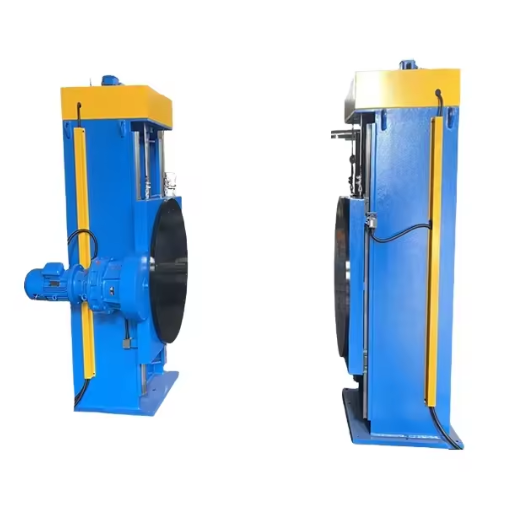
- Enhanced Precision: Double-column rotary weld positioners offer precise positioning of workpieces, ensuring consistency and minimizing welding errors.
- 提高效率: It securely holds and rotates heavy and/or complex components, thereby streamlining operations and saving time compared to manual handling.
- 多功能性: They can be fitted against components of various shapes and sizes to cover different welding applications.
- 操作員安全: The reduced need for manual handling would decrease the dangers involved and provide a safer working environment for operators.
- Better Quality Welds: Stable support and controlled rotation yield better welds with fewer defects, thereby enhancing product quality.
Improved Precision in Welding
The welding positioner is used for precision to gain stability and controlled movement during welding. Hence, these tools enable workpieces to be positioned optimally, thereby limiting weld defects caused by porosity or misalignment. Welding professionals today are increasingly seeking ways to weld with high precision, which is facilitated by manufacturing technologies such as robotics and automation. Welding positioners, integrated with automated systems, can provide consistency and accuracy unmatched by any manual welding technique. This ensures that welders consistently deliver high-quality results that meet strict specifications, thereby reducing rework and material waste.
提高生產力
Enhanced productivity in any welding operation wholeheartedly depends on an exact welding set-up, a positioner. Automation in welding is therefore something that is increasingly sought after, emphasizing the global thrust for manufacturing efficiencies. Welding positioners enable almost uninterrupted continuous operation with minimal downtime durations when integrated with modern robotic systems. This combination is effective in maintaining high production rates and ensuring uniform quality throughout large-scale production runs. Automation of complex welding tasks enables industries to meet exact deadlines and maintain precision, making these systems a crucial part of the manufacturing process.
Increased Safety in Welding Operations
Positioners provide significant enhancements in welding safety by reducing the need for lifting or handling heavy or awkward workpieces. It ensures that workers can maintain ergonomic welding positions, thereby decreasing the risk of industrial injuries. Welding positioners keep workers at a safe distance from the welding zone, minimizing exposure to hazardous fumes, sparks, and heat. Hence, workers and operational efficiency are further nurtured through the dual benefits of automation and accurate control.
Applications of Double Column Rotary Welding Positioners
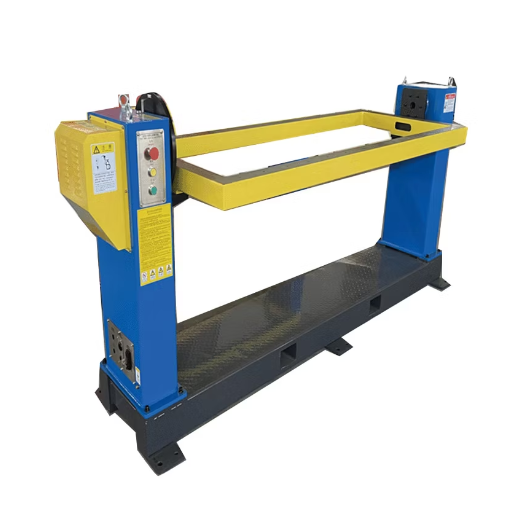
Double-column rotary welding positioners have a wide range of applications in industries where precision and efficiency are crucial for welding operations. These are primarily used in fields such as shipbuilding, construction, aerospace, and heavy machinery manufacturing. They are more suited to welding large and heavy workpieces, such as vessels under pressure, pipes, and structural components. Adjustable in rotation and position, they facilitate welding complex or cylindrical parts with high durability, thereby improving efficiency and reducing the time consumed in production. Their adaptability and reliability make them an indispensable tool in an environment where steady and precise alignment is of the utmost value.
Industries Utilizing Welding Positioners
Welding positioners play a defining role in diverse industrial sectors, equally capable of performing heavy-duty tasks with precision and efficiency. The aerospace industry utilizes welding positioners in the assembly of aircraft components, where precise alignment is crucial to safety and performance. Similarly, the oil and gas industries rely on these tools for laying pipelines, refinery equipment, and pressure vessels. To manufacture vehicle parts with higher precision, the automotive sector utilizes welding positioners to produce components more efficiently while maintaining quality standards. In addition, sectors such as heavy machinery manufacturing, shipbuilding, and renewable energy, including wind turbine manufacturing, will utilize welding positioners to handle and weld complex geometries effortlessly. Given that the positioners increase productivity while offering consistent results, they have become an indispensable process within these fields.
Versatility in Handling Workpieces
Welding positioners are renowned for their versatility in accommodating a wide range of workpieces, regardless of size, shape, or material composition. Industries increasingly favor those positioners capable of multi-axis rotation and exact angular adjustments to accomplish complex welding tasks rapidly. Thus, they provide excellent support for cylindrical objects, irregular geometries, and fine assemblies that require precise welding accuracy. This demand for versatility underscores the importance of welding positioners in industrial development, thereby facilitating optimal performance in terms of productivity.
Case Studies of Successful Integration
1. Automotive Industry Application
An automotive giant utilized advanced welding positioners to streamline the production of car frames and exhaust systems, ensuring precise weld joints through multi-axis rotation and thus significantly reducing production time. The above enhancement increased assembly efficiency by 20% and reduced welding errors; the more precision-oriented equipment entered into a fast-track, high-demand production setup.
2. Aerospace Fabrication Success
An aerospace parts provider utilized welding positioners for manufacturing complex aircraft engine parts that required extreme accuracy. Coupled with robotic welding arms, the positioners allowed intricate geometries to be welded at millimetric accuracy. This integration has resulted in a 30% reduction in waste and has facilitated the achievement of additional industry standards, thereby preserving and strengthening the role of these manufacturing aids.
3. Renewable Energy Advancements
The makers of the wind turbines decided to use welding positioners for large cylindrical towers. The heavy load-handling capabilities of the positioners, coupled with internal stability during welding, ensured consistent weld quality, resulting in a 15% reduction in production costs. It follows that the more efficient processing has helped the company meet rising market demands for promoting energy solutions.
These are a few examples of welding positioners being used in the industries to counter modern manufacturing challenges in the areas of operating efficiency, precision, and productivity.
Choosing the Right Double Column Rotary Welding Positioner
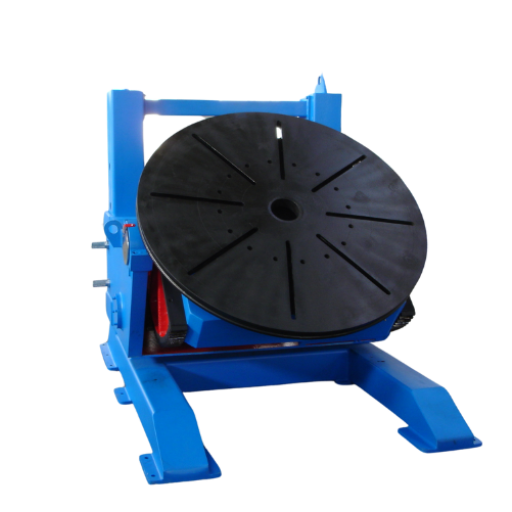
Depending upon the operational need at hand, one would select a proper double-column rotary welding positioner for purchase. The critical factors that determine the choice of the positioner include the maximum weight capacity, size, and type of workpieces it will be receiving. It should have a load capacity and rotational speed that satisfy the welding requirements of the job. Its compatibility with the existing equipment and exact positioning for high-quality welding should be assessed. Always opt for reliable manufacturers and models with proven performance and durability to ensure high efficiency and value over the long term.
Factors to Consider: Load Capacity and Speed
When purchasing a welding positioner, consider its load capacity and speed for optimal performance. Further, here follows a list of five detailed factors for evaluation:
- Maximum Load Capacity
The maximum capacity is the primary concern here, as the welding positioner ought to hold the maximum weight of your heaviest workpiece, including tooling or fixtures. The overloading of the positioner results in mechanical failures and reduced precision in welding.
- 旋轉速度
The positioner should have the provision to be adjusted for variable rotational speed, which depends on the welding process being followed. Typically, the speed levels vary according to the type of welding, whether it is TIG or MIG, to maintain the quality of the weld.
- Weight Distribution
Consider the weight load’s distribution on the positioner. An uneven or offset load may contribute to instability; thus, an operator needs to identify and match the positioner design with the workpiece geometry.
- Dynamic Balance
Examine how the positioner can preserve its stability when its speed changes, especially if the workpiece is irregular or asymmetrical. Thus, the system in its balanced setup allows for continuity in smooth operation and uniform welds.
- Tilt and Rotation Angles
Check if the positioner can tilt and rotate at all the angles that welds present, thus enabling better accessibility and greater precision in areas that are difficult to reach.
Manual vs. Automatic Welding Positioners
Manual welding positioners require operator control for adjustments, while automatic positioners use automation for precision, speed, and efficiency.
|
參數 |
手動 |
自動的 |
|---|---|---|
|
控制 |
Operator-driven |
自動化 |
|
速度 |
慢一點 |
更快 |
|
精密 |
中等 |
高 |
|
成本 |
較低 |
更高 |
|
效率 |
Labor-intensive |
Time-saving |
|
應用 |
小規模任務 |
Large-scale production |
Welding Positioner Prices and Budgeting
When discussing welding positioner prices and budgets, it is primarily related to what you wish to have in terms of operation, specifications, and features. I would first suggest determining precisely what you need. The bigger the load you require, the more automatic the operation will be. Alternatively, do you want it to tilt at specific angles or adjust speed? Entry-level systems are therefore less expensive but lack most of the features; on the other hand, average-sized automatic systems can be costly. Between the two, there must be a balance between cost and functionality for the best value for money.
參考來源
-
Capitol Iron Works: Essential Guide to Welding Positioners – Comprehensive guide covering types, benefits, and selection criteria for welding positioners.
-
Resize Global: Working Principle and Operation Process of the Double Column Rotary Welding Positioner – Detailed explanation of the working principles and operation processes.
-
MISA Manufacturing: 15 Essential Types of Welding Positioners – Expert guide on various welding positioners, including structures and applications.
- Top Double Column Rotary Welding Positioner Suppliers in China
常見問題(常見問題)
Q: What is a double column rotary welding positioner?
答:雙柱旋轉焊接定位器是一種專用裝置,可在焊接操作過程中精確定位工件。它具有可以旋轉和傾斜的轉盤,為焊工提供最佳的角度和接觸焊接接頭的機會,最終提高焊接品質。.
Q: How do welding positioners improve productivity?
答:焊接定位器透過減少工件手動重新定位的需要來提高生產率。這使得焊工能夠更有效地工作,因為他們可以專注於焊接過程,而不是頻繁處理和調整工件,從而最大限度地減少焊工疲勞。.
Q: What types of welding positioners are available?
答: 有不同類型的焊接定位器可供選擇,包括 2 軸和 3 軸定位器、水平軸和垂直軸定位器以及管道焊接定位器等專用選項。每種類型都提供適合各種焊接項目和工件形狀的獨特功能。.
Q: What is the role of a welding turntable in a positioner?
答:焊接轉盤是焊接定位器的重要組成部分,可實現工件的旋轉。這種旋轉可以更好地接觸焊接接頭,透過讓焊工保持一致的姿勢來提高焊接過程的效率和精度。.
Q: How does a welding manipulator work with positioners?
A: A 焊接機械手 works in conjunction with welding positioners to automate the welding process. It can control the welding machine’s movement along different axes, enhancing the automation of welding operations and ensuring consistent performance in various welding conditions.
Q: What are the benefits of using a benchtop welding positioner?
答:桌上型焊接定位器結構緊湊且用戶友好,非常適合小型車間。它們為各種焊接項目提供足夠的負載能力,並為精確定位工件提供靈活性,最終受益於在狹小的空間中使用此類設備。.
Q: What specifications should I consider when choosing a welding positioner?
答:選擇焊接定位器時,請考慮負載能力、軸配置、速度控制選項以及您計劃執行的焊接類型等規格。這些因素將幫助您確定特定焊接應用所需的定位器。.
Q: Can automated welding systems benefit from using rotary positioners?
答:是的,自動焊接系統可以從使用旋轉定位器中受益匪淺。這些系統透過自動化工件定位來提高焊接過程的效率並減少焊工疲勞,從而實現快速且一致的焊接操作。.
Q: How can I reduce welder fatigue in my welding operations?
答:為了減少焊工疲勞,請考慮使用焊接定位器,最大限度地減少手動操作,並更好地定位工件的人體工學位置。結合轉盤和機械手還可以幫助保持舒適的工作姿勢,從而改善焊接效果。.
Q: What is the importance of using a welding chuck with positioners?
A: A 焊接卡盤 is crucial for securely holding round or cylindrical workpieces in place on a positioner. It ensures that the workpiece remains stable during the welding process, contributing to the quality of welding and the overall efficiency of the operation.