プラズマ カッターの消耗品 ¤ 電極、先端、ノズル、渦巻きリング、トーチ内のシールド キャップ ¤ 通常の勤務で数週間ごとに摩耗し、カットがきれいになるか醜くなるかを判断します。このガイドは、コンポーネントの解剖学的構造、交換タイミング、Hypertherm Powermax の互換性、OEM とアフターマーケットの数学、および寿命延長パラメータを 1 つのすぐに使える基準に引き込み、このシフトに作用します。.
クイックスペック: プラズマカッター消耗品
| 5 ピーススタック(ハンドヘルド) | 電極 ・ 渦巻き リング ・ ノズル / チップ ・ 保持 キャップ ・ シールド キャップ |
| Hypertherm ベースライン部品寿命 | 時間通りに 1 ~ 2 時間;数百本のピアス (規律あるケアで最大 1,000+) |
| 交換トリガーピットの深さ | 電極ハフニウムエミッター上の 0.040 ~ 0.125 インチ (1.0 ~ 3.2 mm) |
| ピアース-高さ則 | 1.5 × 2 × カット高さ (ピアスが低すぎるのは、ノズルの早期死亡の #1 原因です) |
| 運用コストの割合 | 業界分析では、一般に総プラズマ切断運転コストの 15 ~ 25% が推定されます |
| 標準リファレンス | AWS C5.2 (プラズマアーク切断の実践); ISO 9013:2024 修正 1 (カット品質) |
プラズマカッター消耗品とは何ですか?
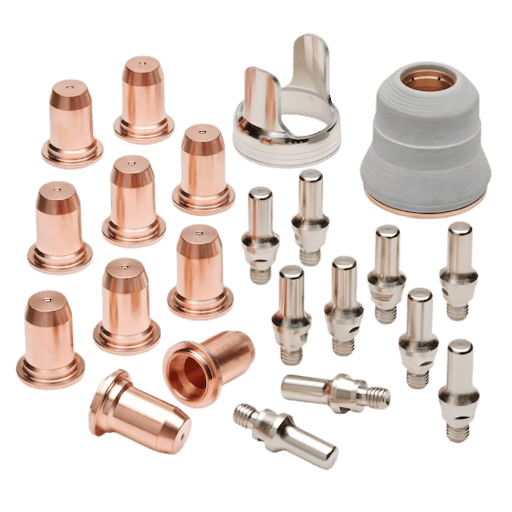
プラズマ カッターの消耗品は、トーチ ヘッドの内側に取り付けられている摩耗部品です。 20,000 °C のプラズマ ストリームに直接面するシステムの唯一の部品です。上流ギア (電源、トーチ ボディ、ケーブル アセンブリ) は何年も稼働し続けます。 5 つのエンドピースは、アークの衝突のたびに材料を失います。.
アセンブリは電極、負の DC 電荷を担持し、アークを維持するハフニウムまたはタングステン放射インサートを備えた銅ホルダーから始まります。ガスは渦リングを通って電極を通過し、流れを回転させてプラズマの集束渦を形成します。渦はノズル (先端と呼ばれることもあります) を通過し、精密オリフィスがカットを形作ります。シールドキャップはスパッタを取り、保持キャップはアセンブリ全体の機械的位置合わせを維持します。. Hypertherm の公式拡張パーツライフ リファレンス ハフニウムエミッターは「アークの熱によって徐々に浸食され、深さ 0.040 ~ 0.125 インチになります。ピットが深すぎると、アークが銅ホルダーに取り付けられ、溶けてしまいます。」この 1 本の線は、消耗品の摩耗物理学の 80% と下流への影響のほとんどを説明しています。.
プラズマ切断システム自体について知りたい場合は、こちらをご覧ください プラズマ切断機の仕組みに関するガイド 上流側をカバーします。ここでの後続のセクションでは、消耗品の摩耗部品に焦点を当てます。.
5 つの中核となる消耗品タイプ
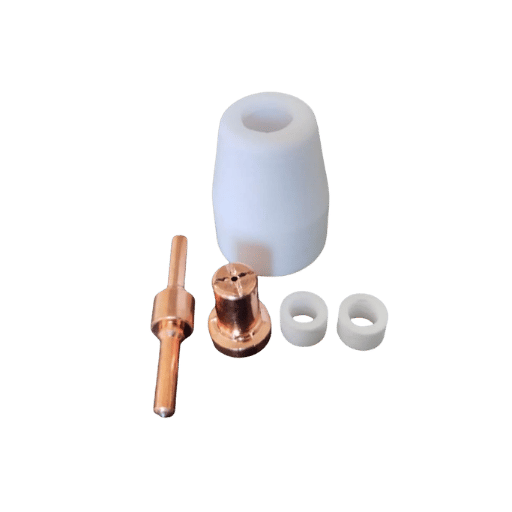
各ピースには微妙な機能、材料の種類、および軽量のアイテムと最も一般的に間違われる故障経路があります。電極とノズルの関係を混乱させることは、ほとんどの場合、「新しい」消耗品セットが期待寿命の半分で摩耗することです。.
電極
先端にハフニウム (または場合によっては銀結合) インサートを備えた銅本体 一部の高級ハイパーサーム電極は、SilverPlus または Copper Plus と呼ばれる銀結合型を使用しており、摩擦溶接された銀/銅接合が純粋なハフニウム設計よりも寿命が延びています。ハフニウムは流れに電子を放出してゆっくりと磨耗し、同心のクレーターを残します。クレーターの深さ × アークオン時間時間だけではない × は、いつ交換するかを決定する最良の方法です。.
ほとんどのプラズマオペレーターが無視する埋もれた費用: 標準の銅電極が最終的に故障すると、廃銅が下流のノズルにスプレーされ、オリフィスを噛み砕きます 銀結合電極は寿命の終わりに破壊性の低い材料を鋳造するため、ノズルを保護します 持続的で高アンペア数の切断を実行するオペレーターは、多くの場合、より高い前払い価格にもかかわらず、数学が銀電極に有利であることがわかります。.
ノズル (Tip)
オリフィスが寸法的に丸く同心円状でなければならない精密に穴が開いた銅部品。プラズマジェットは銅の壁に触れることなく通過し、渦巻くガス境界層によって遮蔽されます。摩耗はオリフィスの面取り、内壁への酸化ハフニウムの蓄積、または壊滅的な出来事の際には ¤ アーク取り付けからの「鍵穴」ガウジとして現れます。ドラッグチップとファインカットチップは、それぞれ接触切断と詳細な作業に最適化されたノズルバリアントです。.
渦巻き リング
プラズマガスを渦巻き渦に引き込む角度付きの穴を備えた小さな絶縁体リング。電極/ノズルの意味で「摩耗」することはほとんどありません。 ¤ 代わりに、熱サイクルによる亀裂や、空気供給中の油や湿気による詰まりが発生します。穴に亀裂、アーク火傷、汚れがないか検査します。トーチサービス技術者の間での実際的な経験則は、損傷が早く現れない限り、電極の変化の 5 回ごとに渦巻きリングを交換することです。.
シールドキャップ(ディフレクター)
溶融金属スパッタを取り、内部スタックがそうならないようにします。 洗浄後に再利用できることが多い ――ハイパーサームのガイダンスでは、シールドは「物理的損傷の兆候が見られる場合にのみ交換する必要がある」こと、金属スパッタは通常洗浄してシールドを再利用できることになっています。カートリッジを交換するたびにシールドを捨てるとお金が無駄になります。.
リテーニングキャップ
機械的にスタックを一緒に保持します。故障はまれです ――通常、洗浄せずにあまりにも多くの変更を行った後にトーチを落としたり、糸をこすったりすることによる。綿棒と電気接点クリーナーで糸をきれいに保ちます;グリースを塗らないでください(アークチャンバー内で点火します)。.
プラズマカッターの消耗品はどれくらい持続しますか?
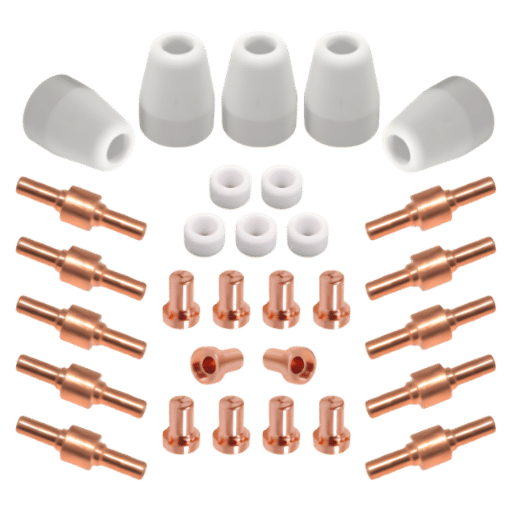
SERPが直接提供する答えはほとんどありません: 最先端の空気および酸素プラズマ システムの Hypertherm が公開したベースラインは、1 ~ 2 時間のアークオン時間と数百のピアスで、慎重に実行されたセットアップは部品交換が必要になるまでに 1,000 + ピアスに達します。. それが天井です。実際の店舗番号は、アンペア数、材料の厚さ、ガスの乾燥度、オペレーターのピアス技術によって異なります。.
“「最先端の空気および酸素プラズマシステムの通常の部品寿命は、アークオン時間1~2 時間で数百のピアスです。一部のシステムでは、部品交換が必要になるまでに1,000 回以上の始動に達することがあります。」”
Hypertherm 技術文書、「部品と消耗品の寿命を延ばす」“
その天井をメンテナンスプランにするには、ほぼすべての製造ショップを3 つの使用階層でカバーします:
| Tierを使う | 典型的な義務 | フルスタック交換間隔 | ピアース カウント 指導 |
|---|---|---|---|
| 重工業 | 毎日、4+ hrアークオン、混合アンペア数 | Every 3–5 weeks | 200–600 pierces / stack |
| Medium fabrication | Daily, 1–3 hr arc-on | Every 6–8 weeks | 400–800 pierces / stack |
| Light / hobby | Weekly bursts, <1 hr arc-on per week | Every 3–6 months | As needed by inspection |
Most practitioners on welding forums cite a rule of thumb of swapping the entire stack after 10–20 hours of cutting, but that mixes up electrode life (shorter) with shield life (longer). A disciplined approach is to track pierce count per machine and replace each part on its own schedule rather than as a set.
How many pierces will a Hypertherm electrode last by amperage?
Hypertherm’s published parts-life ranges scale with amperage. Hand cutting at lower amperage (30–45 A) generally averages 500–1,000 pierces per electrode on mild steel 6–10 mm thick. Mechanized cutting at higher amperage (85–105 A) on thicker plate drops to 200–400 pierces because each pierce dumps a much larger amount of energy into the emitter. SmartSYNC SYNC-series cartridges raise these figures by roughly 2× for mechanized cutting and up to 5× for hand cutting per Hypertherm’s SmartSYNC specifications.
Wear Signs: When to Replace Each Component
Pulling the stack and reading the parts is a 60-second skill that pays back in months of avoided rework. Hypertherm’s troubleshooting framework breaks failures into three diagnostic scenarios plus a concealed fourth:
- ✔
Case 1 — Both electrode and nozzle severely worn: Electrode failed first, blew copper into the nozzle. Check coolant flow (water-cooled torches: bucket-test the return line), gas flow rate, and gas dryness. Black residue on the electrode = contaminated air supply. - ✔
Case 2 — Electrode looks new, nozzle destroyed: Double-arcing of the nozzle. Internal damage (“keyhole” slot) = low plasma chamber pressure (look for gas line leaks). External damage = pierce height too low or torch dragging the plate. - ✔
Case 3 — Electrode pitted deep, nozzle good: Plasma gas flow rate too high; the over-aggressive swirl burns the hafnium emitter unusually fast. - ✔
Hidden Case 4 — Both parts look pristine but the torch wouldn’t fire: Hard starting from excessive plasma pressure during preflow. Parts are fine; the gas regulator isn’t. Discarding good consumables here is one of the most common shop wastes.
Pit-depth thresholds vary by source. Hypertherm’s official wear envelope is 0.040–0.125 in (1.0–3.2 mm). Field practice often replaces earlier — around 1.0–1.6 mm — to preserve cut-quality margin. Industry guidance commonly cites 1/32 in (0.79 mm) as a conservative trigger when cut quality is critical. Use the tighter threshold when your tolerance budget is small.
Hypertherm Powermax Compatibility Quick Reference
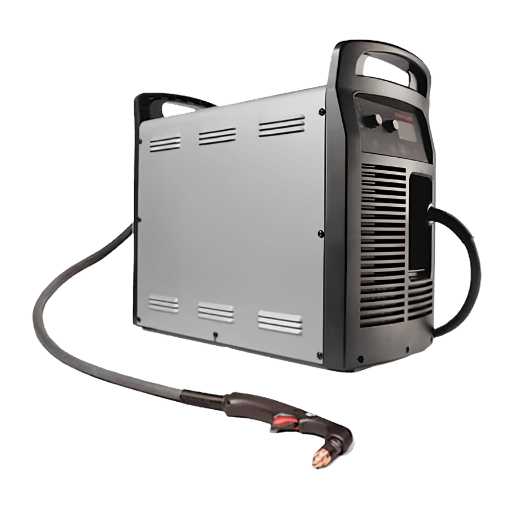
Powermax is the dominant handheld plasma platform in fabrication shops, and Hypertherm runs two parallel consumable families: traditional 5-piece stacks for legacy units, and the newer single-cartridge SmartSYNC for SYNC-series machines. Mixing them is a non-starter — the torch geometry differs.
| Powermax model | Consumable family | Notable trait |
|---|---|---|
| Powermax30 AIR / 30 XP | Traditional 5-piece (low-amp) | Drag-tip variants common; for 3/8 in (10 mm) cuts and below |
| Powermax45 / 45 XP | Traditional 5-piece | Workhorse for ½ in (12 mm) mild steel |
| Powermax45 SYNC | SmartSYNC single cartridge | Up to 5× longer hand-cutting consumable life vs traditional |
| Powermax65 / 65 SYNC | Traditional 5-piece OR SmartSYNC (model-dependent) | ¾ in (20 mm) gouge/cut; SYNC version gives ~2× mechanized life |
| Powermax85 / 85 SYNC | Traditional 5-piece OR SmartSYNC | 1 in (25 mm) cut; SYNC adoption growing in 2025–2026 fab fleets |
| Powermax105 / 125 | Traditional 5-piece (heavy-duty) | High-amperage continuous duty; SilverPlus electrodes recommended |
SmartSYNC’s tradeoff is upfront cost: the cartridge replaces five separate parts but the per-cartridge price runs higher than the equivalent 5-piece stack. For shops running >3 hours of arc-on per day on hand torches, the math typically favors SmartSYNC within 90 days — consumable longevity plus changeout time (under 30 seconds vs. roughly 2 minutes for the traditional stack). For occasional users, the legacy 5-piece is still the rational choice. To match a Powermax to your application before committing to a consumable family, see our breakdown of CNC plasma cutter selection criteria and the broader RESIZE plasma cutting machines lineup.
OEM vs Aftermarket: True Cost & Performance
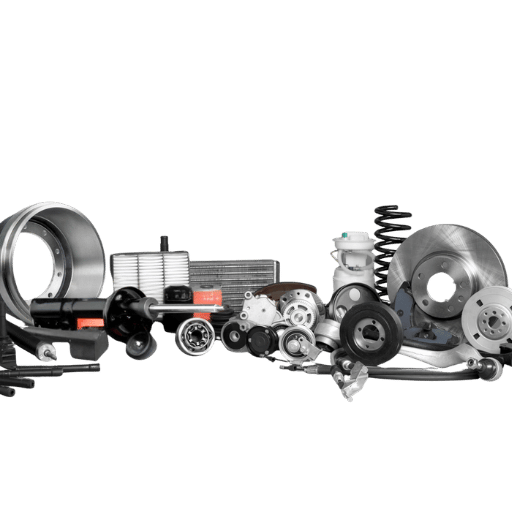
Aftermarket plasma consumables — third-party electrodes, nozzles, and shield kits — typically price 20–40% below OEM. The real question is the longevity delta, and the honest answer is that it varies enormously by aftermarket brand. Reputable aftermarket houses (PrimeWeld, Forney, Harris-stocked alternatives) routinely deliver 70–90% of OEM life. Bottom-tier no-name parts can drop to 30–50%, with inconsistent orifice tolerances that wreck cut quality before the parts wear out.
| 要因 | OEM (Hypertherm genuine) | Quality aftermarket | Budget aftermarket |
|---|---|---|---|
| Cost vs OEM baseline | 100% | 60–80% | 30–50% |
| Lifespan vs OEM baseline | 100% | 70–90% | 30–50% |
| Cut-quality consistency | Tight orifice tolerance | Good, batch-dependent | Variable, sometimes off-spec from new |
| Warranty impact | Full Hypertherm coverage | May void torch warranty | Voids warranty |
- Light hobby (≤40 A, weekend use): Reputable aftermarket is fine. Lifespan delta is small in absolute hours.
- Medium daily (45–65 A, 1–3 hr arc-on): Quality mid-tier aftermarket OK; avoid no-name budget kits. Track per-shift cost per pierce, not per-part cost.
- Heavy continuous (≥85 A, 4+ hr arc-on, mechanized): OEM only — SilverPlus / Copper Plus electrodes if available. Cut-quality variability of budget aftermarket adds rework cost that eclipses the part savings.
Are plasma cutter consumables interchangeable between brands?
No — and the answer holds across nearly every torch family. Hypertherm Powermax consumables do not fit a Miller Spectrum or a Lincoln Tomahawk; ESAB CutMaster parts do not fit a Forney Ignite torch. The torch head’s mechanical geometry and ohmic contact points are torch-specific. “Hypertherm-style” aftermarket consumables exist for the Powermax line and the SmartSYNC ecosystem, but they are still Hypertherm-platform parts. Cross-brand swapping risks instant nozzle destruction and may void torch warranties on both ends.
How to Maximize Consumable Life: Field-Tested Practices
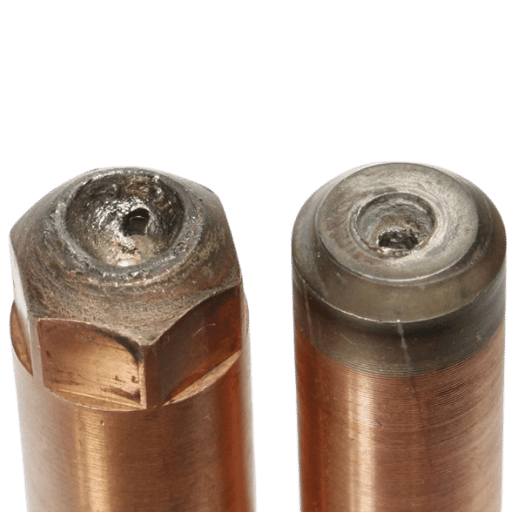
Hypertherm’s 10 common plasma arc cutting mistakes reads as a checklist of every shortcut that quietly reduces parts life. Five practices deliver the most measurable gains:
- Match amperage to the nozzle rating. Best cut quality and parts life land at roughly 95% of the nozzle’s rating. Under-current cuts come out sloppy; over-current accelerates nozzle wear sharply.
- Set pierce height at 1.5–2× cut height. Piercing too low — Hypertherm’s #1 cause of premature nozzle failure — sprays molten metal back into the orifice on every pierce. Use torch height control with a tested standoff routine.
- Verify gas pressure and dryness daily. Excess plasma pressure during preflow causes hard starting; contaminated compressed air shortens electrode life dramatically. A paper-towel test at the torch outlet (no moisture, no oil) catches most contamination issues for free.
- Inspect rather than calendar-replace. Calendar replacement throws away parts with life left and misses early failures from off-spec conditions. Pull the stack when cut quality shifts, not on a fixed date.
- Keep the threads clean. Cotton swab plus electrical contact cleaner or hydrogen peroxide on assembly. Never grease O-rings — grease ignites in the arc chamber and destroys the torch interior.
Pierce height matters more than amperage choice for electrode life on production runs. Hypertherm recommends a pierce standoff of 1.5–2× the recommended cut height; piercing below cut height deposits molten metal on the nozzle face within the first 100 pierces, even when the electrode is brand new. Set pierce delay so the plasma fully transfers before motion begins — typical 0.4–0.8 s on mild steel up to 12 mm thick (cross-reference: AWS C5.2 §5 Recommended Practices for Plasma Arc Cutting and Gouging; ISO 9013:2024 Amendment 1 for cut-quality acceptance grades). For a properly sized air supply to support these parameters, see our note on matching an air compressor to a plasma cutter.
Cut Quality Issues Traced to Worn Consumables
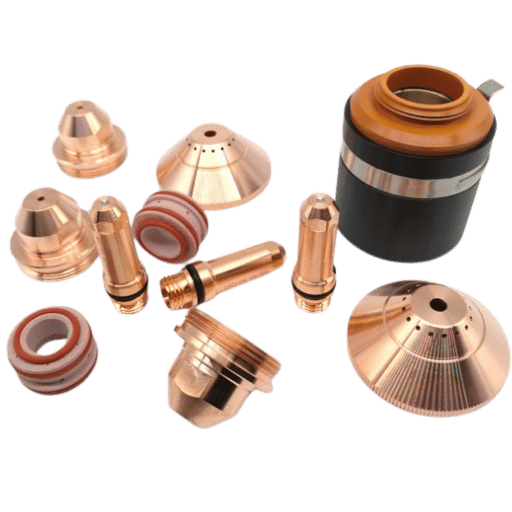
When a cut goes ugly, the failure mode points at the component. The matrix below maps the five most common symptoms to the most likely culprit — pulling the stack to confirm is faster than chasing the problem in the cut program. Cut-quality acceptance ranges follow ISO 9013, with plasma cutting typically classified at Class 2 dimensional tolerance.
| Cut symptom | Most likely cause | First action |
|---|---|---|
| Rough or chamfered top edge | Nozzle orifice enlarged | Inspect nozzle for chamfering; replace if oval |
| Excessive bottom-edge dross | Electrode end-of-life or speed too low | Check electrode pit depth; verify cut speed against amperage chart |
| Beveled cut surface (>5° lean) | Worn swirl ring or off-center electrode | Replace swirl ring; verify electrode seating |
| Wide kerf, low edge precision | Nozzle orifice enlarged or speed too low | Replace nozzle; review cut speed |
| Arc fails to start; “spits and sputters” | Hard starting from excess preflow pressure (parts are likely fine) | Drop plasma gas pressure before assuming the consumables are dead |
A common operator instinct is to throw new consumables at quality problems. A discipline of pulling the stack and reading the parts first — usually a 60-second routine — catches most cases at the first symptom and avoids the “everything goes in the bucket when something looks off” habit that bleeds shop budgets.
Industry Outlook: Plasma Consumables Market 2025–2030
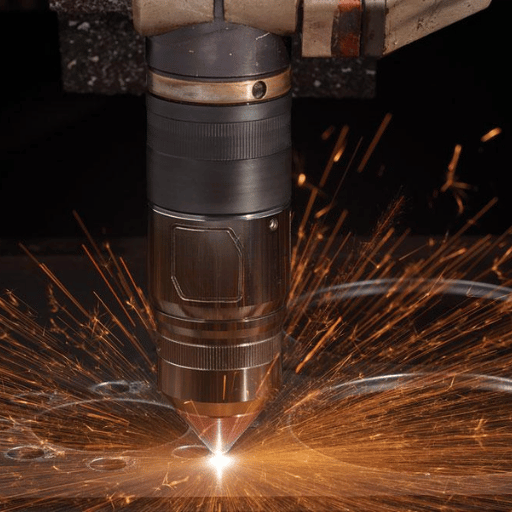
The plasma cutting torch and consumables market sat at roughly $1.54 billion in 2025 and is projected toward $2.45–2.60 billion by 2031–2033. Three independent market researchers place the compound annual growth rate between 4.5% and 6.6% over the forecast window. IntelMarketResearch’s plasma arc cutting system outlook pegs the broader cutting-system market at $1.909B in 2024 heading toward $2.595B by 2031. Steady, not explosive — meaning consumable inventory planning faces no boom-bust risk through 2030.
Three technology shifts matter for buyers planning equipment now:
- SmartSYNC cartridge adoption — already mainstream. Hypertherm’s single-cartridge SmartSYNC replaces the traditional 5-piece stack on Powermax 45/65/85 SYNC machines and delivers up to 5× longer hand-cutting life. For any new Powermax purchase above the entry level in 2026, the SYNC variant is the default — the upfront cartridge premium pays back within a quarter for shops above 3 hr daily arc-on.
- Silver-bonded electrodes for high-duty applications. Hypertherm’s SilverPlus and Copper Plus electrodes use friction-welded silver/copper junctions to roughly double electrode life and reduce downstream nozzle damage. Mainstream availability for the 85–125 A Powermax range; specify these for any continuous mechanized cutting line.
- IoT wear-sensor consumables — 2027 and beyond. Embedded wear-monitoring is in the pre-commercial phase as of 2026. Do not pay a premium today for “smart consumables” claims — the production-grade rollout is one to two years out.
On the standards side, ISO 9013:2024 Amendment 1 updated the thermal cutting classification standard covering plasma, oxyfuel, and laser. Cuts going into regulated industries (pressure vessels, structural steel) should reference the 2024 amendment, not the 2017 edition. AWS C5.2 Recommended Practices for Plasma Arc Cutting and Gouging remains the process-side reference and has not been revised since 2001 — still the authoritative US-side practice document.
よくある質問
Q: How thick of steel will a 20 amp plasma cutter cut?
回答を見る
Q: Can plasma cutter consumables be cleaned and reused?
回答を見る
Q: Are plasma cutter consumables the same for hobby and industrial use?
回答を見る
Q: How do I store plasma consumables to prevent contamination?
回答を見る
Q: Does shop compressed air shorten consumable life vs bottled gas?
回答を見る
Q: What is a SmartSYNC cartridge and is it worth the upgrade?
回答を見る
プラズマカッターのセットアップを指定しますか?
消耗品の選択は機械の下流にあります。新しいプラズマ切断システムのサイジングを行う場合 ―― キネティック、パイプ、または CNC テーブル ―― プレートの厚さ、デューティ サイクル、および材料混合に合わせて構成します。.
About This Plasma Cutter Consumables Reference
This consumables reference is compiled from Hypertherm’s official extending-parts-life and SmartSYNC documentation, the AWS C5.2 Recommended Practices for Plasma Arc Cutting and Gouging, ISO 9013:2024 cut-quality classification, and three independent 2025–2026 market research reports. Practitioner-reported insights are paraphrased from welding forums. The RESIZE engineering team reviewed it for plasma cutting machine specification context — feedback or corrections welcome at official@resizeglobal.com.
参考文献と情報源
- Extending Parts and Consumables Life — Hypertherm Technical Documentation
- 10 Common Plasma Arc Cutting Mistakes — Hypertherm
- SmartSYNC Torches and Consumables — Hypertherm Powermax
- AWS C5.2 — Recommended Practices for Plasma Arc Cutting and Gouging ――米国溶接協会
- ISO 9013 — Thermal Cutting Classification — International Organization for Standardization (2024 Amendment 1)
- Plasma Arc Cutting System Market Outlook 2025–2032 — Intel Market Research
- Industrial Plasma Cutting Torch Consumables Market Research — Growth Market Reports
関連記事
- What is a Plasma Cutting Machine: working principles & key components
- CNC plasma cutter selection guide for fabrication shops
- CNC plasma table guide — features, sizing, and torch height control
- Plasma cutting vs laser cutting: cost, speed, and material range
- Compare plasma, laser, and waterjet cutting for thick plate
- Pipe milling and beveling machines for post-cut edge prep