![RIDGID B-500 Pipe Beveler Review: specificaties, prijzen en beste alternatieven [2026]](https://resizeweld.com/wp-content/uploads/2026/05/0-4-1024x683.webp)
Snelle specificaties 0 RIDGID B-5 in één oogopslag
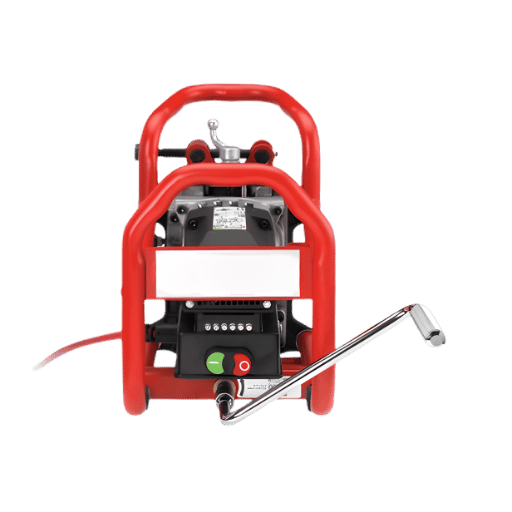
| Specificatie | Value |
|---|---|
| Catalogusnummer | 49298 |
| Minimale Pijpgrootte | 4″ OD en groter (handvat ook vlakke plaat) |
| Wanddiktebereik | 0,188″ 0,500″ (4,8 mm, 12,7 mm) |
| Standaard Afschuining Hoek | 37.5° |
| Optionele Hoeken | 30° en 45° (wisselwissel invullen vereist) |
| Motor Speed | 950 TPM |
| Cutter Inserts | 6 indexeerbare carbide inzetstukken |
| Geadverteerde Bevel Time | 45 seconden* |
| Gewicht | 56,5 lbs (25,6 kg) |
| Power Supply | 120V, enige fase |
| Lijst Prijs (ca) | $4.885 |
| Gebruikersbeoordeling | 3,8 / 5 (6 beoordelingen, 67% aanbevolen) |
* Afschuiningstijd van 45 seconden op 10-inch Schedule 40 koolstofstalen buis Tijden variëren per buismaat, wanddikte, materiaal en insteekconditie.
In tegenstelling tot de meeste draagbare buisafschuiningen heeft de B-500 een klem die aan de buitenkant van de buis zit in plaats van aan de binnenkant. Monteer hem op de buis, selecteer de aanbrenghoek en de 950-toerenmotor laat de snijkop rond de buis draaien, geen slijpschijf, geen open vlam. Het proces spant materiaal weg in plaats van vonken, wat vooral belangrijk is als er moeilijk warm werk kan worden verricht.
Voor meer informatie waarin alle procesopties worden vergeleken (interne klem-ID-molens, handslijpmachines, enz.), zie ons artikel op wat een afschuinmachine is.
Wat is de RIDGID B-500 en hoe werkt het?
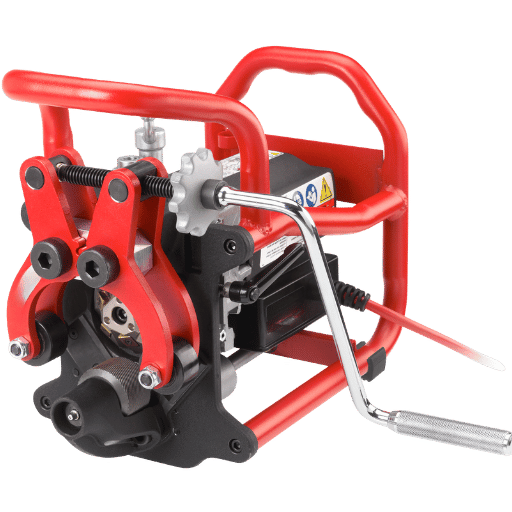
De B-500 is een elektrisch aangedreven, OD-gemonteerde, draagbare afschuinmachine Het is anders dan de meer gebruikelijke alternatieven: handmatige schuine zadelpijp (die op zuurstof-brandstof of plasmatoorts lopen), en interne-klem ID schuine randen (die binnen de pijpboring moeten worden bevestigd).
Het is eenvoudig op te zetten U klemt het op de buitendiameter van de pijp, zet de zes indexeerbare carbide inzetstukken op de gewenste hoek, en zet de 120V motor aan De snijkop draait bij 950 RPM, scheermateriaal van het pijpuiteinde in één doorgang Omdat het een puur mechanische snede is - er is geen warmtebron bij betrokken - de door warmte beïnvloede zone blijft minimaal en de afschuining lengte blijft nauwkeurig Een 37,5 V afschuining komt vlak en consistent van de machine af, binnen ASME B16.25 specificaties voor drukpijpdoorgang.
Het ontwerpvoordeel ten opzichte van op fakkels gebaseerde zadelmachines is consistentie. Het afschuinen van fakkels is ongelooflijk gevoelig voor de verplaatsingssnelheid van de fakkel en de fakkelhoek. Factoren die aanzienlijk variëren van operator tot operator, van lot tot lot. De B-500 behoudt een constante snijhoek en -positie. Het verandert niet van de eerste afschuining naar de honderdste.
Sommige setup realiteiten zijn het vermelden waard Het ontwerp van de OD-klem vereist toegang tot het buisuiteinde (het uitsluiten van in-line sneden op geïnstalleerde pijp, tenzij de pijp eerst wordt gesneden Bij 56,5 lbs, is het draagbaar, maar sommige grotere pijp diameters kunnen twee operators in het veld nodig hebben voor de setup De 120V stroombehoefte kan een probleem zijn, tenzij u uw eigen generator (pneumatische gereedschappen lopen van een compressor.
Welke buismaten heeft de B-500 eigenlijk?
De fabrikant spec zegt “4 inches en groter, inclusief vlakke plaat.” De beperkende factor is niet diameter (het is wanddikte De B-500 behandelt muren van 0.188 inches tot 0.500 inch Het bereik omvat standaard (Std), extra-sterk (XS), en een gedeelte van 80-schema pijp op de meest voorkomende maten.
De limiet is belangrijk Schedule 160-pijp van 15 cm heeft een wanddikte van 0,718 inches 44% boven het maximum van de B-500. 120-inch Schedule 120 loopt 0,719 inch. Als u wanddikte kwalificeert voor uw werk aan drukvatsproeiers, hogedrukstoomkoppen of structurele pijp met dikke wand, controleer deze dan eerst voordat u vertrouwt op de B-500 om de applicatie af te dekken. Het zal niet.
Voor hulp bij het afstemmen van de machinecapaciteit op uw leidingschema, zie onze pijp snijden en afschuining machine selectie gids.
Prestaties: wat echte gebruikers melden
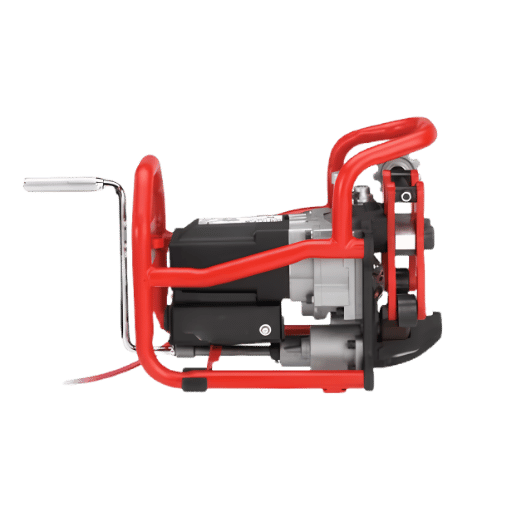
De RIDGID B-500 heeft een 3,8-uit-5 sterren rating uit zes reviews gepubliceerd tot nu toe, met 67% van reviewers die de tool aanbevelen De zes reviews zijn statistisch niet significant als een steekproef, maar het verhaal clustert sterk genoeg voor een aankoopaanbeveling.
Snelheid is de meest voorkomende lof, meestal van gebruikers die hun machine laten draaien op standaardwandige koolstofstalen buizen ergens in het bereik van 6 tot 12 inch. Snelle cyclustijden worden bevestigd doordat gebruikers het gereedschap op hoekslijpmachines van 4,5 inch laten draaien met schuine tijden van 3 tot 8 minuten op basis van pijpdiameter, lasserervaring en andere variabelen. Voor een winkel met een hoog volume is tijdwinst vaak voldoende om een aankoop te rechtvaardigen.
Twee van de zes gepubliceerde beoordelingen vermelden motorische storing (een 33% motorstoringspercentage in die kleine steekproef Dat is niet genoeg informatie voor statistische vertrouwen, maar het is voldoende om zorgen te uiten voordat een $4,885-tool in een dagelijkse productielijn wordt gemonteerd.
| Strength | Beperking |
|---|---|
| Snelle cyclustijd op standaardwandpijp | Motorstoring gemeld in 2 van de 6 beoordelingen |
| Er zijn geen open vuurwerken waarvoor de vergunning voor warmwerk beperkt is | Wanddikte met een afdekking van 0,500″ 0,500' sluit zware schema's uit |
| Consistente kegelhoek geen operator drift tussen passages | Slechts 3 hoekopties zonder wisselplaten |
| Alleen chipverwijdering: geen maalstof of vonken | 56,5 lbs 56,5 lbs een echte draagbare eenpersoonshulpmiddel |
| Reinig prep voor geautomatiseerde of orbitale lasfollow-up | 4″ minimale pijpmaat kan pijp met kleine boring niet hanteren |
Voor perspectief op hoe de kwaliteit van de afschuining wordt beoordeeld en welke maattoleranties worden toegekend aan lasvoorbereiding, zie ons artikel over afschuinings- en afschuiningsnormen.
RIDGID B-500 versus topalternatieven: zij-aan-zij vergelijking
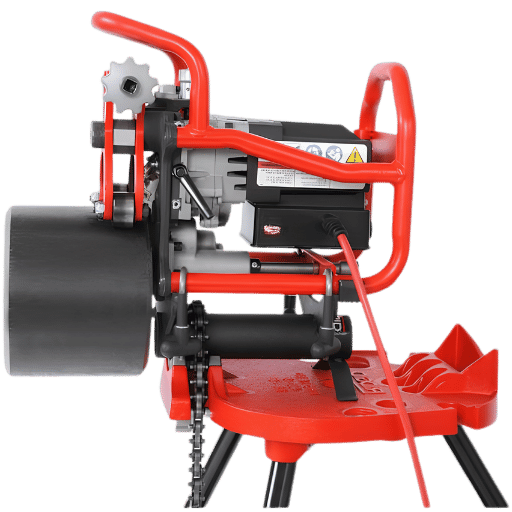
De B-500 heeft een speciale marktniche: elektrische, OD-geklemde, draagbare, single-operator afschuining van 4-inch-en-grotere pijp die standaard of extra sterke wanddikte is Hier is hoe het stapelt tegen vier andere machines die kopers meestal in dezelfde categorie beschouwen.
| Tool | Mechanisme | Pipe Range | Max Wall | Angles | Gewicht | Prijs (USD) |
|---|---|---|---|---|---|---|
| RIDGID B-500 | Elektrische OD-klem | 4″+ OD | 0,500″ | 30°, 37.5°, 45° | 56,5 pond | ~$4.885 |
| H&M HM02 | Handzadel (fakkel) | 6″-12″ OD | Elke (fakkel) | Verstelbaar | ~20 pond | $2.848 |
| Mathey Dearman 2SA | Handzadel (fakkel) | 6″-12″ OD | Elke (fakkel) | Verstelbaar | ~18 pond | $2.495 |
| ESCO Mini MILLHOG | Elektrische ID-klem | 1,25″-6,6″ OD | Zware muur | Elke graad | N.V.T | Citaat |
| RESIZE Frezen & Bevelen | Elektromotor aangedreven | 0,5″-24″ ID | 12″+ wand geschikt | Elke graad | Modelafhankelijk | vanaf $1.565 |
In die vergelijking vallen verschillende verschillen op De H & M - en Mathey Dearman-zadelmachines werken op zuurstof - of plasmatoortsen en draaien niet door middel van centrifuges Ze zijn lichter, minder kostbaar, maar vereisen een gastoevoer of plasma-voeding, en behoren tot een andere categorie veiligheid bij warm werken Hun afgewerkte afschuiningen zijn niet afhankelijk van de bediener, maar zijn een functie van de kwaliteit van de toorts. Elektrische gereedschappen bereiken een constante mate van precisie, zelfs bij gecertificeerd constructie - of druklaswerk voor nucleaire, offshore - of hogedruktoepassingen.
De MILLHOG-lijn van ESCO Tool is de industriële standaard elektrische ID-klem-afschuinmachine ESCO produceert sinds 1954 afschuingereedschappen. Hun productlijn strekt zich uit van 0,5-inch ID tot 36-inch OD. De Mini MILLHOG zorgt voor buizen met een kleine boring die de B-500 niet kan bereiken. De Dictator MILLHOG zorgt voor buizen tot 18-inch Schedule 160 ’, ver buiten de 0,500-inch muurbeperking van de B-500. ESCO-prijzen zijn gebaseerd op offertes via distributeurs en worden niet openbaar gemaakt, en staan in het prijsvraagprogramma voor industriële apparatuur.
Voor winkels die één enkele machine nodig hebben die een breed assortiment bestrijkt, of die regelmatig te maken krijgen met buizen met zware muren en grote diameters, is de RESIZE frezen en afschuinen machinelijn covers pipe 0.5-inch through 24-inch ID in multiple configurations. For a more detailed look at types of machines and how they facilitate different applications, check out our pipe beveling machine guide.
Is the RIDGID Worth $4,885? Price-to-Performance Analysis
For high-volume shops, the calculus often favors the investment. A welder running a 4.5-inch angle grinder generally takes 3 to 5 minutes to prep a typical 6-inch carbon steel pipe end. The B-500’s nominal 45-second cycle time on 10-inch Sch40 suggests 30 to 45 seconds is a reasonable expectation on smaller, lighter-wall pipe. At a fully-loaded labor rate of $75/hr, that 3-minute difference equates to approximately $3.75 saved per bevel. A shop processing 20 bevels a day hits payback for the $4,885 machine cost in about 65 working days.
That calculus vanishes if the motor croaks. Replacing or repairing on a premium tool quickly undermines the ROI, and the distribution of motor failures in unscientific reviews would lead you to believe it is not insignificant. For manufacturing environments operating the machine 8 hours a day, motor duty cycle becomes more important than it is for unscheduled shop applications.
The 0.500-inch wall restriction presents another hidden expense in mixed shops. If 20% of your jobs need something heavier, you will require two machines, not one – it is an absolute necessity. Owning a $4,885 beveler that is unused on heavy-wall days costs you serious money.
The B-500 is justifiable for buyers whose pipe range and wall thickness falls squarely within its parameters and who do not need to bevel above typical weight. For buyers whose job mix includes regular heavy-wall, stainless, or large-diameter pipe, a machine with broader capacity will deliver better per-bevel economics across the full workload.
For a broader discussion of why beveling machines are important to weld quality and production economics, see our guide to the function of beveling machines in production welding.
How to Choose a Portable Pipe Beveler: The 4-Decision Framework
Most beveler purchasing errors result from optimizing for one factor – most often price – while neglecting three others. This questionnaire addresses those four facets before you buy.
Decision 1: What pipe sizes do you need to bevel?
If your work runs at 4″ and above in standard or extra-strong schedules, the B-500 covers the pipe range. If you are routinely beveling 2″ or 3″ pipe – typical of process piping, instrumentation lines and chemical plant work – the B-500’s 4″ minimum leaves you a gap that you will need another tool to fill. ID-clamp tools like the ESCO Mini MILLHOG or RESIZE small-bore tools cover pipe from under 1″ OD up. Purchasing the B-500 for a mixed-bore shop with no other machine to handle small pipe means grinding by hand – defeating the reason you purchased the machine in the first place, in terms of speed of production.
Decision 2: Shop installation or field portable?
At 56.5 lbs (25.7kg), the B-500 is portable in that you can transport it wherever you need to go – but not in that one person can carry it up the ladder, through the confined space entry, etc. For real field portability (scaffold work, platform work, etc.) lighter manual saddle or pneumatic beveling machines are typically better suited. For shop use with a fixed work area and easy access to 120V power, the weight becomes irrelevant. Be hard on yourself in honestly specifying where the machine will be used before portable enters into your justification.
Decision 3: What wall thickness governs your work?
This is the question often overlooked. wall thickness is driven by both machine selection and the welding code to be followed. The B-500’s 0.500″ (12.7 mm) maximum easily covers standard through extra-strong wall on the majority of common pipe sizes. Pressure vessel nozzles, reactor piping and high pressure steam headers routinely go beyond. 6-inch Schedule 160 pipe has a 0.718-inch wall – 44% beyond the B-500’s rated limit. Know where you will draw on heavy wall work before you select a machine for your pipe or vessel fabrication shop.
Decision 4: Which welding code governs the work?
Bevel angle is a code requirement, not a preference. ASME B16.25 (pressure piping butt welds) specifies 37.5° for wall up to 22.5 mm — the B-500’s standard angle, no modification needed. API 1104 (oil and gas transmission pipelines) uses 30° as the standard groove angle. AWS D1.1 (structural steel) varies by joint configuration. If your contract calls for 30° and you bought the B-500 expecting its standard 37.5° setup to cover it, you need the optional insert set — available, but not included in the base price. Know the code requirement before you configure the machine.
See our article on welding beveling standards for a full detailed breakdown of beveling standards by code
Pipe Beveling Standards: ASME B16.25, API 1104 & AWS D1.1
In certified welding applications, bevel angle is not discretionary — it is a code requirement. Here are the four standards that govern most pipe welding in North America and internationally.
| Standaard | Application | Bevel Angle | Root Face | Notes |
|---|---|---|---|---|
| ASME B16.25 | Pressure piping butt welds | 37.5° ± 2.0° | 1/16″ ± 1/32″ | For wall ≤22.5 mm (0.88″). Wall >22.5 mm requires J-groove at 19° ± 4° |
| API 1104 | Oil & gas transmission pipelines | 30° (standard groove) | Varieert | Lower angle reduces filler metal on large-diameter pipeline butt welds |
| AWS D1.1 | Structural steel welding | Varies by joint | Varieert | Multiple groove profiles — single V, double V, and J-groove depending on section thickness |
| ISO 9692-1:2013 | International fusion welding | Typically 35°–37.5° | Per drawing | Common in European and international project specifications; governs weld joint preparation for steel |
When should you use a J-groove prep instead of a standard V-bevel?
ASME B16.25 indicates the use of the J-groove bevel at wall thickness over 22.5 mm (around 7/8 inch). The J-groove machining uses a 22 included angle with a curved root radius in place of the flat V. The result: 30 to 50% less filler metal than is needed to fill a standard V-bevel at the same thickness, which translates to a very significant cost savings when using stainless steel, duplex steels or other high alloy materials to weld with.
In brief, the critical limitation:
J-groove prep requires a precision machine. An angle grinder cannot produce a uniform J-profile. The RIDGID B-500 does not support J-groove geometry — V-bevel only, three fixed angles. For J-groove on thick-wall pipe, you need an ID-clamp lathe-type beveling machine or a CNC weld-prep system.
For a complete breakdown of bevel types from single V through compound J-groove, see our complete guide to pipe cutting and beveling machines.
Future of Pipe Beveling: CNC, Automation & the 2025–2026 Outlook
The portable beveler market has been structurally stable for decades, but two segments are shifting more quickly than the others.
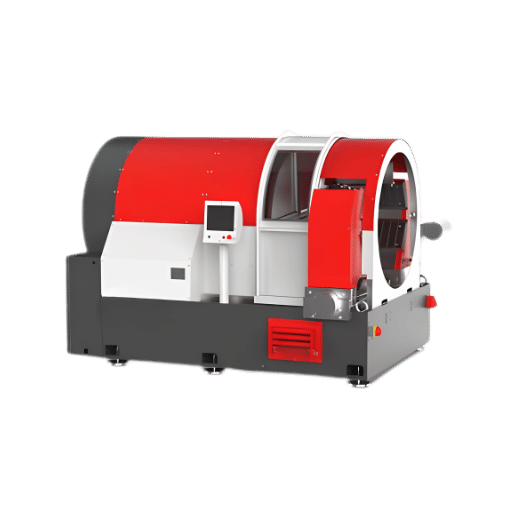
CNC weld-prep machines are moving into mid-tier fabrication shops that previously relied on manual or semi-automatic electric bevelers. CNC-controlled beveling supports programmed compound angles, J-groove profiles, and automatic feed—features that fixed-angle portable tools like the B-500 cannot imitate. For shops machining stainless, duplex, or nickel-alloy pipe where accuracy is key and weld rework costly, the cost analysis increasingly favors the higher initial price tag of CNC.
Orbital cutting and beveling systems that complete the cut and bevel prep in one pass are gaining ground in pipeline construction and offshore maintenance. These systems completely do away with the cut-before-bevel workflow and are typically cold cutting systems—no open flame—addressing hot-work-permit issues that torch-fitted saddle machines cannot.
Automation integration is driving demand for beveling equipment that can connect with robotic welding cells and automated pipe handling. The B-500 is not automation-ready — it is a manually operated stand-alone tool. Equipment designed for automated line production demands different drive systems and control interfaces.
For fabricators choosing equipment now, the question is not simply what you need today; it is what process flexibility you will require in three to five years. The RESIZE frezen en afschuinen machinelijn covers pipe from small-bore through 24-inch ID and provides configurations both suitable for existing production and the angle flexibility that automated beveling needs.
Veelgestelde vragen
- What is the RIDGID B-500 pipe beveler used for?
- The RIDGID B-500 is a portable electric pipe beveling machine used to prepare pipe ends for butt welding. It produces a V-groove bevel — standard 37.5°, optional 30° or 45° via insert change — on pipe 4 inches and larger with wall thickness up to 0.500 inches. It is used primarily by plumbing contractors, mechanical shops, and general fabricators working with standard and extra-strong schedule carbon steel pipe. It is not designed for small-bore pipe under 4 inches, heavy-wall schedules above 0.500 inches, or J-groove profiles.
- Can the RIDGID B-500 bevel stainless steel pipe?
- Above the recommended wall thickness, the manufacturer specification is for stainless steel. One cannot be certain that the B-500 will be up to the job. Work-hardening in stainless is more aggressive than in carbon steel by a factor of 1.5 to 2.0 while work-hardening rates increase the insert wear rate and may drive cycle times in excess of the published 45 seconds, especially on high alloy steels. For offhand applications of any regular stainless fabrication – especially duplex or other high-sulphur index grades – we typically recommend ID-clamp machines with rigid vibration damped clamping for optimum results in surface finish and bev geometry reproducibility. Confirm insert availability and expected wear rates before designating the B-500 as your primary stainless prep tool.
- What is the pipe size range for the RIDGID B-500?
- The B-500 is good for 4 inches and above including flat plate. The practical limitation for large size is not the pipe bore diameter – it is wall thickness. The machine will cut walls from 0.188 inch to 0.500 inch. That limits practical use to the very large-diameter pipe of standard or extra-strong schedule, while excluding heavy-schedule pipe. Six-inch Schedule 160 (0.718 inch wall) and eight-inch Schedule 120 (0.719 inch wall) pipe both exceed the rated wall thickness rating of the tool. Reference wall thickness, not just pipe diameter, when matching the B-500 to a project.
- How long does it take to bevel a pipe with the B-500?
- The published B-500 cycle time is 45 seconds. On the general subject, the footnote adds that this cycle time is appropriate for 10-inch Schedule 40 carbon steel pipe. Based on a rough calculation, actual beveling cycle times for any given size pipe will be a function of wall thickness, pilot material alloy, and insert sharpness. Smaller pipe, thinner walls is faster, as is pipe well below the machine’s 0.500 inch wall thickness threshold. Pipe close to the upper limit range will be slower and place more amperage load on the motor. Insert wear down is a variable that is usually underestimated by operators – dull inserts will slow cycle time and adversely affect bevel finish quality. Use the 45 seconds as the optimal scenario number, rather than a guaranteed cycle time across all projects.
- What is the difference between a pipe beveler and a pipe chamfer tool?
- A pipe beveler makes a weld prep bevel – a V-groove or J-groove with the dimensional characteristics specified by any welding code covering the project (ASME, API, AWS). A pipe chamfer tool removes the extreme edge condition of the pipe end, usually at an angle of 15 to 20 for fit-up, deburring or push-fit joint prep. Compared with a weld prepd bevel, chamfer tools are more portable, lighter and less costly, but cannot provide the profile and dimensional tolerances required by a welding code. When certification comes into play, you need a beveling machine – not a chamfer tool. Read our article on beveling and chamfering to see the complete comparison.
- Which pipe beveling tool is best for heavy-wall pipe?
- For wall thickness greater than 0.500 inches the RIDGID B-500 is not rated for heavy duty applications. Heavy-wall pipe – Schedule 160, double-extra-strong (XXS),pressure pipe for vessels and constrictions – is a different tool demanding far greater forcing capability, hefty rigidity, stiff setup and more capable machinery. Typical tools are electric ID-clamp machines (ESCO MILLHOG series, RESIZE heavy models). For thick-wall pipe requiring a J-groove prep (a condition triggered by ASME B16.25 at wall thickness greater than 22.5 mm) the appropriate machining process is a lathe type ID beveling machine or CNC weld bevel prep system. See the RESIZE beveling machine range for specs across models covering heavy-wall and large-diameter pipe.
Who Should Buy the RIDGID B-500 — and Who Should Not
The RIDGID B-500 is a good fit for a specific buyer: a mechanical contractor or fabrication shop working primarily with 4-inch-and-larger standard or extra-strong carbon steel pipe, operating where spark-free work is required, and running enough bevels per day to justify the $4,885 price over manual grinding. In that application, it lives up to its core promise.
It is the wrong tool for buyers who regularly work with pipe above ½-inch wall thickness, need small-bore capability under 4 inches, require J-groove prep, or need a machine that integrates with automated production lines. The motor reliability pattern in published reviews is also worth factoring in before committing to daily production use.
If your pipe range, wall thickness requirements, or production volume has outgrown what a single-angle portable beveler can handle, it is worth reviewing machines built for broader applications. The RESIZE frezen en afschuinen machinelijn covers pipe from 0.5-inch ID through 24-inch ID across configurations designed for heavy-wall, large-diameter, multi-angle, and production-environment requirements.
Related resources: Pipe beveling machine types and applications | Laspositioneerders | Lasrotatoren